Picking Exterior Paint Colors
I posted last week about how we majorly changed the appearance of the exterior of the flip house by limewashing it. While the outcome is a huge improvement from what we started with, it left the house pretty monochromatic and kinda blah. Well, now it’s time to shake things up by adding some color!
The Easy, No Mess Way to Choose Exterior Paint Colors
I posted last week about how we majorly changed the appearance of the exterior of the flip house by limewashing it. While the outcome is a huge improvement from what we started with, it left the house pretty monochromatic and kinda blah. Well, now it’s time to shake things up by adding some color!
In this week’s post I’ll walk you through the different color options and combinations we considered, how we tried them out without actually painting a thing, and what we decided on in the end!

Testing paint colors without painting anything
Let me tell you, picking exterior paint colors is intimidating.
With interior paint you can at least limit the number of people that see if you pick a hideous color, but exterior paint isn’t so easy to hide.
Painting a flip added another layer of complexity because I couldn’t follow my normal loooooooong paint color choosing process of trying several different samples and staring at them at different times of the day. I work full-time and have two little kids so finding time to go to the flip can be tricky. Not only that, but we’re in the home stretch of wrapping this flip up and are trying to stay on schedule, so I didn’t have my normal “ho hum” thinking time.
All these factors got me to thinking, “How can I test colors without actually testing colors?” The answer was simple - photo editing software!
I haven’t used Photoshop in years and my skillz are definitely lacking. I didn’t want to waste time relearning how to use it, so I researched some other resources. One option I considered was the Sherwin-Williams Visualizer, which allows you to upload a photo and outline certain areas that you want to test colors on. It’s a good concept, but it was a little clunky. What I ended up using was Canva, which is a free graphic design software platform that I was already familiar with - yay!
To test different colors I simply took the “final” picture I posted last week of the limewashed house and pulled it into Canva. I then drew blocks over the areas we plan on painting, resized them, and went to town picking out tons of different color combinations.
The great big world of color possibilities
Before I jump into showing you all the colors we tried out, let’s refresh our memories of what the house looked like before and after the limewash…

Pretty big improvement, but as you can see, the house was looking a little flat so adding color was a MUST.
Here’s what the house looked like with our different tests:
My initial idea was to paint the front door coral, but painting the shutters to match was too intense. To tone it down I changed the colors to charcoal gray in one example and white in another. When Lucius saw the gray and the white options with the coral door he thought the house was still looking too monochrome. What a buzzkill.
But mark my words, I WILL get my coral door one day! You just wait….


Before I share the next color combo, let’s just take a moment to laugh at those ridiculous bushes. If you squint a little they look real-ish… right? This method of picking paint cracks me up with the combination of color blocking on top of real-life photos, but hey, it served its purpose and saved us time and money! Plus, it gave me some laughs.
In the next example, the pink door with blue was kinda fun, but I just wasn’t feeling it 100% for this house. I could see it working on a different house though!

I was pretty drawn to the red door below, but again, Lucius thought the white was too monochrome. Seriously guys. Buzz. Kill. I’m tellin’ ya.
Side note, in case you didn’t notice, I tested out some different, and equally realistic looking, landscaping below.

I actually really liked black/yellow/white combination in this picture, but I felt like it was a little busy with the other factors going on on the exterior of this house (the texture of the brick, the 3 different types of windows that unfortunately aren’t in the budget to replace) so I kept on testing!

I love teal so I couldn’t help but try a few combos with a couple of different shades of teal in the next few pictures.


So many options, and I didn’t even share all of them!
At this point I felt like I had enough examples so I ran them past Lucius and there was one mock-up that stood out from the rest for both of us.
And the winner is….
…..the example in the very last picture! But before we set anything in stone we continued to bounce some ideas off each other and made a few tweaks to get it juuuuuust right. Or, as right as it could be with color blocking.
First off, we decided to paint the door white and the things next to it (they’re not really sidelights - just pieces of wood) teal instead of the other way around. We also color blocked the window sills and liked how much it made them pop, so we’ll be painting those.
To make take it a step further and get it as close to the real thing as possible (plus, let’s get real, I was having fun playing around), I added some makeshift lights on either side of the door and updated the address numbers to something more modern.
Lastly, I made the doorknob and knocker oil rubbed bronze because apparently I didn’t get the memo that the doorknob wasn’t going to stay brass. The disgusted face Lucius gave me when I thought he was going to leave the brass doorknob was priceless though.

Testing the paint colors in this way wouldn’t work for every scenario. For instance, if you were using a picture with a bunch of stuff in the way or needed to color block a ton of areas it’d be a bit of a pain. But for this project it was the perfect way to sample lots of options.
Because I only had a few areas I’m painting and they’re simple shapes to outline, this method was really simple and it gave me the ability to let my mind run wild and try out tons of different possibilities that I would never have considered if I were testing the paint old school style.
I’ve actually started painting it already and IT LOOKS AMAZING!!! I want to share a sneak peek SO BAD, but I’m not going to juuuuuuuust yet.
We’re crazy close to being done with this property and when it’s complete (we’re shooting for a couple of weeks from now) I’ll be sure to post tons of pictures of the inside and out and even throw in a budget breakdown of what it all cost. Until then, I’m gonna go find something else to color block…

Related House Flipping Posts:
How to Choose Exterior Paint Colors Without Paint

How To Limewash Your Brick House
If you’ve read some of my previous posts, you may have come across the post where I wrote about the flip that we bought. In that post, I talked about painting our little brick flip house white. Well, I’m excited to say that now it IS white! But I didn’t end up painting it - I limewashed it!
How I Limewashed our Flip
If you’ve read some of my previous posts, you may have come across the post where I wrote about the flip that we bought. In that post, I talked about painting our little brick flip house white. Well, I’m excited to say that now it IS white! But I didn’t end up painting it - I limewashed it!

What is limewash?
You may be asking yourself, “What the heck is limewash!?” Well, I’m here to fill you in!
At a high level, limewash is essentially crushed limestone that is combined with water to make a wash. It’s a method that’s been around for centuries. When applied to a porous surface (like brick), it creates a chalky, matte finish. In the picture above I’ve only applied one coat, but you can apply multiple coats for a more opaque finish.
How is that different from whitewash?
There are actually lots of differences between limewash and whitewash. Allow me to break it down for you.
Going Green: First of all, limewash is environmentally friendly. In fact, it’s also mold-resistant, so once applied you shouldn’t have to worry about power washing that green fungus off the side of your house! On the flip side, whitewash is made with diluted water-based paint, which is pretty chemically and not so great for the environment.
Permeability: Limewash penetrates the brick, which means it won’t peel with time whereas paint never truly soaks in and can peel and flake after a couple of years. Limewash will erode eventually, but it takes much longer and can actually end up making the brick look antique and even better. But if you don’t like how it looks once the limewash starts to wear off, you can always apply more on top.
COST!: The ingredients for limewash are incredibly inexpensive. One 50-lb bag of hydrated lime cost us around $8. The only other ingredient is water.
Color: Limewash really only comes in one color - white. You can add pigment, but I didn’t explore that option for our house and didn’t see a lot of “how to’s” out there so I’m not sure how tricky it is. Whitewash on the other hand can technically be done with any color of paint.
Safety: Limewash is highly caustic and will burn you if it touches your bare skin. Paint on the other hand is… paint. No big deal.
Why did we choose limewashing over whitewashing?
Obviously, there are pros and cons to both limewashing and whitewashing. But how do you choose one method over the other? I think it’s really up to personal opinion. After hours of research, there were several big reasons that pushed me to give limewashing a try.
I knew I wanted the brick to be white, so color wasn’t an issue.
I really like the matte finish of limewashing. However, it’s worth noting that you can get a matte finish if you were to use flat paint for whitewashing.
I had never tried this method before, so it was definitely intriguing to try something new.
COST! Since this is a flip, we’re always focused on the budget. But even if it were my own house it’s just my nature to be sensitive to how much things cost.
And the biggest factor: permeability. Knowing that the limewash would stay on the surface of the brick for longer, and may even look better over time, was a big plus. Even though I won’t be living in this house, I want to do right by the person who eventually buys it, so the option with the proven longer-lasting result felt like the right way to go.
How did you do it?
Ah yes, the the fun part, where I give you a step-by-step first-hand experience as to how I limewashed our house! Here’s what you’ll need to get your limewashing on -
Materials

As an Amazon Associate I earn from qualifying purchases. This post may contain affiliate links, meaning I receive commissions for purchases made through those links, at no cost to you.
- Hydrated lime
- Large paintbrush (mine was 4 inches)
- 5-gallon bucket
- Hose w/ spray nozzle
- Gloves
- Long sleeves
- Mask
- Safety goggles
- Long stir stick or drill with mixing paddle
- Nice weather - I know this isn’t really a “material”, but it’s super important for a nice finished product! Avoid weather that is too cold or too hot. You should also try to avoid applying your wash in direct sunlight (especially on hot days) as it can dry out too fast, or on overly humid days (which will slow down the drying process).
Step 1 - Preparation

When preparing to do any finish on the exterior of a home it’s important to get rid of any grime or dirt that could cause a barrier between your exterior surface and your paint/wash. Several days before I limewashed the house, Lucius took some time to power wash the exterior to get it so fresh and so clean, clean.
It would have been smart to remove the shutters before the power washing but, meh. You live, you learn (and now you have Alanis Morissette stuck in your head). Above is my father-in-law helping me with a tricky screw on the shutters before I got started limewashing.
Step 2 - Mixing your wash

The main ingredient for this project is hydrated lime. Everything I read makes it sound like this is available at any hardware store, but in my experience, it was crazy hard to find! I was thisclose to buying a bag off Amazon for a lot more when we finally found a store that carried the brand above.
When I say this project is cheap, I mean it. The entire 50 lb bag cost us less than $8! And although only the front facade of our house is brick, we barely made a dent in the bag.
As previously mentioned, lime is really caustic. The hydrated lime comes in a fine powder that gets EVERYWHERE so before you start mixing your wash cover yourself up! Throw on some pants, long sleeves, gloves, goggles, and a mask.
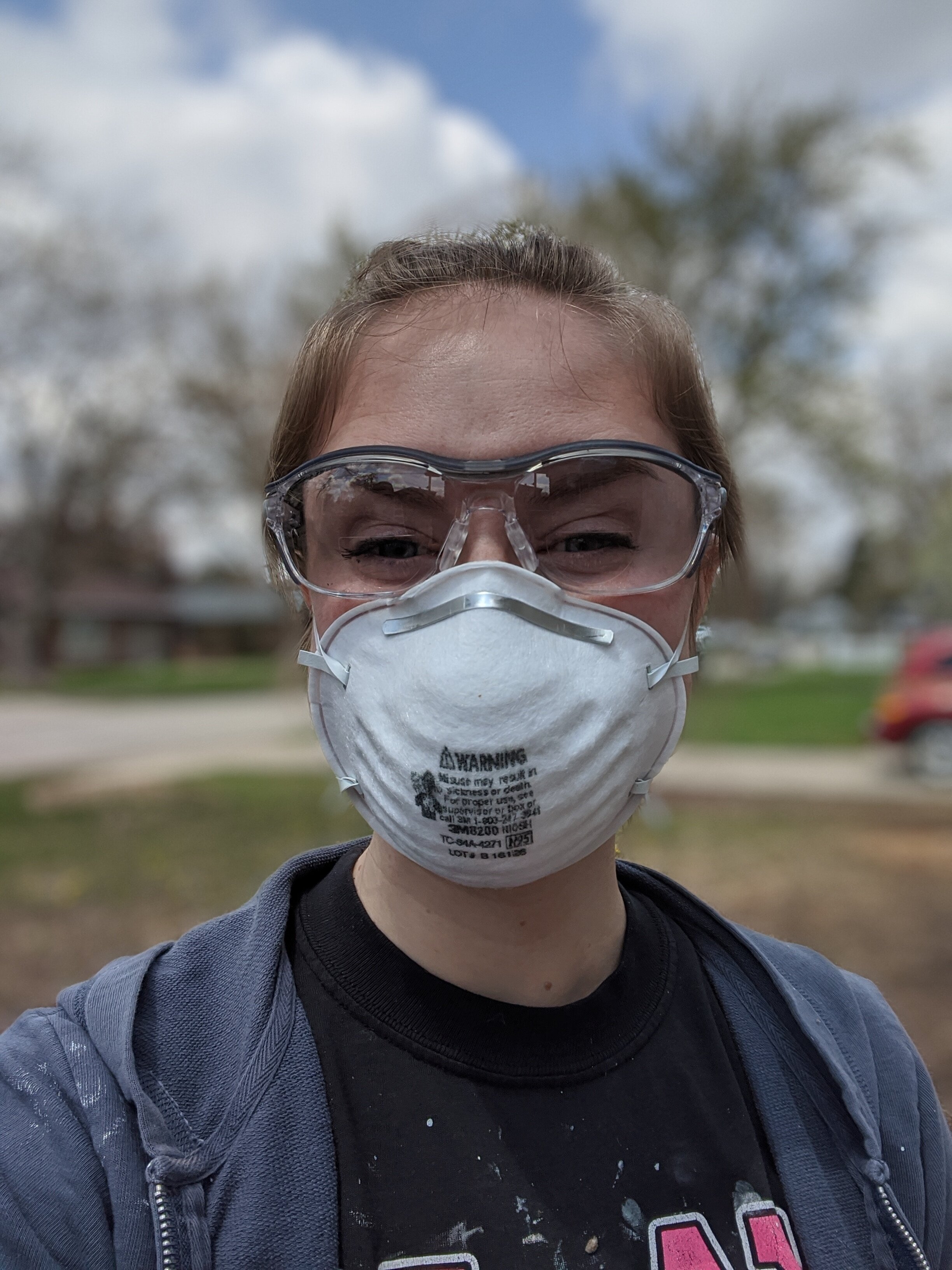
I don’t know why i felt the need to smile in this picture.
To mix your wash you need an 80/20 ratio - 80% water, 20% hydrated lime. I poured water and the hydrated lime in the correct proportions into a 5-gallon bucket until it was pretty full, then took my drill with the mixing paddle and mixed it up.
If you’re limewashing a whole house, several of the sources that I read talked about how it’s worthwhile to mix all your wash at once in a wheelbarrow so you have a consistent batch. You can mix batches as needed, but you run the risk of one batch being more opaque or transparent than the next. Since our house is small and only the front is brick, I didn’t think I’d need more than one small batch.
I don’t know why but I was anticipating it to be MUCH more difficult to mix. It was actually very easy and could be done with a long stir stick if needed. The most commonly used comparison I found when researching this process was that your final product should be the consistency of whole milk.
Step 3- Application
Changing the exterior of your house is pretty terrifying, especially with a process you’ve never done first-hand and that isn’t easily reversible if you dislike the end product. But let me tell you that limewash is insanely easy to apply!
To begin, wet the brick down with your hose. I recommend wetting it down in sections as you work your way around the house so it doesn’t dry before you get to it. Then, start at the top and work your way down in sections.
You can apply your limewash liberally, just take care not to drip a ton on any concrete or porous surfaces below that you don’t want limewashed. Depending on the look you’re going for, it’s not necessary to get in every nook and cranny.
Below is a quick little video I shot as I was applying the wash so you can see first-hand how easy this is.
As you can see, I wasn’t shy about loading up my brush and just slapping it on. I did try to avoid big drips on the lower bricks because I didn’t want them to dry before I could smooth them out, but even the inevitable drip here and there ended up being a nonissue.
Something good to know ahead of time - the wash goes on very transparent. Don’t let this scare you! I only did one coat on the whole house and as you can see in the picture below, as the wash dries it gets more opaque.

In fact, you can do multiple coats of the wash to create a completely opaque look.
This project is not only inexpensive and easy, but it’s pretty fast! Because you don’t have to be super precise with your wash (and if you’re going for an uneven look it’s even less important to apply wash to every square inch), this project only took me around 3 hours! Granted, only the front of our house is brick, an entirely brick house could be limewashed in a day or two, especially if multiple people were taking part in the limewashing party.
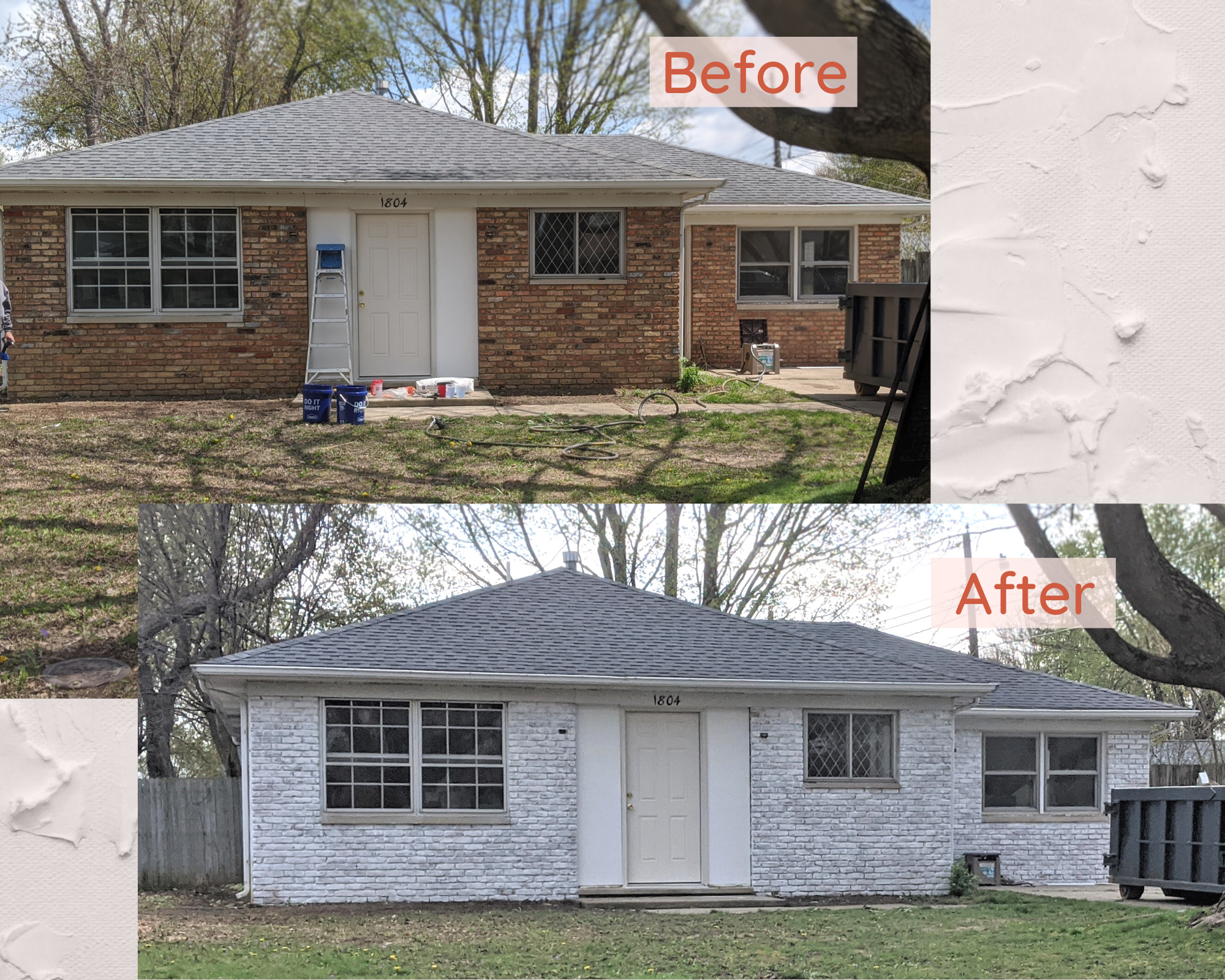
Admittedly, the house is looking pretty monotone right now, but have no fear! I’m deep in the brainstorming process of adding some pops of color and landscaping, which this house desperately needs.
We hope to finish up this flip in the next few weeks and I most definitely plan on sharing lots of photos when it’s all complete. Keep checking in so you can check out the final product!