
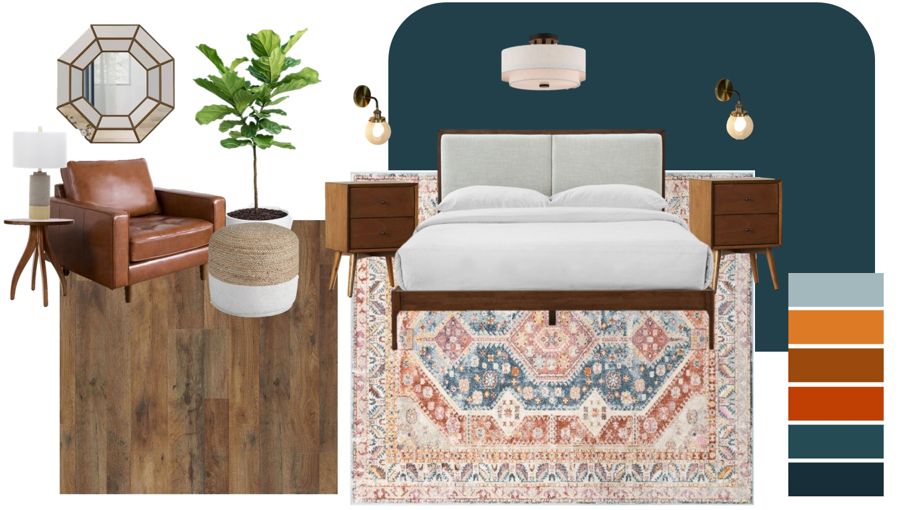
Mid-century Modern Master Bedroom Mood Board
We're getting SO CLOSE to being done with the bedroom renovation I can taste it (or maybe that's just the drywall dust floating in the air….). So while Lucius is mudding and sanding, and mudding and sanding some more, I'm planning the next stage of our master bedroom - PAINT, DÉCOR, AND FURNISHINGS!
Mid-century Master Bedroom Design
Guys, I can see the finish line. We're getting SO CLOSE to being done with the bedroom renovation I can taste it (or maybe that's just the drywall dust floating in the air….). So while Lucius is mudding and sanding, and mudding and sanding some more, I'm planning the next stage of our master bedroom - PAINT, DÉCOR, AND FURNISHINGS!
Can I be real for a second? It's honestly been really frustrating not being able to play a more active role in the renovation. I'm feeling like a little bit of a DIY fraud over here.
While Lucius and I both work full-time, his job as a realtor allows him pockets of time where he can step away and work on the reno, while I'm chained to my desk. And when I'm not working my 8-5, I'm usually trying to keep the kids occupied so Lucius can work on the renovation some more. But once the drywall is wrapped up, it's my time to shine! And boy, do I have a vision!
I first saw this picture while scrolling through Pinterest, and it sent my creative gears into overdrive.

That dark wall color. That geometric rug. That cozy, leather chair. I HAVE TO HAVE IT!
So, naturally, I started pinning ideas left and right and planning planning planning away. And of course, the final product won't look exactly like what I've put together, but I feel like I have a really clear idea of how I want to decorate this room that I can't wait to share with you today!
Like, right now.
Seriously, look below.

It’s definitely leaning towards the mid-century modern end of things, but hey, apparently that’s where my head it at right now. Let's walk through how I came up with this design, shall we?
Wall Color
Now that we've removed the stupid sunroom that once blocked all the windows in our bedroom, we now have 3 large windows spanning across the exterior wall that let in TONS of glorious, glorious natural light.

That being said, I think this room can more than handle a deep, moody color.
So far, I've narrowed it down to two colors: Archipelago (left) and Oceanus (right) by Sherwin Williams


They're pretty similar, but Archipelago has a more intense, saturated color while Oceanus is more gray. Once the drywall is complete, I'll be able to prime the walls and slap on some samples to finally get a good view of how these colors look up on the wall.
But I don't plan on stopping with the walls. Oh no. I'm diving DEEP into this teal/navy sea and I'm gonna paint the WHOLE ROOM the same color. I'm talking trim, doors, baseboards. Only the ceiling will be safe. I've been so inspired lately by images like these, and I convinced Lucius to let me give it a whirl, so I'm going for it.
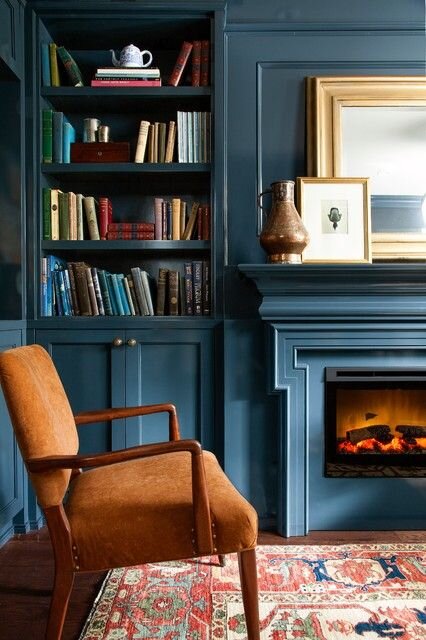
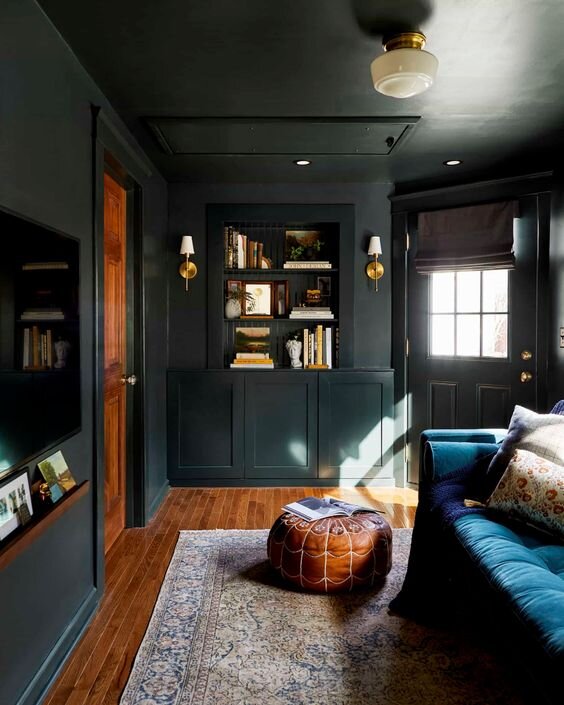
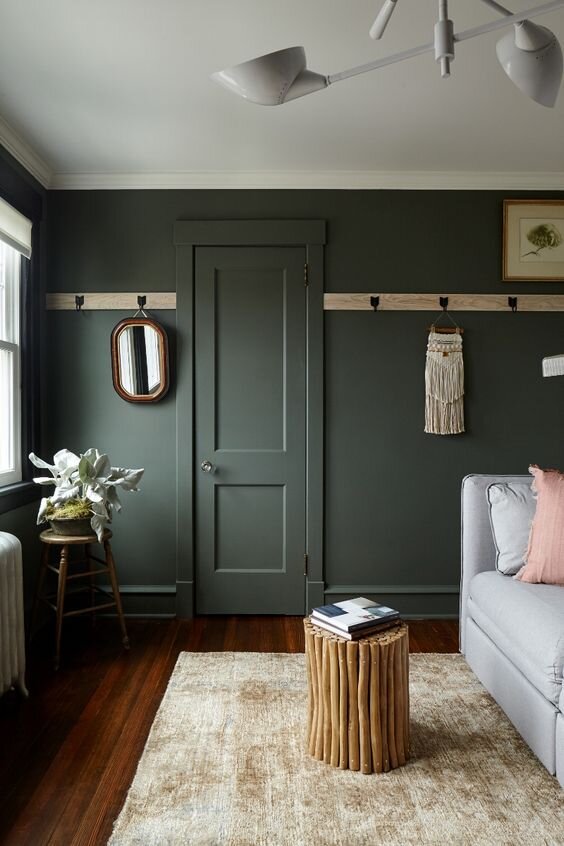
While we're talking about colors, I love the pop of warm tones in the leather chair and in the rug from my inspiration picture. So I’m looking to recreate that same feel, starting with a new area rug.
As an Amazon Associate, I earn from qualifying purchases. This post may contain affiliate links, meaning I receive commissions for purchases made through those links, at no cost to you.
Area Rug
I've mentioned previously that I really love oriental rugs. But Lucius? Not so much. Well, I THINK I'M WEARING HIM DOWN, GUYS. Because he agreed to get one for the bedroom!!
I looked at lots of them but kept coming back to this beauty.

I love the symmetry, the details, and the warm tones with some of the teal incorporated too. Plus, although there's a lot going on, it's a little lighter and less intense than some of the other rugs I was looking at, which I think will help brighten up the room a bit.
And you wanna know a secret? I already bought it! And I was so excited to see it that I already unrolled it in the playroom and I honestly love it even more than I did online!
There are way more colors incorporated in the rug than what I could see online. There's actually a couple of different shades of orange/rust, but there's also a little bit of pink and purple, too, which was a nice surprise.


Reading Nook
While the orange tones in the rug are a little less bold than I thought they'd be, I don't mind because I plan on incorporating some warm tones in with a big, comfy, cognac leather chair. In our new layout, we have a perfect spot for a big cozy chair in the corner that I plan on turning into a bit of a reading nook. I can see it now….

I'm not opposed to buying something new, but I've actually seen some pretty cool used chairs pop up on Facebook Marketplace, and I kind of like the idea of finding a leather chair that's already broken in. But honestly, as long as it's cozy I don't really care where it comes from.
And of course, I'll need an ottoman to go with the chair. I've had my eye on some that have some texture to them and a more natural color, like this:

But I could be swayed to get a cognac leather poof to match the chair too…
Next up, I'll need to add a little end table and a lamp. This end table is really popular right now - and for good reason! Check out those lines!

The nesting end tables here also showcase a classic mid-century pairing of brass and walnut that is another viable option.
And lastly, I plan on loading up that corner with oodles of plants too.
Flooring
One big thing to note in this design is that we have to replace the flooring in our bedroom (and the hallway), so we actually get to pick something we like instead of the laminate flooring throughout the rest of the house that we loathe. I know, I know, the floors won't match. But hopefully, down the line, we can upgrade all of them to the same flooring. In the meantime, the tone of flooring that we plan on putting in this room was important to consider, so I threw it into the design plan.
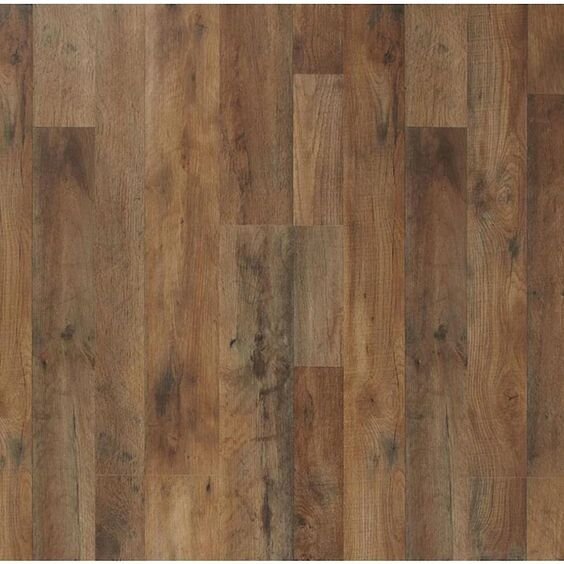
Our current flooring throughout the house is DARK and I feel like I can see every crumb that lands on it. I don't really want something too light either, so I think a mid-tone with some character is gonna be our sweet spot. We probably won’t go with this EXACT flooring, but it at least gives us a direction to work toward.
Bedroom Furniture
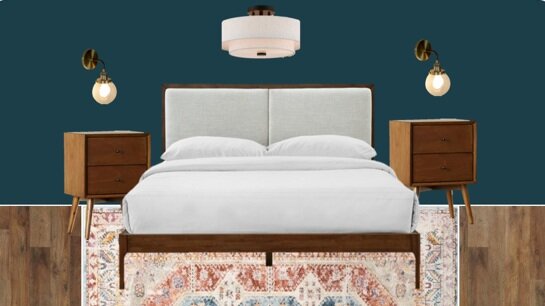
We already have a bed and likely won't purchase a new one right away, but when we do, I'm falling hard lately for partially upholstered bed frames. I really like the contrast between the color of the wood and the fabric, and between the textures.

I can’t find the bed in the mood board but here’s a similar one.
Currently, we only have one mismatched nightstand, so we'll want to replace that too sooner rather than later. I think something like this will work well with the bed.
In the interim, because we have an IKEA Malm bed with the drawers underneath that we use for storage, I might build some little floating nightstands to get us by.
Lighting
Lastly, lighting. Our ceilings are standard height so I don't want anything too big and crazy hanging from the ceiling. I feel like this semi-flush mount fixture is the perfect balance of practical, yet interesting. It's close enough to the ceiling without being a typical boob light and the tiered drums add some interest.

Here’s an example of a light that would also look great in the space. It’s not a tiered drum shade, but the lines in this fixture really caught my eye.
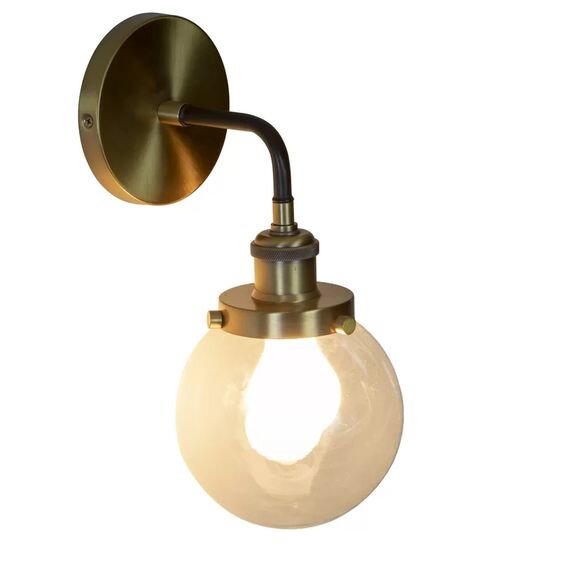
On either side of the bed, I'd like to add some classy sconces for additional lighting. I like the brass in the sconces I chose, which is echoed in the mirror and the lamp next to my cozy chair, but there are some brass/black combo sconces that I’m really drawn to also.
Which leads me to the lamp next to my cozy chair. I'd like to find ways to incorporate more natural elements into the room. I think this stone lamp does just that while also tying into the style of the rest of the room. Plus, it comes in a set of two so I could use one in another part of the house!

Final Thoughts
Of course, our room won't look like this mood board immediately, or maybe even ever! I'm not going to run out and buy everything I envision for this room right away - I'm not made of money over here! With that being said, it's very likely I'll find other décor that I like even more than what's in this mood board as I slowly fill up the room.
I also don't think the room would be complete with just what's on the mood board - I'll definitely need to add some artwork. Not only that, but I may even need to pick a separate, smaller rug to go over in my reading nook since I know the main rug won't extend that far. It'll come together more as we start to move back in so patience is key. But MAN, it's getting really hard not to BUY ALL THE THINGS! At the rate we're going, hopefully, in a couple of weeks we'll be moved back into our bedroom (and out of the loft!) and I can provide some progress shots!

Related Master Bedroom Renovation Posts
Dark and Moody Master Bedroom Mood Board
How to Reuse Your Halloween Decor for Fall
Now that Halloween is over, it was time to switch up my décor to something less spooky and more fitting for the autumnal season. BUT, of course, I didn't want to spend a bunch of money buying all new décor. So in this post, I'm sharing how to transition your Halloween decorations to general fall decor in 4 steps.
Transition Your Spooky Halloween Decorations to Cozy Fall Decor
If you love summer like I do, and refuse to admit the weather is getting colder until Oct 1st at the earliest, you'll likely be scrambling to decorate for Halloween by the time you get your butt in gear. At least, that's what happened this year. Believe it or not, this was the first time I've ever decorated my own house for Halloween!
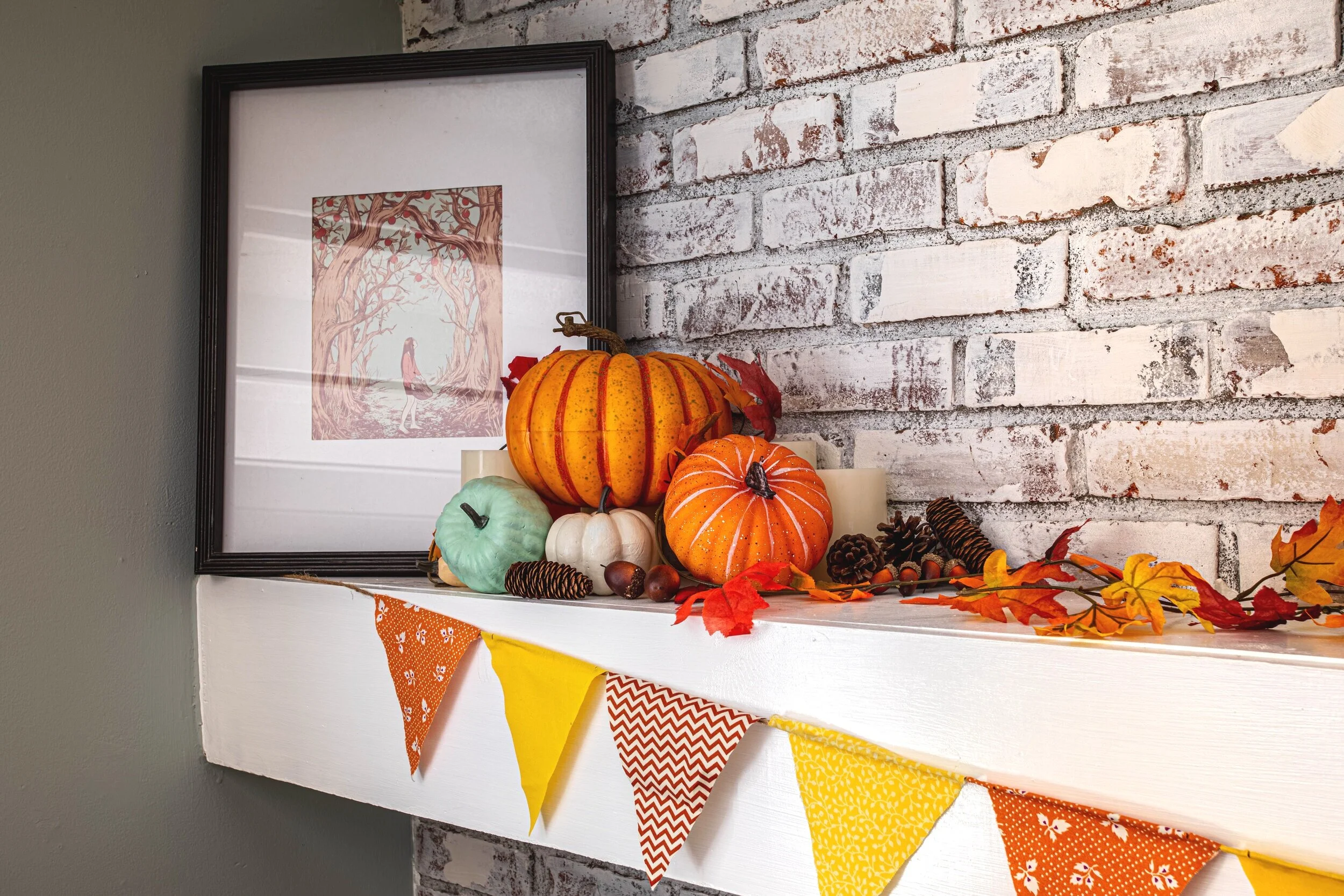
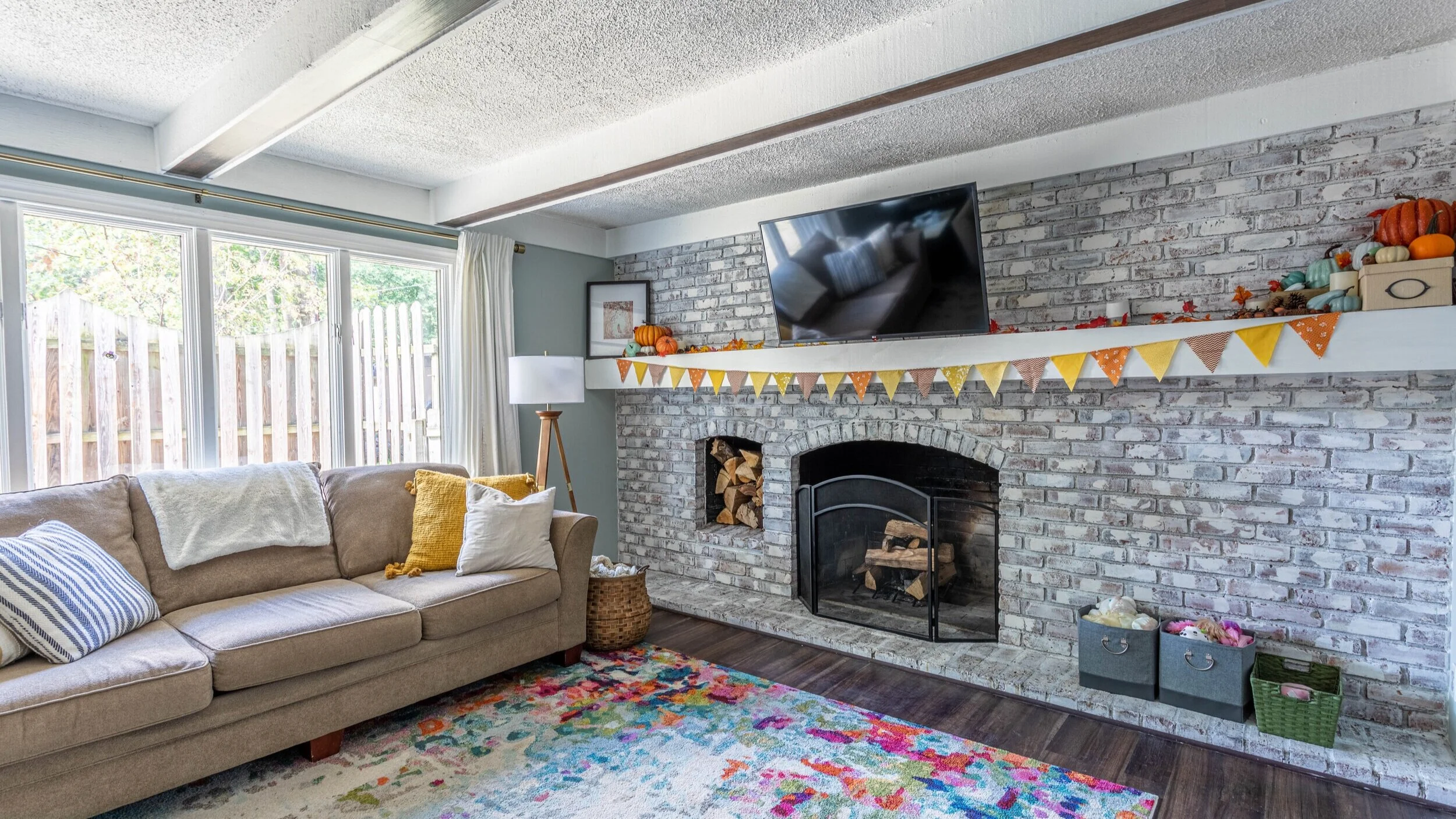
A few weeks ago, I posted about how I decorated for Halloween on a budget, but with very little initial direction as to what I wanted it to look like. After some trial and error (and several trips to Dollar Tree), I finally put together a mantel design that I really liked.
But now that Halloween is over, I figured it was time to switch up my décor to something less spooky and more fitting for the autumnal season. BUT, of course, I didn't want to spend a bunch of money buying all new décor. So in this post, I'm sharing how to transition your Halloween decorations to general fall decor in 4 steps.

Gather All Your Decorations
When I started transitioning my mantel from Halloween to fall décor, I tried to leave everything as is and just pluck out the Halloweeny stuff. But I quickly realized the décor was kinda looking like I just threw some stuff up there with no real effort.
You see, when I decorated for Halloween, I styled the vignettes on either end of the mantel based on the decorations I had available.

Now that I removed a bunch of the décor, it just didn't flow anymore. I figured the best course of action was to start from scratch. So I cleared off the mantel and lay all the decorations out together on the kitchen table. If you’ve decorated multiple areas of your home, gather the decorations from all around your house.
Remove All the Blatantly Obvious Halloween Stuff

Sorry, bats, ghosts, and spiders, but you gotta go.
This is a pretty obvious step, but it's worthwhile to say that you need to remove the Halloween décor from your pile to really see what you have left to work with. After going through my decorations, I still had pumpkins, gourds, and candles galore left. I also kept the bunting I made hanging on the mantel.
Decorate With The Decorations That Are Left
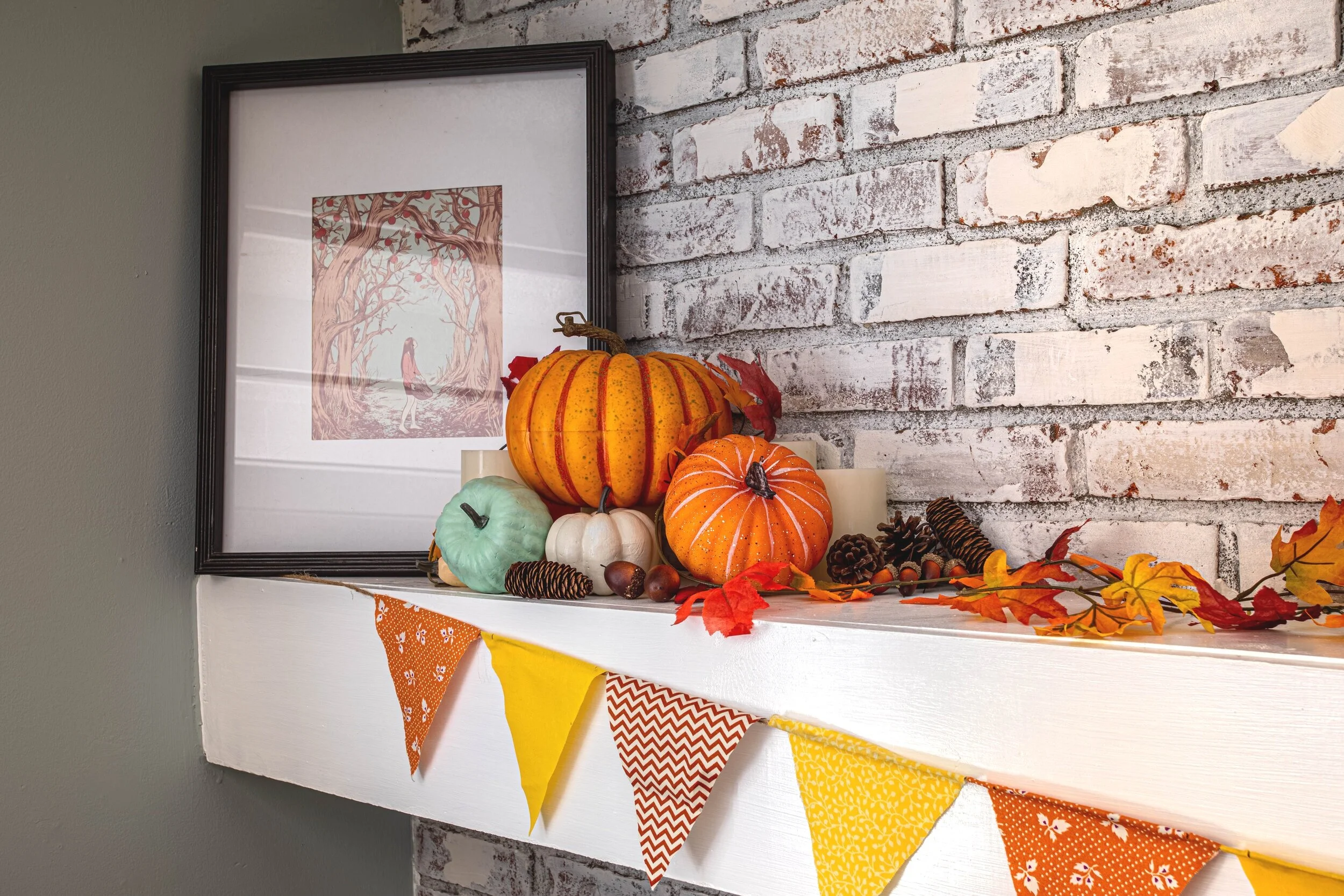
Now that you have a clean slate to work from, start creating new vignettes. Don't get stuck on which items you paired together before. Just start picking things up and placing them where you think they'll look good now. And don't be afraid to move them around a couple of times to see what looks best. You might be surprised at how much you like some of the items you put together.
Add a Few New Items

When you're happy with your décor, you can choose to be done. Or, if you feel like you still need to add a little sumthin' sumthin', do it! On my mantel, I added some leaf garland from Dollar Tree and a bag of acorns/pinecones I grabbed from Hobby Lobby. Everything else was leftover in my Halloween décor.
Bonus Step
If you’re feeling real crazy, knock some stuff over!
But seriously - to get a more natural look, don’t place all your decor perfectly upright or evenly spaced. Lay some items on their side, use different elevations to give other items height (I used boxes, bowls, and candles), and let your design be fluid. This will help your design flow better.
And there you have it
An easy peasy, inexpensive way to decorate for fall by mostly using what you already have on hand. Do you have any other tips on reusing your decor for different holidays? I’d love to hear them!

Related Holiday Decor Posts
Transition Halloween Decor to Fall in 4 Easy Steps
How to Stay Positive and Motivated During a Renovation
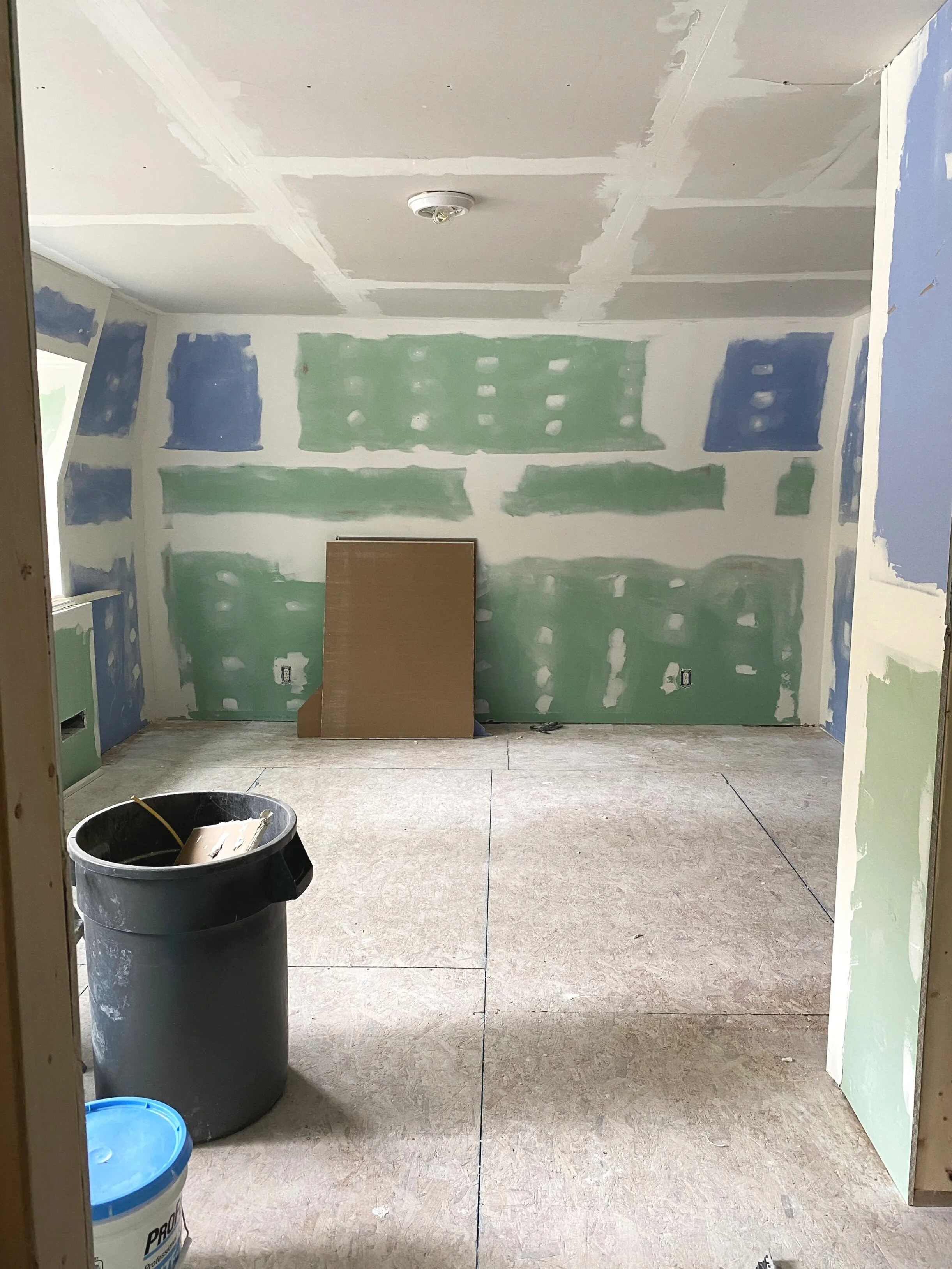
We've been in the midst of our master suite renovation for several months now and I'm sure you're not surprised to hear that it takes its toll on a person. This is our biggest renovation to date and it has certainly had its ups and downs. But although we’ve had our “off” days, overall I'd say Lucius and I have done a pretty darn good job staying positive and motivated along the way (bonus points for not killing each other!). But exactly how DO you stay positive and motivated during a renovation?
5 Ways to Stay Positive During a Major Renovation
We've been in the midst of our master suite renovation for several months now and I'm sure you're not surprised to hear that it takes its toll on a person. This is our biggest renovation to date and it has certainly had its ups and downs. But although we’ve had our “off” days, overall I'd say Lucius and I have done a pretty darn good job staying positive and motivated along the way (bonus points for not killing each other!). But exactly how DO you stay positive and motivated during a renovation?
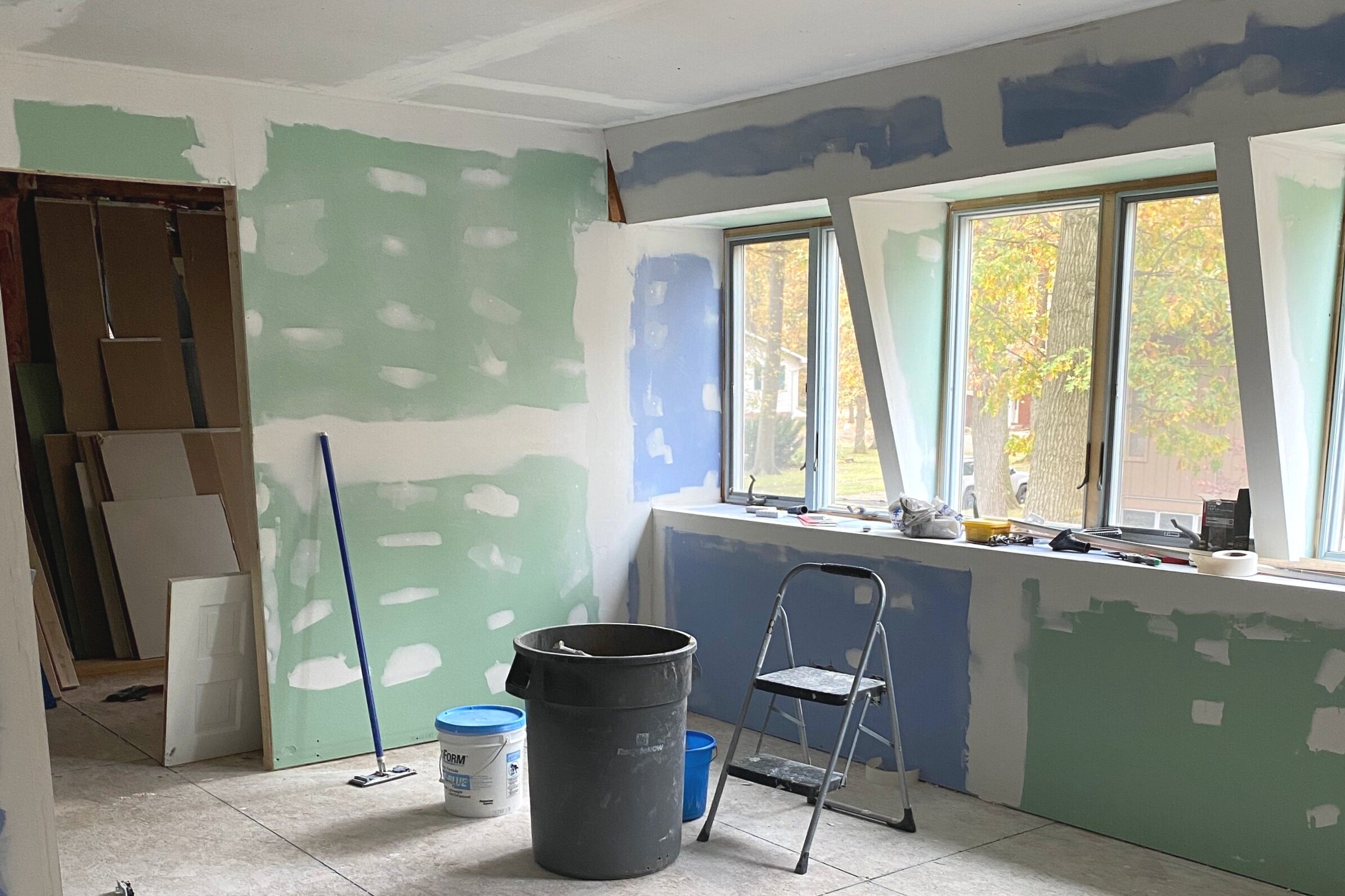
I have to be honest, staying upbeat, and inspired when your house is chaos and there's somehow a fine layer of dust on everything doesn't always come naturally. I recently came across a post by the blog Yellow Brick Home where they asked this question to other bloggers and it got me to thinking, how are we managing?
I quickly realized that it’s not a quick and simple answer - there are lots of ways we’re coping! So I put together some tips that have been working for Lucius and me to keep our heads up and looking towards that light at the end of the tunnel. So in case you too are in the thick of a renovation or are nervous to start one, I hope these tips are helpful to get you through to the finish line (or to the starting line if you haven’t taken the plunge just yet).
Set Realistic Expectations and Be Flexible
I thrive when I have a goal to work toward. My type-A personality eats that ish up! But during a renovation, plans frequently go awry and, especially for type-A people like me, that can be REALLY HARD TO DEAL WITH. But when this happens during a renovation, you simply have to learn to roll with it.
It's not uncommon during a renovation to discover an unwelcome surprise that throws your plans out of whack. For instance, once we pulled down the drywall in the master suite, we realized part of the bedroom we hoped to open up absolutely had to have a support under it. It was frustrating at first to have to rethink the layout that I was so excited about. But what choice did we have? In the end, we came up with a new layout we love even more than the original.

Or consider timelines for a second. We're mostly DIYing our renovation, so luckily our timeline is already flexible. But that doesn't mean we want to spend years without our master suite. However, Lucius and I both work full-time and we have little kids, so this project has been inevitably slow going. On several occasions, when we started to feel like we were putting too much pressure on ourselves to get the room knocked out quickly, we’ve had to take a step back and reevaluate.
If you're hiring out for your renovation, you'll want to prepare yourself for timelines to get messed up. You can hope and plan to have a project done by X date, but really it depends on your contractor and subcontractors and when they can have the work completed. Especially when you consider that a lot of the work depends on something else being done beforehand. If one of those tasks misses its deadline, it can have a Domino effect and you'll need to adjust accordingly.
Know That It's Going to Get Worse Before It Gets Better
There are so many feelings that come with a renovation. It's exciting to see your ideas come to life, but terrifying what you might find behind the walls (and the unexpected cost associated with it). But one thing is for sure: there's a point in the renovation when you're deep in demo and you look around and panic a little bit (okay, a lot a bit) because you realize there is no turning back. Truthfully, at this moment, the state of our master bathroom even makes my heart race a little.
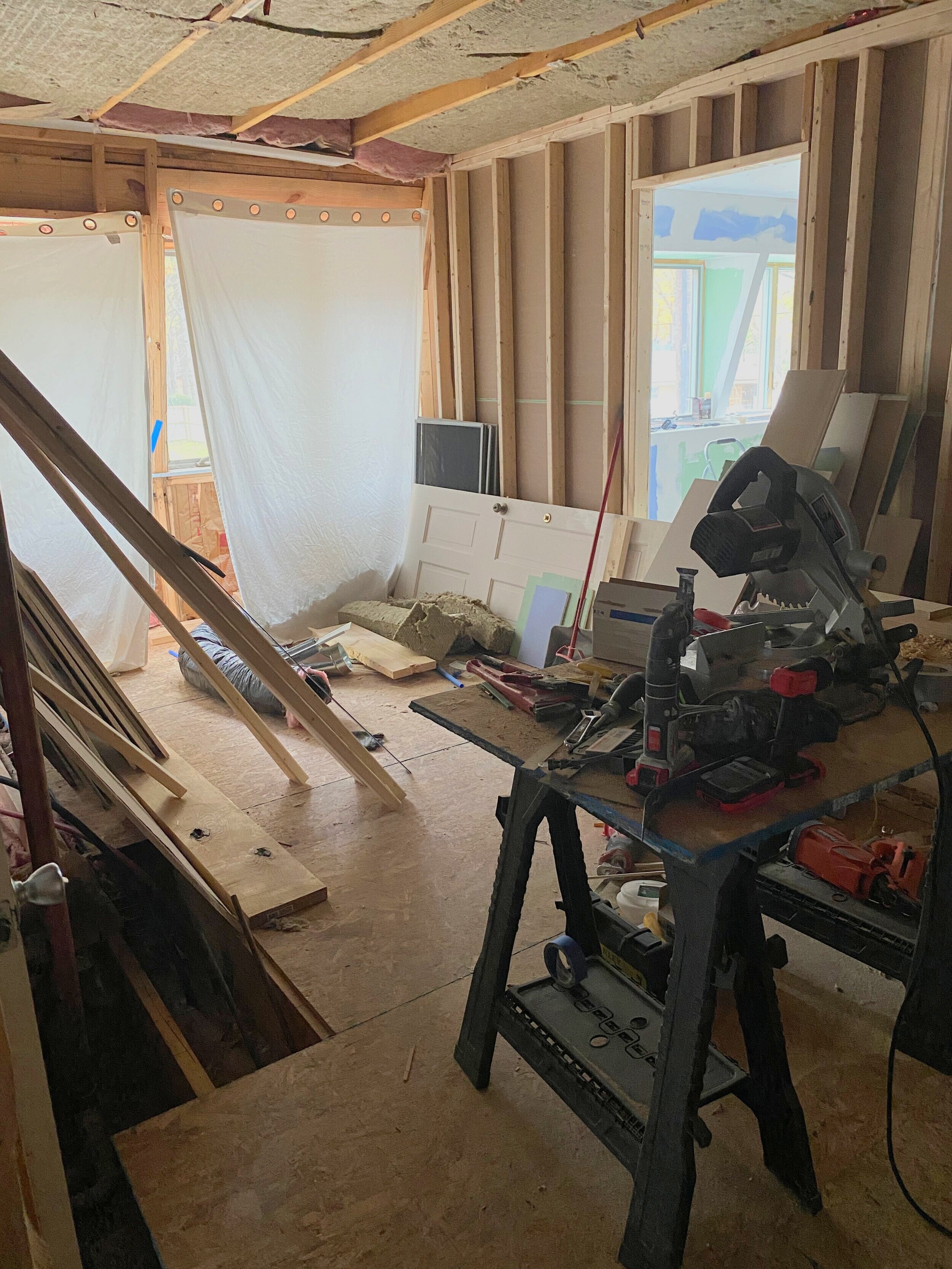
The best advice I can give here is to KEEP GOING.
Believe in yourself, your design, and your contractor that it's going to turn out okay… because, at this point, it kinda has to, right?
But seriously, you hit a point in the renovation that everything is a mess and it's hard to see past that to what's to come. Trust me, once the demo is done, the rebuilding begins and that part IS SO EXCITING that it'll get your spirits back up in no time. The middle of a renovation is confusing, messy, and makes no sense. Just keep swimming.
Take It One Day At A Time
So at this point, your original plans have gotten all messed up, but no sweat. You've stayed cool, calm, and collected. You've readjusted and you're back on track with a new plan. Now you're deep into demo, and panicking at the sheer chaos of the state of your house. How do you deal? You take it one day at a time.
It seems so simple! But really, taking our renovation one day at a time has been a huge help in staying positive. Remember that Rome wasn't built in a day and your house won't be rebuilt in a day either. With that being said…
Celebrate the Milestones - No Matter How Small
It’s overwhelming to think about your whole renovation as one big project. Instead, look at it as a slew of little projects. After all, how do you eat an elephant?
And each time you complete one of those projects, celebrate! You're one step closer to the end! You finished demo? Hooray! The framing for a new wall went up? Alright! You started drywalling? Margaritas, anyone!?

Celebrating the little milestones along the way has played a huge part in keeping us motivated. It doesn't necessarily mean we're throwing a party, or heck, even going out to eat each time we make some progress (#thankscovid). But Lucius and I love to dream together, talk about what we're tackling next, look at pictures of what the house looked like before we started, and congratulate ourselves on how far we've come. Each step along the way is truly something to be proud of, so don't hesitate to pat yourself on the back (over and over again)!
Keep Perspective - Know Your Why
Lastly, when you're in the thick of a renovation and it feels like you're miles away from being done, it's easy to forget why you started. Don't. It's important to keep perspective and remember your Why for starting a renovation to help keep you motivated to meet that goal.
Lucius and I started our master suite renovation because from the minute we walked into the bedroom during our initial showing, we started talking about how stupid the layout was. Planning to renovate the master suite was a huge factor in me agreeing to buy this house - so here we are.
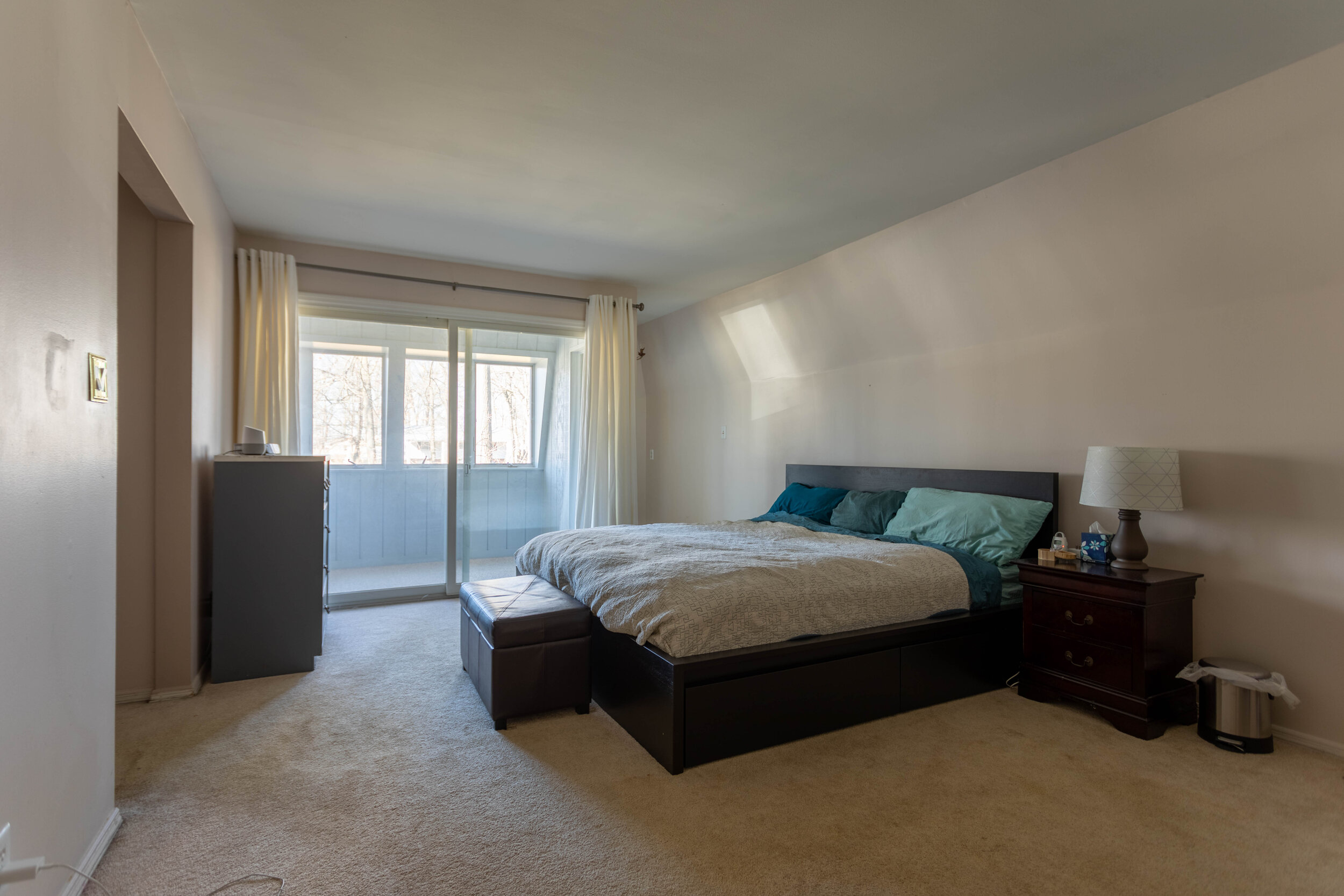
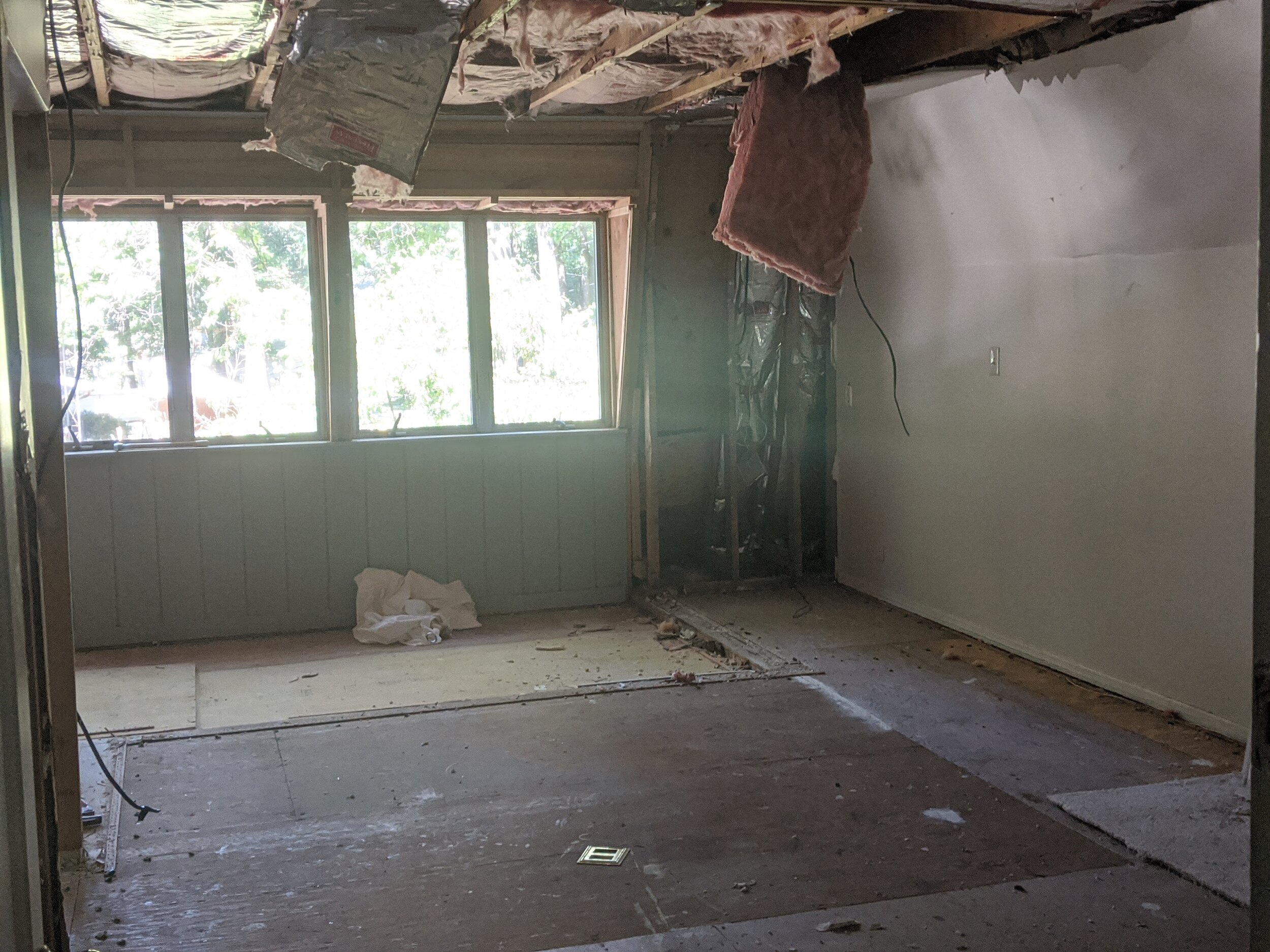
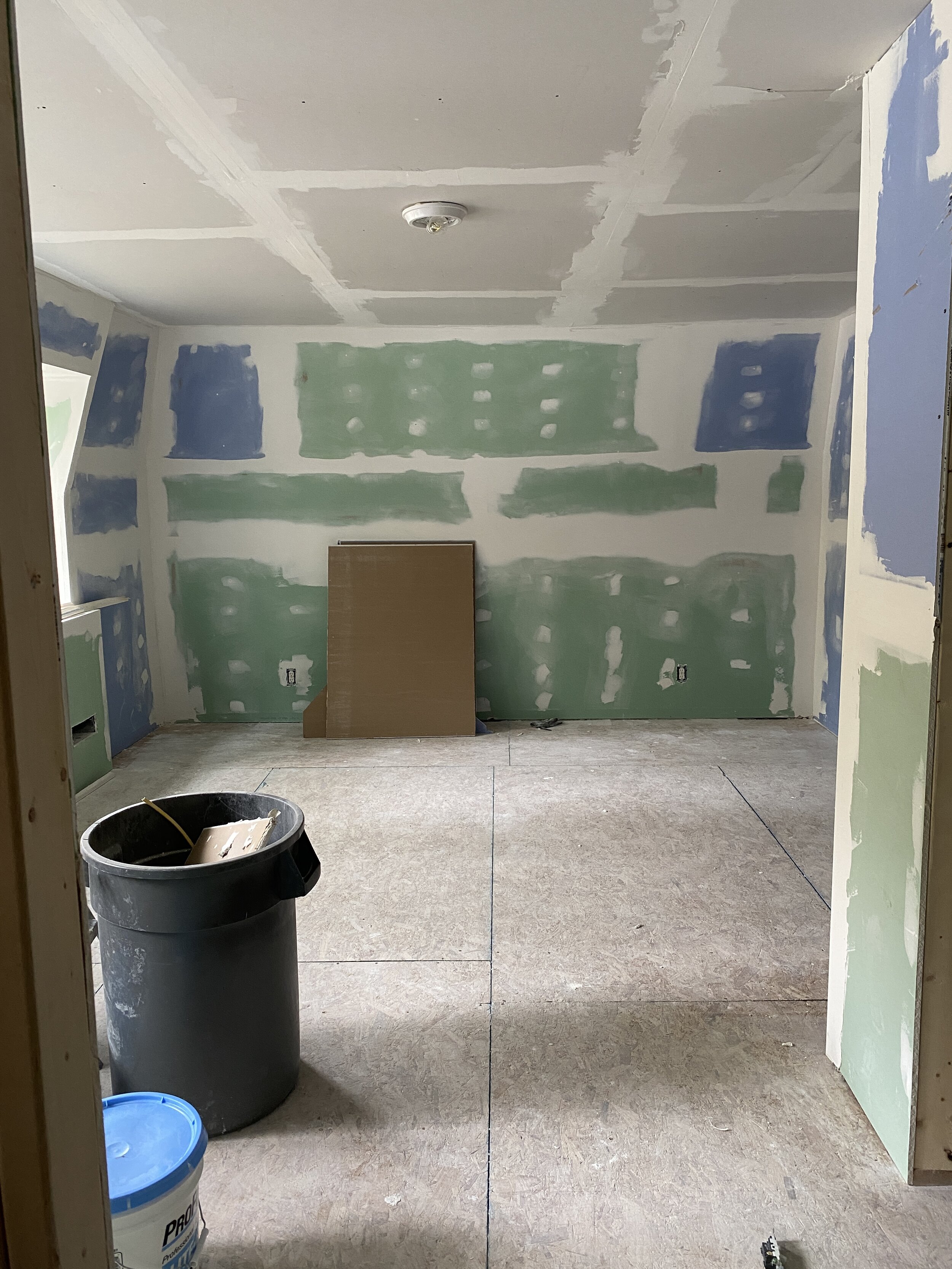
Our Why is because we know we can add resale value to our house by reconfiguring the master suite and turn it into a space we love to spend time in while we're living here. So in those times when I'm overwhelmed and have that sudden, "What did we get ourselves into!?" feeling, I remember that it'll be more than worth it in the end.
So whatever the reason, don't forget why you started.
Final Thoughts
There’s no sugarcoating it - renovations are HARD. But hopefully keeping these first-hand tips in mind will help get you through your next renovation a little easier. I know there will be days when I’ll need to come back and read through them myself!
Does anyone out there have any more helpful tips on how to stay positive or motivated during a renovation? I'd love to hear them!

Enjoy this post? Check out some of my other renovation posts:
Tips to Keep Yourself Motivated During a Renovation

DIY Bunting - an Easy, No-Sew Tutorial
I obviously LOVE home design, but when it comes to seasonal decor, with the exception of Christmas, it’s always felt a little pointless to me. I mean, who am I decorating for anyway?
Well, let me tell you… now that my older daughter is almost 5, I need to get my ish together because there’s no way she’s letting me get away without any fall decor up in here! I couldn’t say no to her incessant pleas for decorations (kids, amirite?), so we’ve been spending a lot of time lately finding ways to create some festive decorations together, including the topic for today’s post: how to make an easy, no-sew bunting.
How to Create Your Own Bunting
As you may have learned from my previous post, I’m terrible about decorating for the seasons and holidays.
Don’t get me wrong, I obviously LOVE home design, but when it comes to seasonal decor, with the exception of Christmas, it’s always felt a little pointless to me. I mean, who am I decorating for anyway?
Well, let me tell you… now that my older daughter is almost 5, I need to get my ish together because there’s no way she’s letting me get away without any fall decor up in here! She is so excited about the changing seasons - and rightfully so! I couldn’t say no to her incessant pleas for decorations (kids, amirite?), so we’ve been spending a lot of time lately finding ways to create some festive decorations together.
One of those decorations is the topic for today’s post: how to make an easy, no-sew bunting. You may have even noticed it hanging out in my last post because I used it as part of my Halloween decor! And because it’s now deep into fall and I used fall colors in my bunting, I’m tagging this as a fall post. BOOM.

But really, this tutorial can be adapted to work for whatever holiday or situation suits your needs.
Before I get this party started, I have to admit that I have a tendency to make things more complicated than they need to be. Well, either I’m getting lazy or I’m turning over a new leaf (get it!?) because this project is fast, easy, and cheap! And lucky for you, it’s unlikely that you too have a ridiculously long mantel, so your bunting will likely be even faster, easier, and cheaper!
Here’s how to do it:

As an Amazon Associate, I earn from qualifying purchases. This post may contain affiliate links, meaning I receive commissions for purchases made through those links, at no cost to you.
Materials
- Cardstock, matboard, cardboard, or another stiff, easy to cut material
- Ruler or Tape measure
- Pen
- Scissors
- Fabric (in various colors/patterns - I just used leftovers of festive colored fabric I had stashed away)
- Twine or another type of thick string
- Hot glue gun
Create a template
Using your cardstock/matboard/cardboard, measure 6 inches horizontally and make a line from point A to point B. Then, find the middle of that line and measure down 6.5 inches (point C). Draw a line from point A to point C. Draw another line from point B to point C. Congratulations, you just drew a triangle!

From the middle of the top line of your triangle, measure up half an inch. Draw a line 2.5 inches to the left and the right from your point (your line will be 5 inches long total).

Then connect the ends of that line to points A and points B. This step creates the flap that you’ll fold over the string when you assemble the bunting… It’ll make more sense below.

Cut out your template.
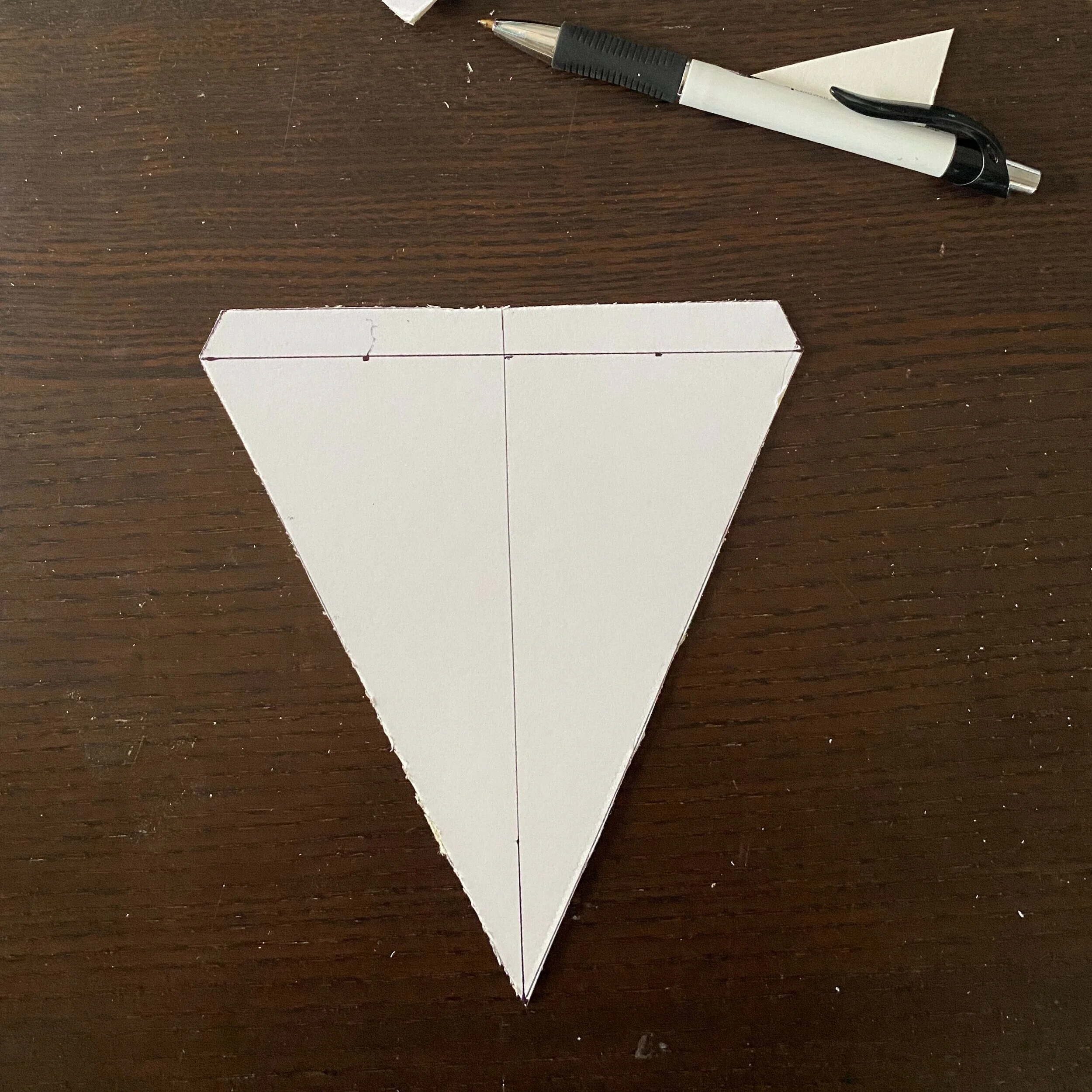
Roughly measure your mantel (or wherever you plan on hanging your bunting)
This isn’t an exact science by any means. To measure my mantel, I just took my string and draped it where I planned on hanging my bunting. Then I made sure to add a little extra string that I would use on either end to hang the bunting before I cut it.
Keep in mind that your bunting will sag a little, so don’t actually measure your mantel and cut your string to match that measurement. It’ll be too short, you’ll regret it, and you’ll end up questioning your whole existence. Totally not worth it.
Determine how many flags you need to cut
Again, not an exact science. Actually measure your string this time, not including any excess you left on the ends for hanging. Divide that by 6 and that’s about how many flags you need.
Decide on a pattern & cut your fabric
You may want to have an idea of how your finished product will look so you know how many of each flag to cut. Or, you can be like me and just start cutting out flags, see what you end up with, and THEN figure out your design.
Either way, once you’re ready to start making your flags, using your template, simply trace the flag on the backside of the fabric with a pen and cut it out. PLEASE don’t use a Sharpie for this step - it’ll bleed through. Then repeat over and over again until all your flags are cut.
While making my bunting, my daughter had a good time just cutting scraps of fabric to shreds while I did all the hard work.
Iron the flags
You’ll want to iron the flags here for two reasons: 1: You want them to hang flat and 2: You need to iron down the flap at the top that will fold over and be secured to the string.

Assemble your bunting
Once all your flags are cut and ironed, you’re ready to assemble your bunting!
For this step, I laid out all my flags facedown, put the string under the flaps, and worked my way around one by one, putting a small line of glue on the underside of the flap as close to the crease as I could. Then I moved on to the next flag and the next and the next until I was done.

Then all that’s left is to hang your up your bunting to add a little festive fall flair!

Here are some other How-To projects you may like:
Easy Step-by-Step Bunting How-To
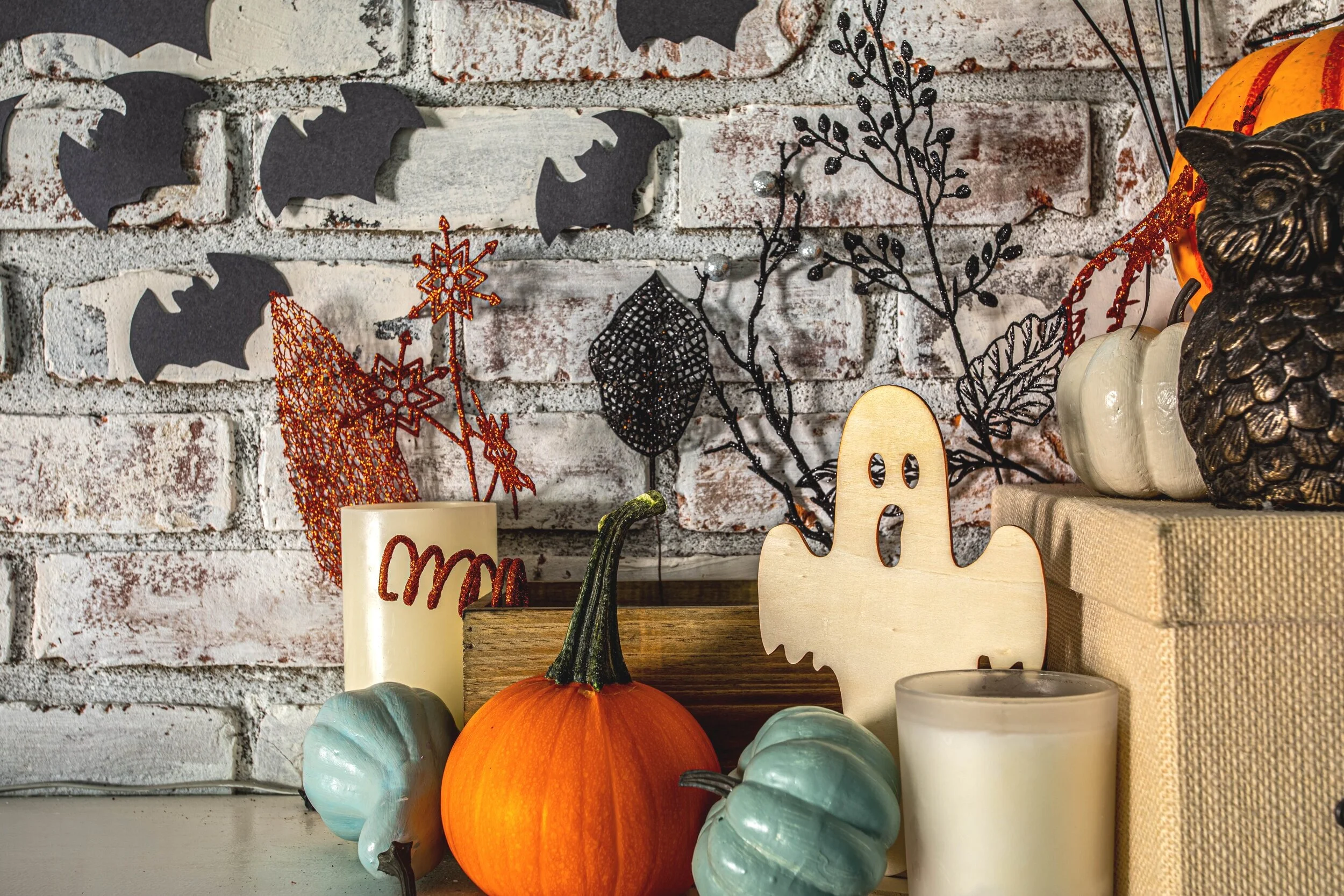
Halloween Mantel Decor on a Budget
Let me tell you, I have had a helluva time decorating my mantel for Halloween and putting this post together… because I’m cheap.
Let me explain…
How to Decorate Your Mantel for Halloween - for Cheap!
In the blogging world, this post is way overdue. Apparently, I’m “supposed” to have posted my Halloween-inspired decor posts like a month ago to give them time to spread all over the interwebs. But let me tell you, I have had a helluva time decorating my mantel for Halloween and putting this post together… because I’m cheap.
Let me explain…
A couple of months ago, I didn’t own a single Halloween decor item. Seriously!
Being my frugal self, I have a hard time spending money on nonfunctional items. And other than Christmas, I don’t get too excited about many holidays. But between feeling the pressure from the blogging world, not to mention my 4-year-old who is PUMPED UP about Halloween, I caved and bought a bunch of decorations, but I didn’t break the bank!
Let’s Go Shopping!
I knew I had to throw something together for Halloween, so being inspired by the craftiness of other bloggers, and the frugalness of my wallet, I headed on over to Dollar Tree and grabbed a bunch of cheap decorations - pumpkins, gourds, wooden ghosts, more pumpkins, flowers, leaf garlands, and more. I also made a pit stop at Wal-Mart for some larger pumpkins to add more interest since Dollar Tree really only carries smaller pumpkins. At Wally World, I also found some Halloween-inspired bouquet fillers for about $1 each so I grabbed those too.
Now that I had my decor items, I was honestly feeling overwhelmed with how to make the hodgepodge of decorations I bought work together. You see, while I was shopping, I didn’t really have a vision for what the end product would look like. But I did know one thing, some of the decor wasn’t quite my style.
Tweaking My Decorations
I wouldn’t necessarily consider myself a hoarder, but when it comes to paint and crafting supplies, I have a REALLY hard time letting go. That’s probably how I ended up with all these paint samples.

I’d been hoping to find some way to make use of all the paint samples I’ve collected, and this was a great opportunity! All over Pinterest, I’ve seen other folks painting their Dollar Tree pumpkins, and rightfully so because those things are insanely bright. So I figured, why not? Let’s give it a whirl…
My daughters and I spent a nice evening painting - my older daughter and I painted pumpkins and gourds together while she regaled me with tales from the playground and my younger daughter painted herself. The best part about using paint samples I already had on hand was that they’re colors I love and already use in my house, so they effortlessly look like they belong.
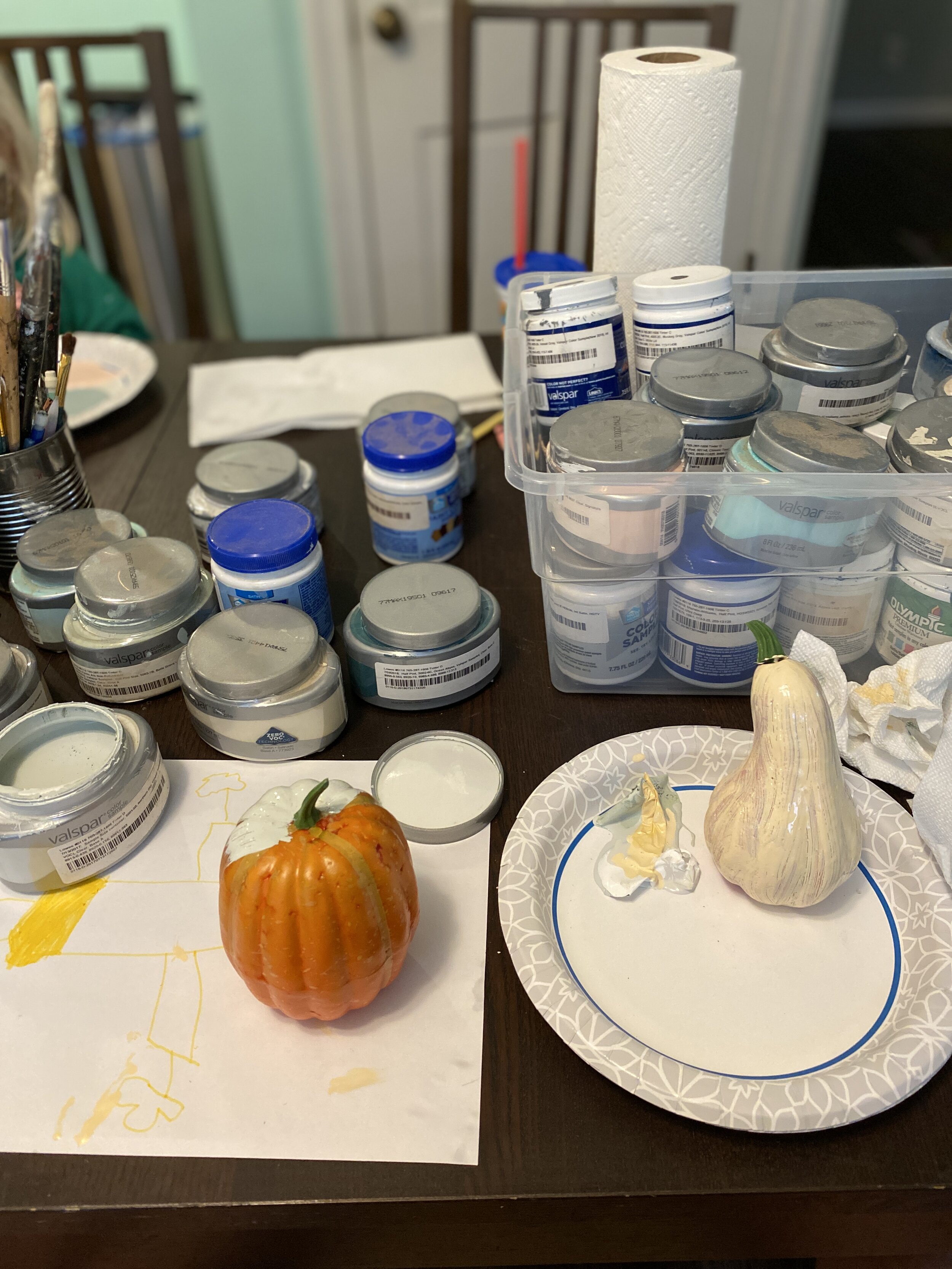
As for my daughter’s pumpkins, I gave her just a few colors to choose from so her pumpkins didn’t end up looking like they were dipped in mud. Then I conveniently arranged them together in a little grouping by themselves in the other room. (That sounds terrible… but it’s the truth.) And don’t worry, my younger daughter had non-toxic finger paints.
Once I modified my pumpkins, I was feeling more confident in my purchases. Here’s how I put it all together:
How I Decorated My Mantel for Halloween
Our mantel is abnormally large. It spans the whole wall! Plopping decor items all along the mantel like I did initially looked crazy busy. I actually wish I had snapped a picture of the hodgepodge of decorations I threw up on the mantel before I took them down and started giving it some actual thought because it was a HOT MESS. I ended up mimicking how I typically decorate this mantel and created groupings on either end.
Normally, I like to keep the groupings on the mantel pretty minimal, but that just didn’t look right to me in this case. I think it was because I had mostly small items that looked insignificant when there were only a few. So, I threw out my own rules, grabbed a whole bunch of my decorations, and put together some spooky little dynamic scenes on each end.

First, to give the larger pumpkins some height, I stacked them on random items that would lift them up juuust enough. I think I used a bowl to lift up one pumpkin and a candle for the other. I already mentioned above that my daughter and I painted the smaller pumpkins and gourds. I used those to hide the items that were raising the larger pumpkins and to add some variety.
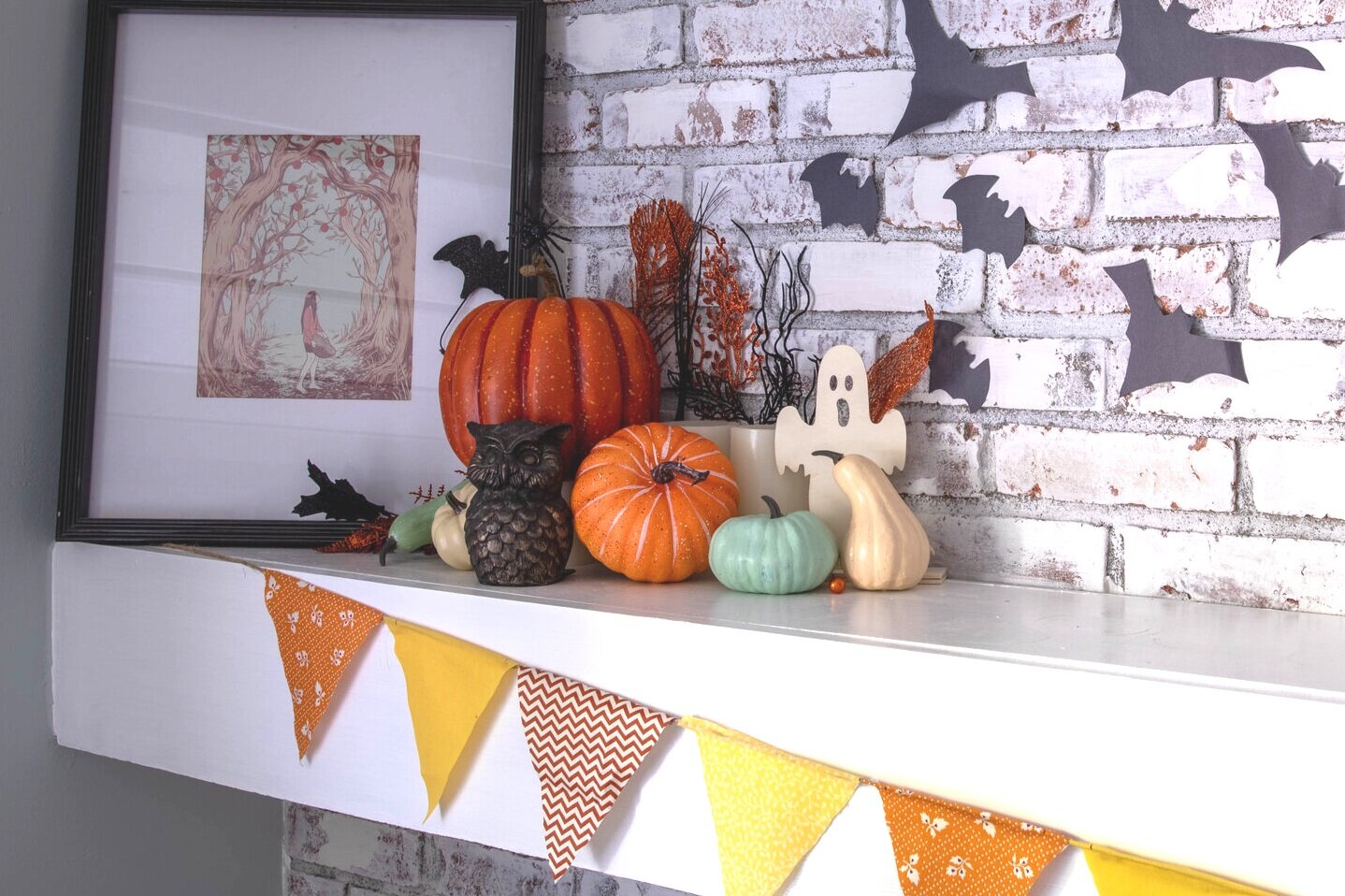
Next, I plopped on cute wooden little ghosts I grabbed from The Dollar Tree on each end of the mantel. I thought about painting them white, but I actually really like the blonde wood so I left them as is. I also used the smaller pumpkins to hide the base of the ghosts.
To add a spooky backdrop, I took the Halloween bouquet fillers that I bought, broke them apart, and spread them out behind the scenes I created. I also shopped around my house and grabbed some other things I already had - like some fake candles and my owl bookends that seemed to fit the theme.

As an Amazon Associate, I earn from qualifying purchases. This post may contain affiliate links, meaning I receive commissions for purchases made through those links, at no cost to you.
Then, there are the bats. THE BATS!
I think the bats are really the icing on the cake and they were probably the easiest and most enjoyable part of this little project. I took another opportunity to involve the kids in this project by drawing and cutting out bats while they colored and cut their own shapes and designs.
I LOVE how the bats add so much movement and really bump up the spook factor. (Admittedly, I bogarted all the black construction paper, but the kids didn’t seem to mind.)
If you don’t want to make your own bats, you can buy packs of them in all different sizes!

Lastly, there’s the bunting that I recently made. The bunting is cheap, easy, and completely customizable. I love how it visually links each end of the mantel, and I’ll be sure to share a tutorial on how to make your own soon.
There are a million other options for garland, lights, or something else I could have hung across the front of the mantel. And you know what? I’m kind of excited to brainstorm and see what I can come up with next year.
One thing to note is that I purposefully didn’t decorate at the base of the fireplace. In case you didn’t pick up on the fact that I have a mischievous little one, I most definitely do. And my mom-brain can’t stop picturing her pulling a giant pumpkin on herself or dragging smaller pumpkins throughout the house. Maybe in a couple of years, I’ll consider mixing it up and adding some decor within the her reach, but for now, I’m good with sticking to keep the decorations up high.

Final Thoughts
This honestly wasn’t a project I was really looking forward to. But once I stopped procrastinating and started putting my Halloween mantel design together, I started to have some fun. I can’t say exactly how much I spent because I didn’t use all the decor I bought and I shopped around my own house for some of it, but I guesstimate it was less than 50 bones (couldn’t help the Halloween pun there)!
So there you have it! It took me way too long to get my butt in gear and decorate, but I’m happy that I did - and the kids are pretty pumped too. I’m loving how switching up the decor is shaking up the every day just a little and really getting us in the spirit. I’m almost willing to say I’m excited to decorate for Christmas. We’ll see…

Related Mantel Decor Posts
Cheap Halloween Mantel Decor

Modern Dining Room Reveal
It’s done! It’s done! The dining room makeover is done!
If you’ve been following along, you saw last’s week post where I shared the accent wall we installed in our dining room. Well, as I was writing that post, I was working on putting the dining room back together for the grand reveal. It took a TON of restraint to not share a million sneak peeks, but I kept my trap shut and now I’m so excited that I can share it with the world!
Dining Room Makeover - Before and After
It’s done! It’s done! The dining room makeover is done!
If you’ve been following along, you saw last’s week post where I shared the accent wall we installed in our dining room.
Well, as I was writing that post, I was working on putting the dining room back together for the grand reveal. It took a TON of restraint to not share a million sneak peeks, but I kept my trap shut and now I’m so excited that I can share it with the world!

If you recall, our dining room looked quite a bit different when we bought our house last year.

Here’s a shot from the other doorway.

And here’s how it looks today.

When we moved in, the dining room was definitely not our style. In fact, it didn’t even seem like it was a part of the rest of the house! It had a mind of its own, with its bright yellow faux finish walls and deep red and gold border. Not to mention the ornate chandelier you see in the pictures above.
The doorway leading to the kitchen definitely wasn’t doing this room any favors either. It was the size of an average doorway but made the dining room feel needlessly closed off from the kitchen, so we took matters into our own hands.
We removed just about everything from this room and started from scratch - including stripping wallpaper, replacing the trim and crown molding, and widening that doorway (on a whim!) so it now spans 8 feet!


Then, after much deliberation, I finally chose a paint color and we installed our accent wall.
But of course, those steps were just the big pieces of the makeover. The icing on the cake and what makes a room really come together is the decor!
I made a whole bunch of mood boards during this overhaul to help get an idea of the direction I wanted to go with the decor (and because I just couldn’t help myself and wanted to see ALL the options). We ended up going with this design:

As a side note, I’m really just getting my feet wet with making mood boards, and I’M OBSESSED. They’re a fantastic and no-risk way to visualize a space in a ton of different ways. Why has it taken me so long to start making these!?
Plus, seeing the out of proportion design above compared to the real-life example below cracks me up. 10/10 would do again.

As an Amazon Associate, I earn from qualifying purchases. This post may contain affiliate links, meaning I receive commissions for purchases made through those links, at no cost to you.
Now… back to the decor! Let’s take a little tour, shall we?
Obviously, our dining room table made it back into the room… that was a no-brainer since it’s pretty new. But honestly, the table and the curtains are the only things that didn’t change!
One of the biggest changes was adding our new area rug. Since the table and chairs are a darkish color and the flooring is super dark, the rug really helped brighten things up. Plus, it added some more interest to the room with the blues, greens, and orange going on in the design.

Another big change is the new light fixture. We switched out the fancy pants chandelier with something more modern and in line with the style we were going for. It took about 3 tries to get the right light bulbs, but now that it’s completely installed I’m in love!

I mentioned at the start of this makeover that I planned on switching out the old buffet table with my IKEA Malm dresser… and I’m happy to report that I followed through and am pleased with how it’s working in the space. The only downside is that now all my clothes are hanging out on the floor of my office until we build my new closet in the master bedroom, ha!

Other changes you’ll notice in our new and improved dining room is artwork! Two of the pictures are simply pages from newspapers we found in the attic of our last house.
This one is from when the first Star Wars was in theaters.

And I’m fascinated by this one because of how cheap paint was!

Plus, it has this little section that makes me laugh.

We also threw some watercolors I painted in here. The colors tie in nicely with the accent wall and the direction I’m going with the rest of the house. I painted these before I got brave and started buying real plants. Perhaps I was living vicariously through my paintings, hoping that they could replace having real plants before I was brave enough to start buying real plants? (Answer: they couldn’t)


Anywho - that’s the dining room!
A complete 180 from where this room started and I am so happy for that fact.

There are still a few finishing touches I want to add because really, is a room EVER completely done? (No, it’s not.) But the finishing touches are minor - like adding leather pulls to the dresser, maybe switching out the white picture frames for something gold or brass, changing the pot of the hanging plant, and possibly adding another largish plant in one of the empty corners.
In the meantime, I’m thrilled with how this room turned out. Unfortunately, a lot of the rest of the house is still a hot mess at the moment. I shared on Instagram not too long ago that I removed all the cabinet doors in the kitchen so I can start painting those, obviously we’re deep in our master suite reno and therefore have been displaced to the loft, and half of my office still needs furniture, along with so many other incomplete spaces in the house.
That being said, we’re taking solace in the fact that even though the dining room is upstaging the rest of the house, at least we don’t have anything pressing left to do in there to make it functional and beautiful. Now we can pivot back to some of our other unfinished spaces - stay tuned!

Related Dining Room Renovation Posts
Modern Dining Room Makeover

DIY Geometric Wood Accent Wall
Well, we finally did it. Our geometric wood accent wall is complete and I’M SO IN LOVE WITH IT! In fact, I love the finished product so much, I wrote a tutorial about it! (Surprise, surprise).
How to Create a Modern Wood Feature Wall
Well, we finally did it. Our geometric wood accent wall is complete and I’M SO IN LOVE WITH IT!
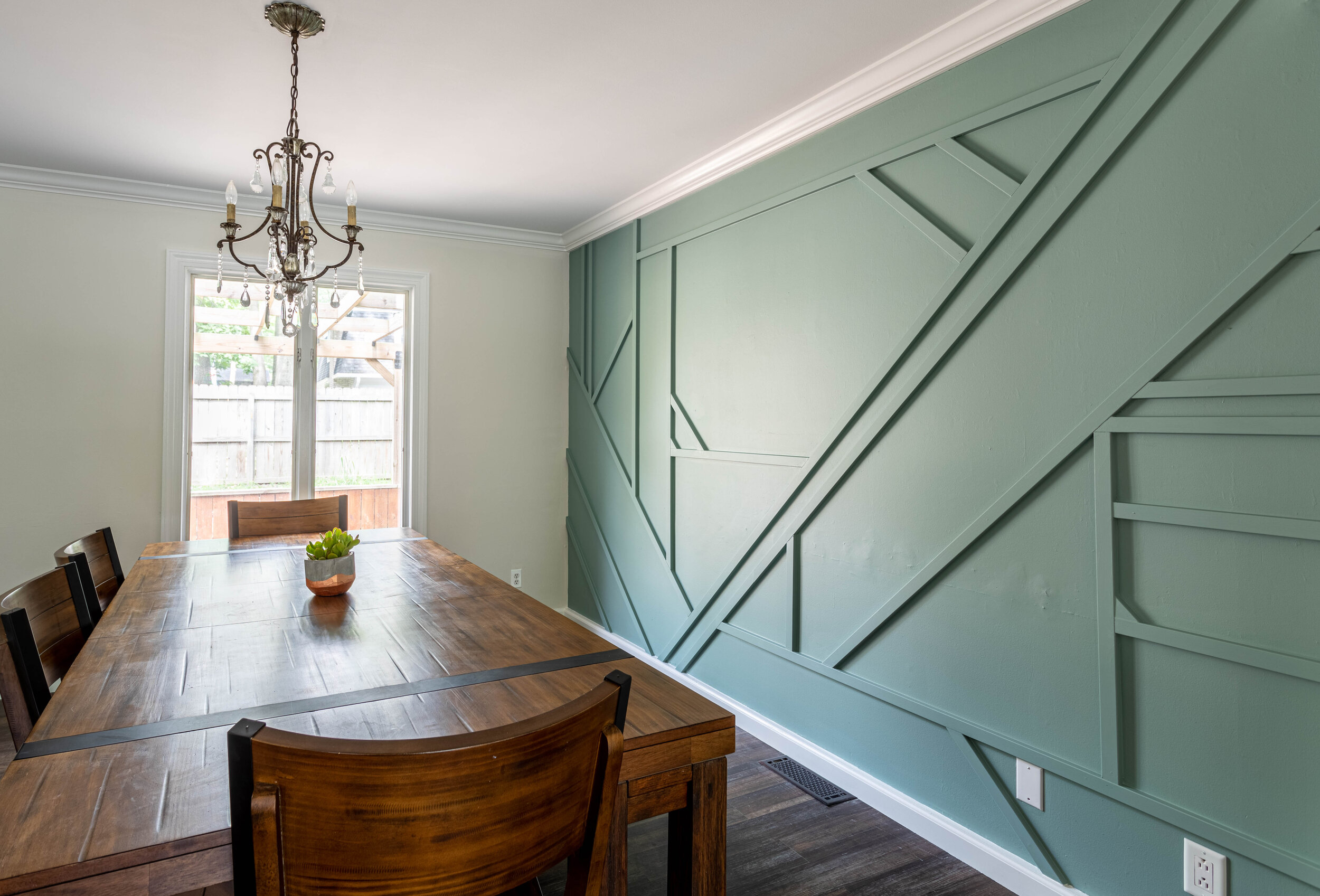
Waaaayyyy back in March, I started renovating our dining room. I was completely inspired by the accent wall Liz over at Within the Grove created and just knew I had to give it a whirl. And heck - I had nothing to lose considering what we started with!

But because we seriously lack focus as far as home renovations go, we got distracted working on my home office redesign, finishing the flip, and… what else?
Oh yeah, completely demolishing our master suite.
But FINALLY, we were able to take a little bit of time, find some childcare (toddlers and nail guns don’t mix - who knew!?), and put this wall up in just a couple of hours! Easy peasy. Then I just had to caulk and paint and now I spend most of my time gazing lovingly at it. I mean, wouldn’t you!?

In fact, I love the finished product so much, I wrote a tutorial about it! (Surprise, surprise). Here’s how I created my geometric wood accent wall:
Materials
As an Amazon Associate, I earn from qualifying purchases. This post may contain affiliate links, meaning I receive commissions for purchases made through those links, at no cost to you.
- Primed 1 x 2 MDF boards (the amount you need will vary based on your design)
- Brad nail gun
- Nails
- Paint
- Paintbrush
- Craft brush
- Paintable caulk
- Wood Putty
- Sandpaper
- Miter saw
- Level
Draft the Design of your Accent Wall
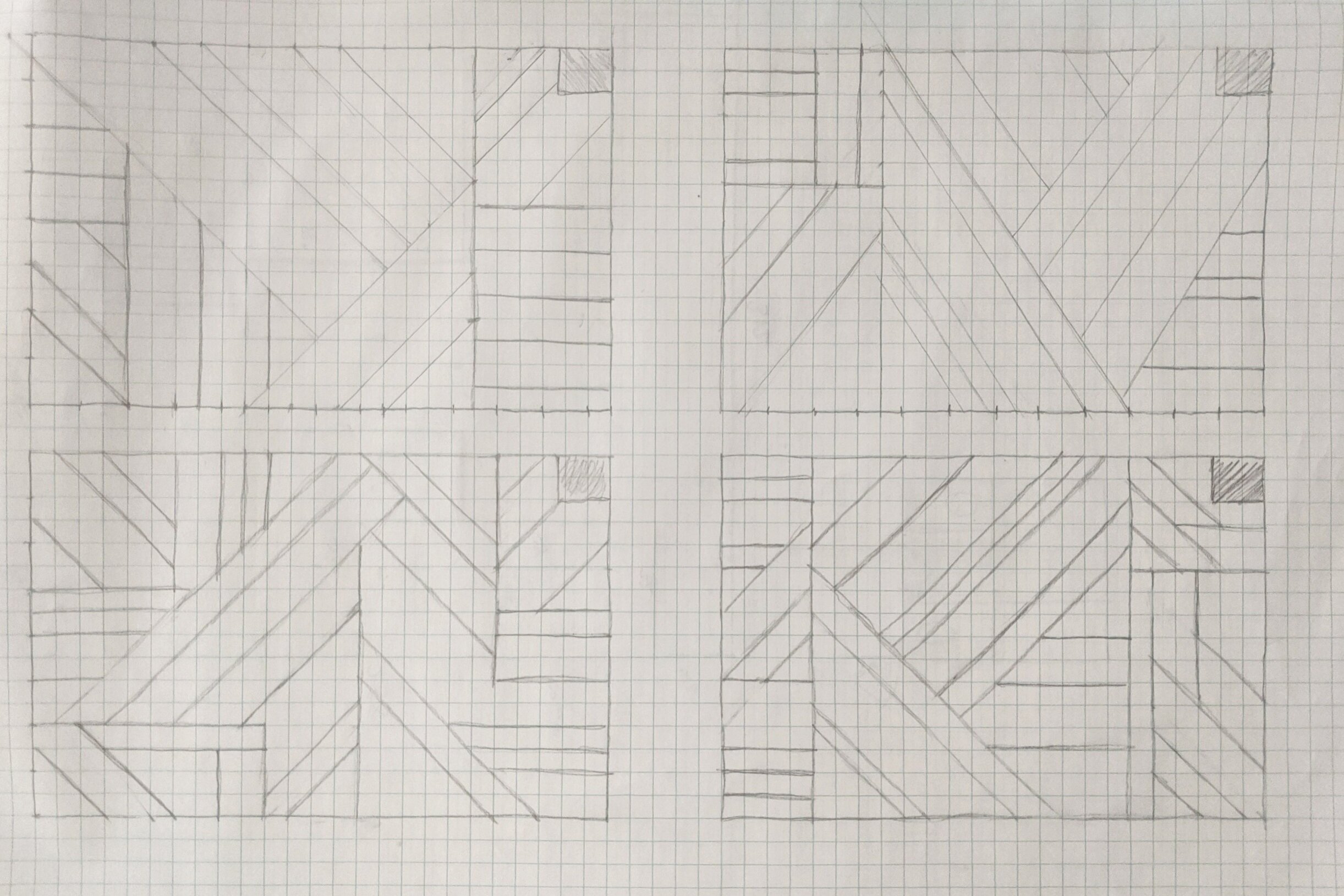
First things first, I started by drafting up a bunch of designs using graph paper. I initially drafted 4 designs and didn’t fall in love with any of them. Then I drafted 4 more. And you know what? I actually didn’t use anything I mocked up!
HOWEVER, I still think this step is important because it gave me an idea of what I definitely did and didn’t want to include in my final design.
Optional Step - Bump Out Your Crown Molding and Baseboards
This step is definitely not required, but I’m really happy we did it.
Since our crown molding and baseboards taper off on the edges, Lucius and I were concerned about how it would look where the MDF boards met up with them. Below is an example of what I’m talking about.

You see how the MDF sticks out further than the baseboard? We wanted a smoother transition. And since we were taking some of the trim off anyway to open the doorway, we just took it all down. Then on the accent wall, we put a piece of MDF up and placed the trim on top of that.

Paint
Once we had the trim finished, I painted the accent wall. This will save you time once your accent wall is installed.
My wall is Desert Lake by Sherwin Williams in an eggshell finish.
Install Your Accent Wall
Once the paint is dry, it’s time to install your accent wall! Here are a couple of tips to get you started:
Stick with 45 and 90-degree angles
Have an extra pair of hands available (especially when it comes to leveling/nailing the long boards)
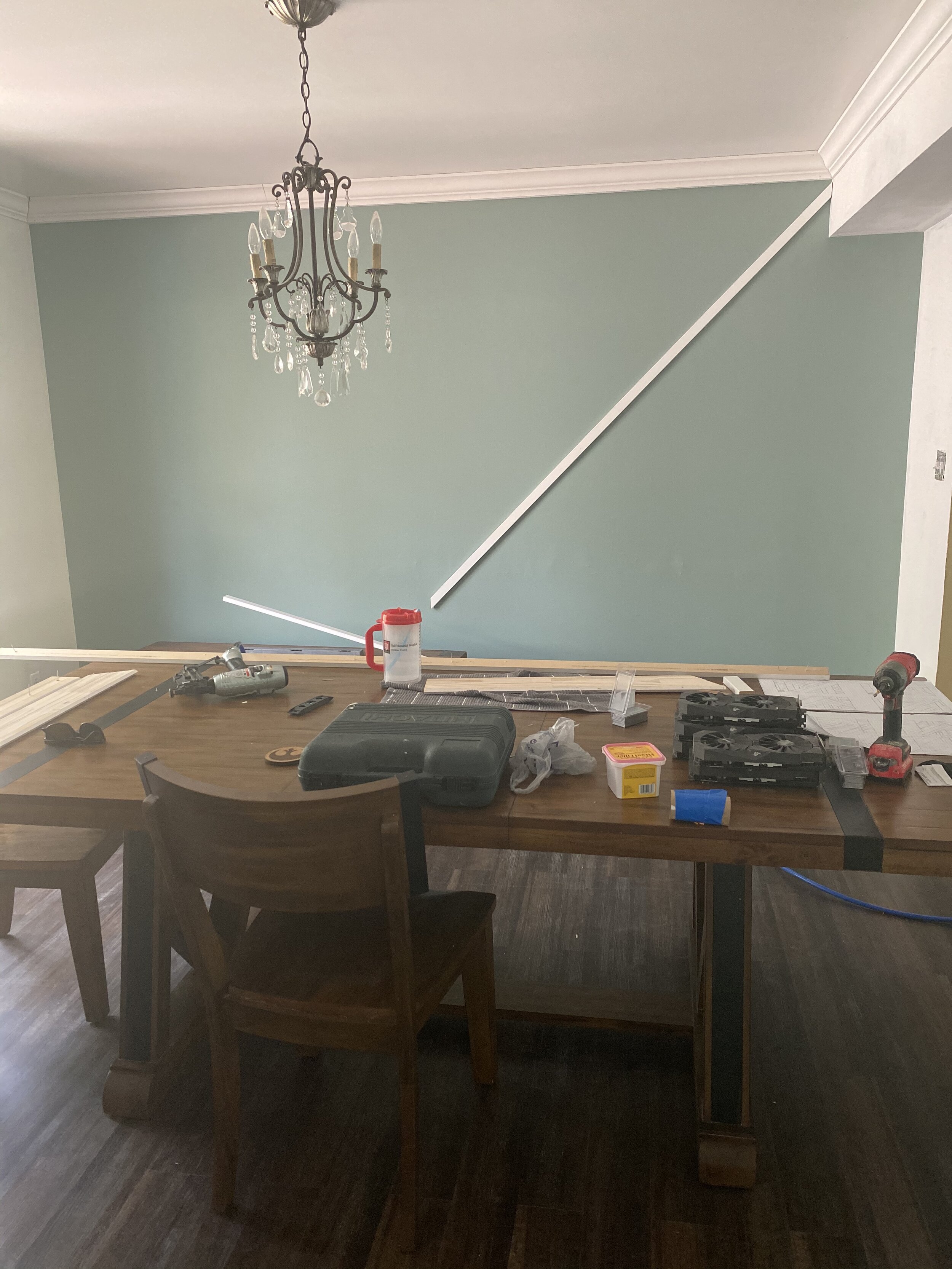
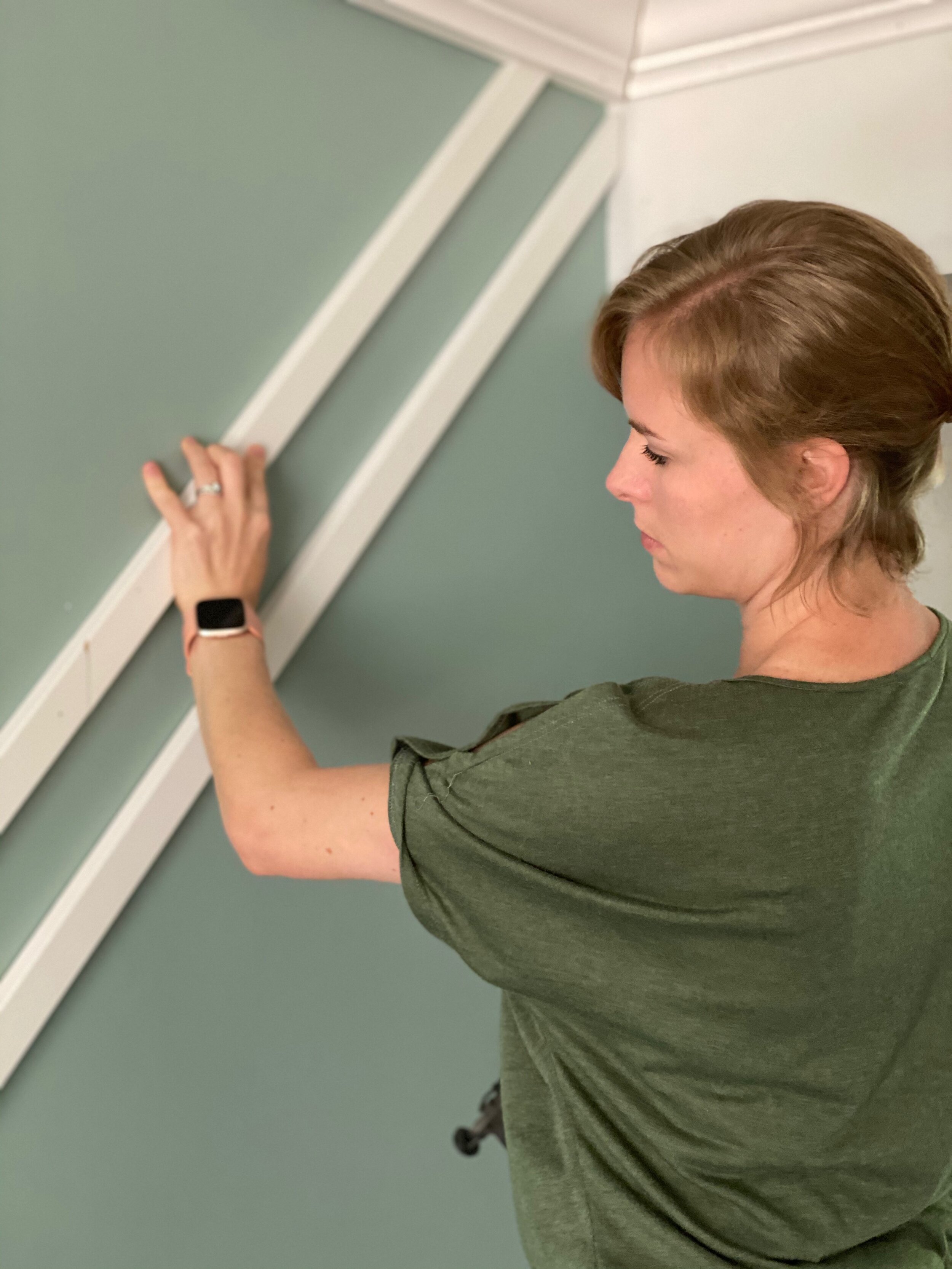
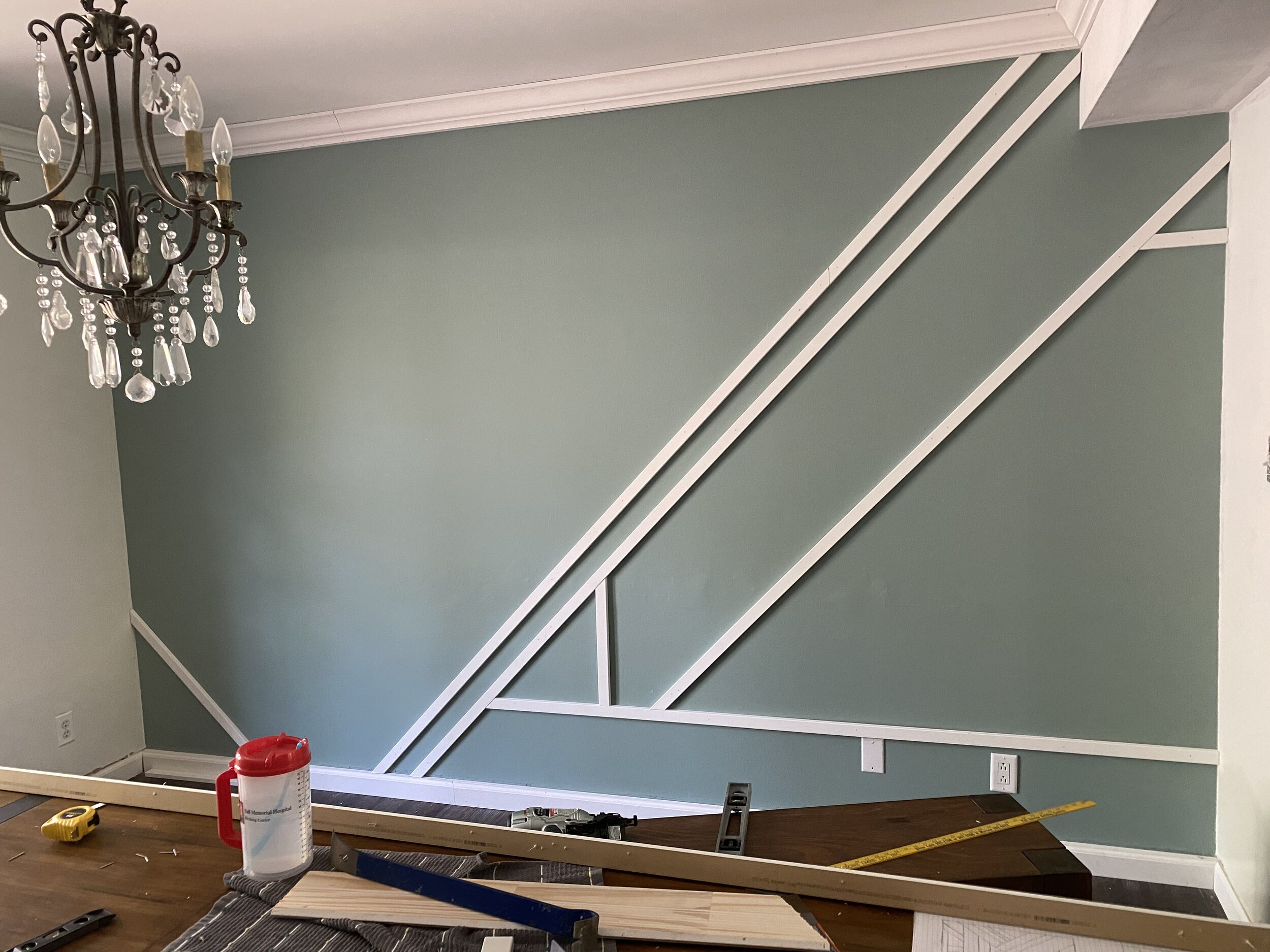
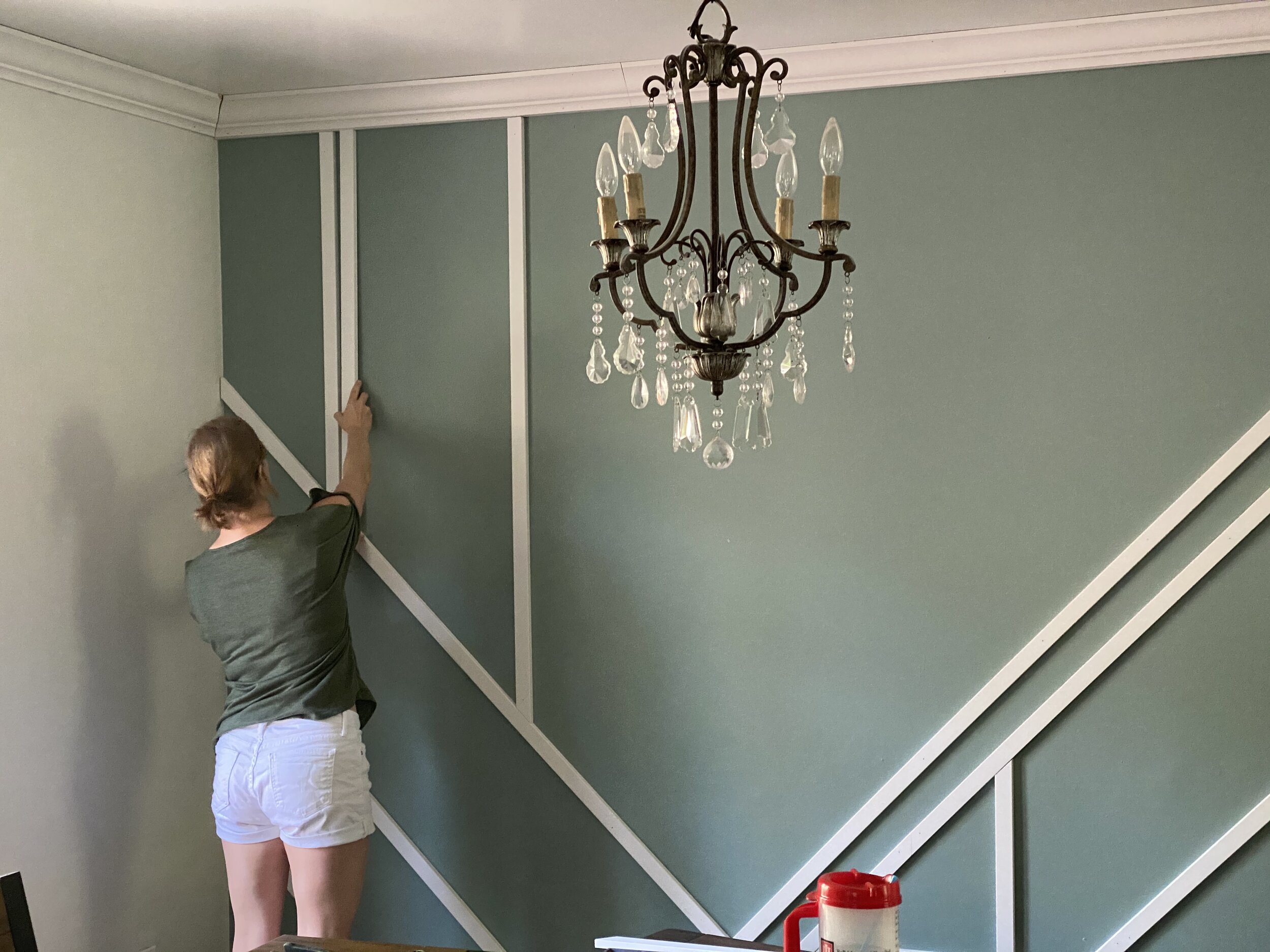
From drafting a bunch of designs, I knew I wanted one long section that went from the bottom left to the top right, so that’s where we started. This also happened to be the longest section and was the trickiest to level and nail.
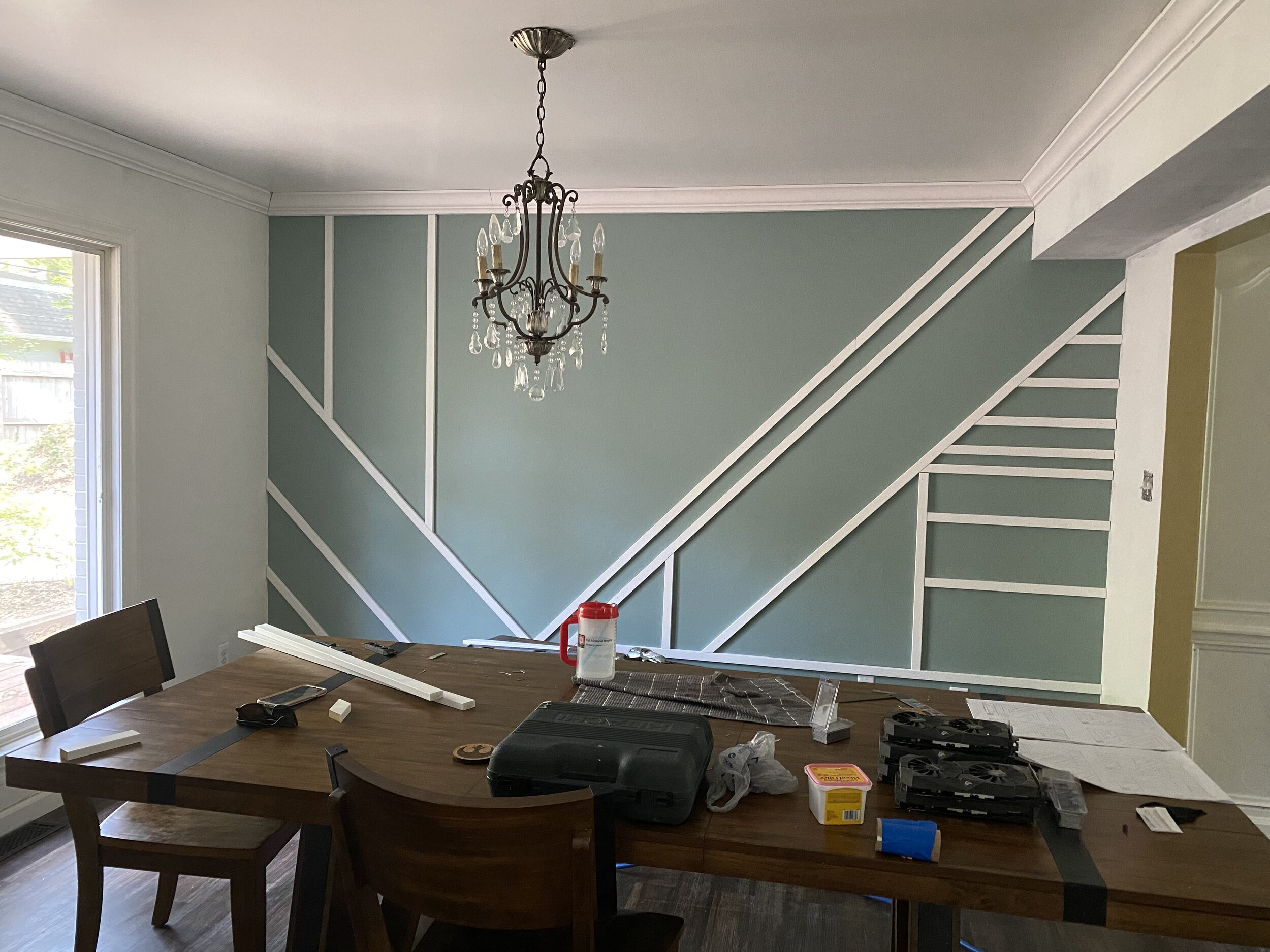
And honestly, from there we just held up boards at different angles and with various spacing to see what looked and felt right. Then we leveled and nailed as we went - even using some of our scraps as filler pieces!
Once we got into a groove, the install went by really fast and ended up being a really fun project.

Fill the Gaps
Of course, installing the wall is only part of the project. Now you have to fill your nail holes with wood putty and caulk all your seams.
I caulked along the seams where the MDF met the wall. I also caulked where two pieces of MDF butted up against each other. You could use wood putty or joint compound here instead, which would probably be a smoother transition, but I really didn’t want to sand all that and I’m happy with the final product. I ended up using about 2 tubes of caulk.
Once the wood putty is dry, sand it down. And once the caulk is dry….
Paint Some More!
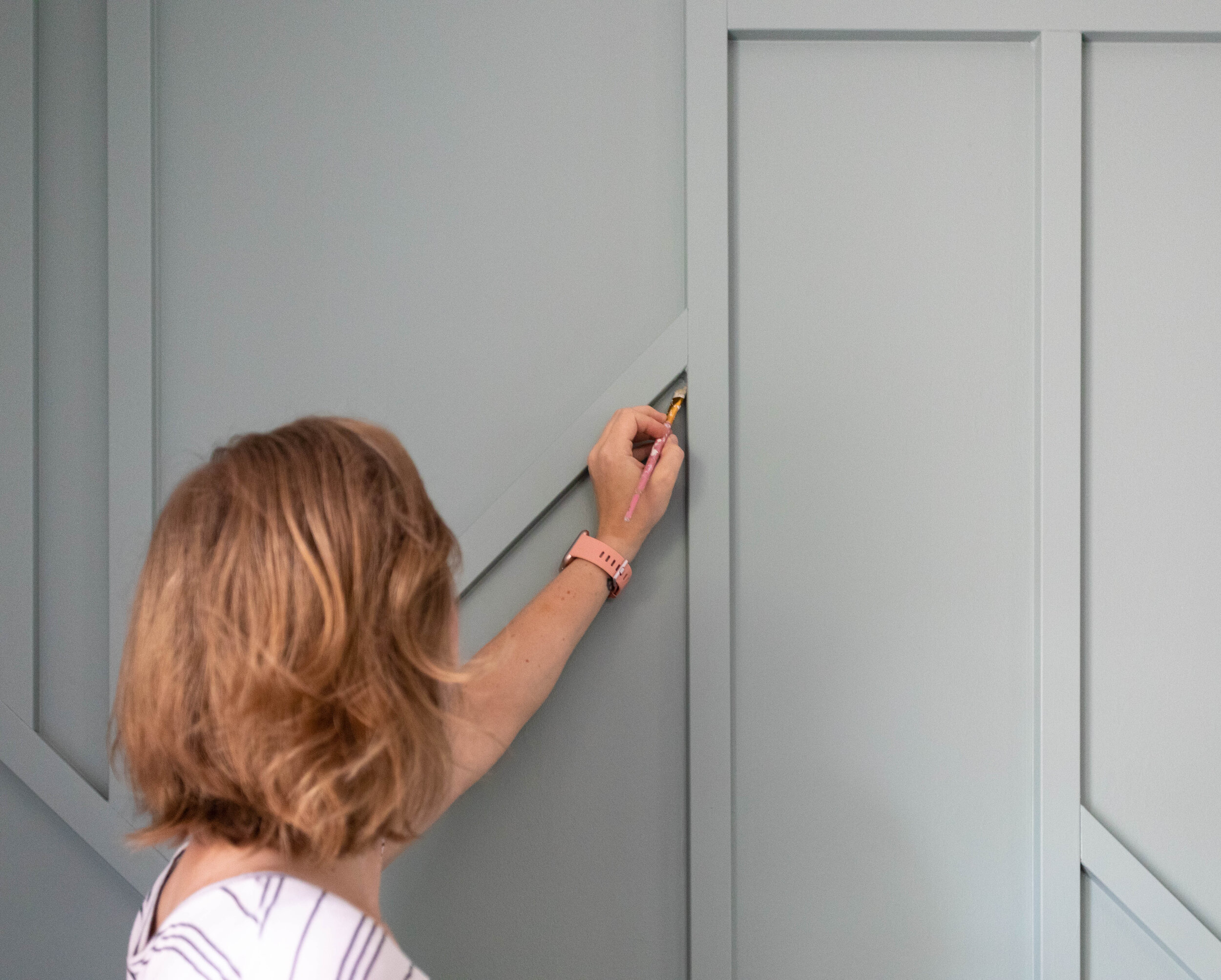
This part of the project gets a little tedious because you have to apply the rest of the paint with a brush, but you’ll get through it (I believe in you).
Make sure you get into every nook and cranny. I used a craft brush in the really tight spots where my boards met with an adjacent wall or the trim. You’ll definitely want to brush on two coats.
Once your paint is dry, you’re done! Now you can style your room and enjoy!
Final Thoughts About Our Geometric Accent Wall

I’m head over heels in love with it! Before this renovation, our dining room was so out of place. It was like it belonged in a different house. Although our house is still a bit of a mixture of different styles (there are several rooms we haven’t touched yet), it’s well on its way to having a cohesive look.
The only thing left to do now in this room is to fill it, and I.CAN’T.WAIT. And you better believe that light fixture is getting the boot! Watch for that post in the next couple of weeks!
Related Dining Room Renovation Posts
Build Your Own Geometric Wood Feature Wall
How to Plan and Hang a Gallery Wall
The thought of hanging a gallery wall can be intimidating. So many pictures. So many nails. So many potential mess-ups and unnecessary nail holes! Where does the madness end!?
Have no fear! I’ve got you covered with a step-by-step tutorial on how to hang a gallery wall that eliminates the probable accidental nail hole (or two, or three).
Hang a gallery wall with this easy step-by-step tutorial
The thought of hanging a gallery wall can be intimidating. So many pictures. So many nails. So many potential mess-ups and unnecessary nail holes! Where does the madness end!?
Have no fear! I’ve got you covered with a step-by-step tutorial on how to hang a gallery wall that eliminates the probable accidental nail hole (or two, or three).

I always seem to make my projects more difficult than they need to be. It’s a problem I’m highly aware of and I’m constantly working to improve upon.
I recently decided to hang a gallery wall in our living room. Unfortunately, true to form, I didn’t picture an asymmetrical one. Oh no. That would’ve been too easy! I envisioned a symmetrical gallery wall in a grid pattern. Meaning, it’s super-duper obvious if your pictures don’t line up properly.
Luckily, I have some hacks that made hanging my gallery wall stress-free - AND this tutorial applies to asymmetrical gallery walls too!
As an Amazon Associate, I earn from qualifying purchases. This post may contain affiliate links, meaning I receive commissions for purchases made through those links, at no cost to you.

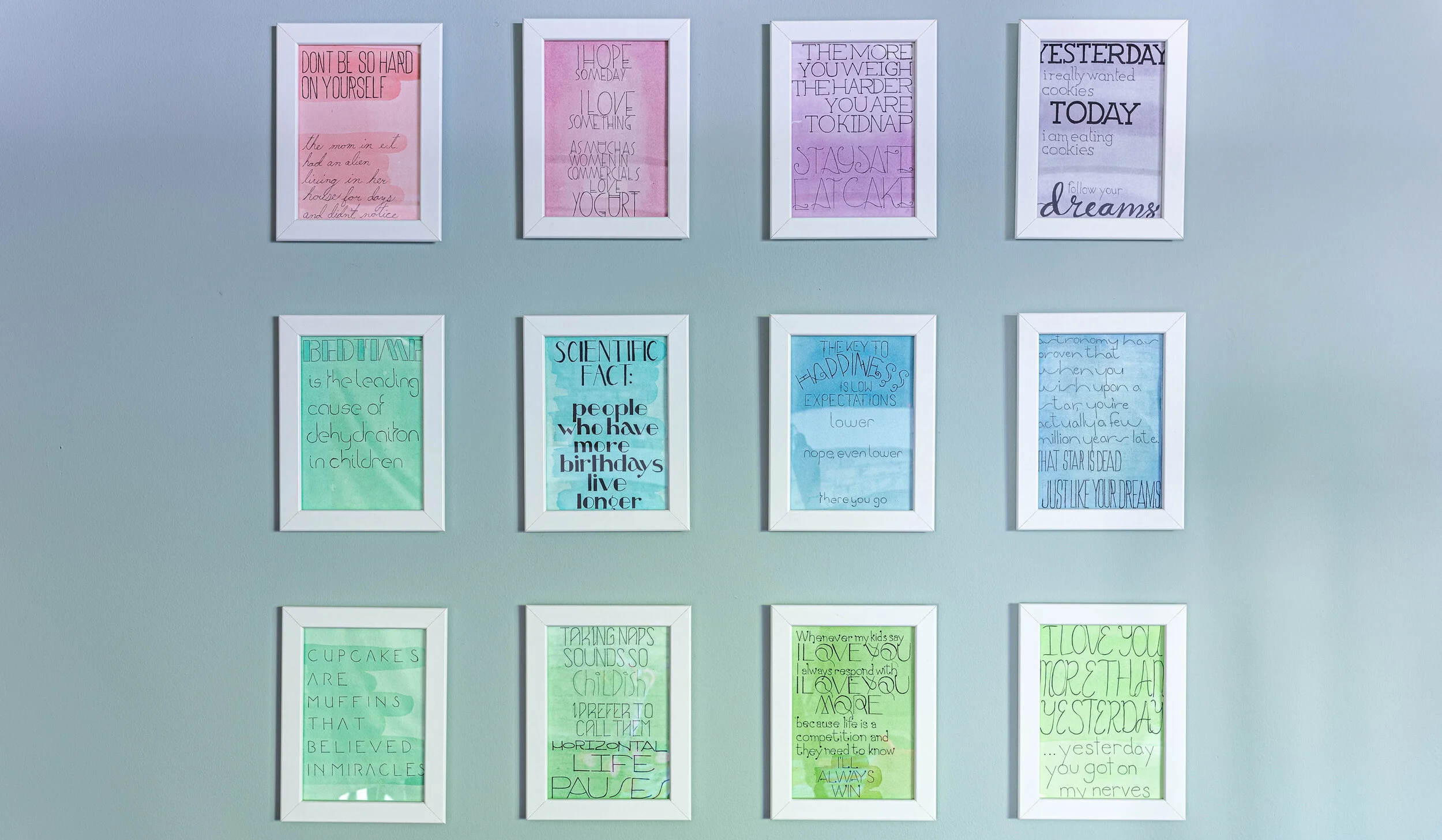
A couple of years ago I started finding all sorts of silly quotes on Pinterest and I felt the urge to do something with them. (They’re all under my “Inspirational Quotes” Pinterest board if you’re looking for a laugh.) So, I decided to have some fun with it and play with different styles of typography while writing these quotes on some watercolor paper.

Once I had a bunch of them, I didn’t just want to stuff them in a drawer - they deserved to be displayed! So I threw some watercolor paint on them and hung them in our stairwell.

And then we moved.
Although we bought another two-story house, the staircase in our new house isn’t as conducive to this kind of artwork display. So I had to find another place to hang these pictures. A big, blank wall in our living room seemed like the perfect place! Here’s how I did it:
Materials

- Masking or painter’s tape
- Tape measure
- Level (either a laser level or manual level will work)
- Hammer
- Nails (I used some small, lightweight nails because my pictures aren’t very heavy, but of course you’ll need to use nails appropriate for your pictures)
- Paper
- Scissors
- Pen or pencil
- Toothpaste (yep, you’ll see why…)
Trace your frames and cut them out
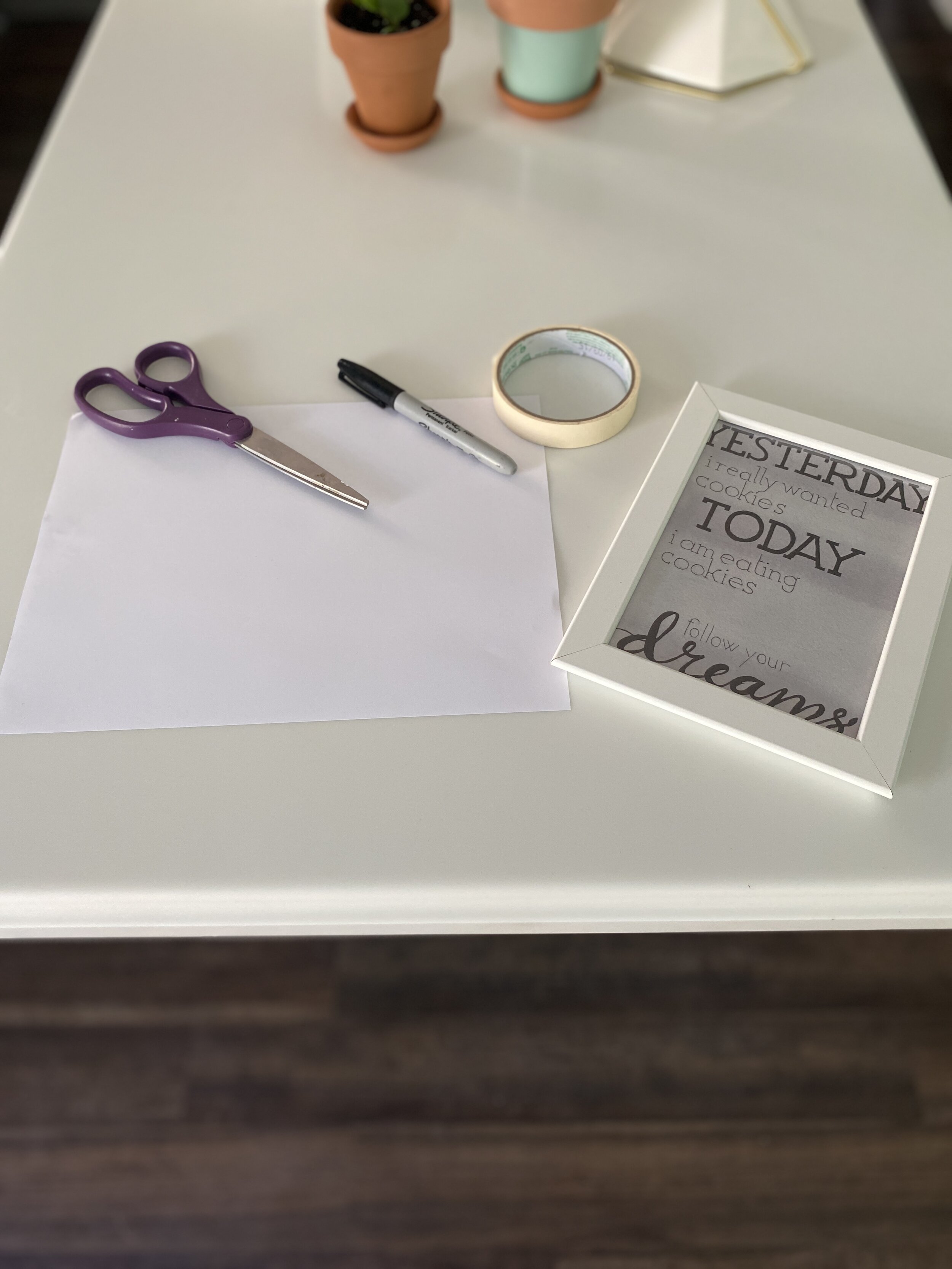
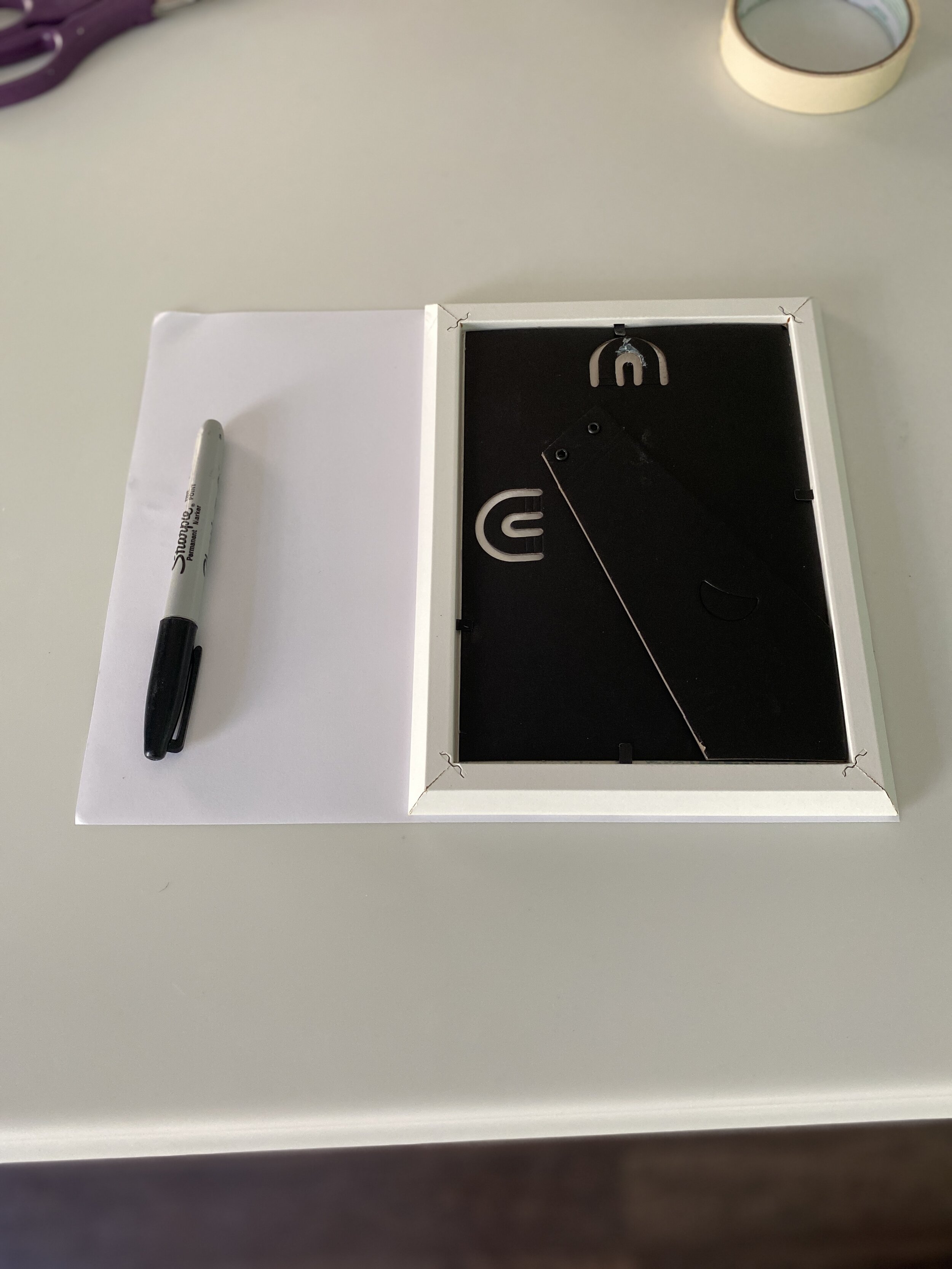
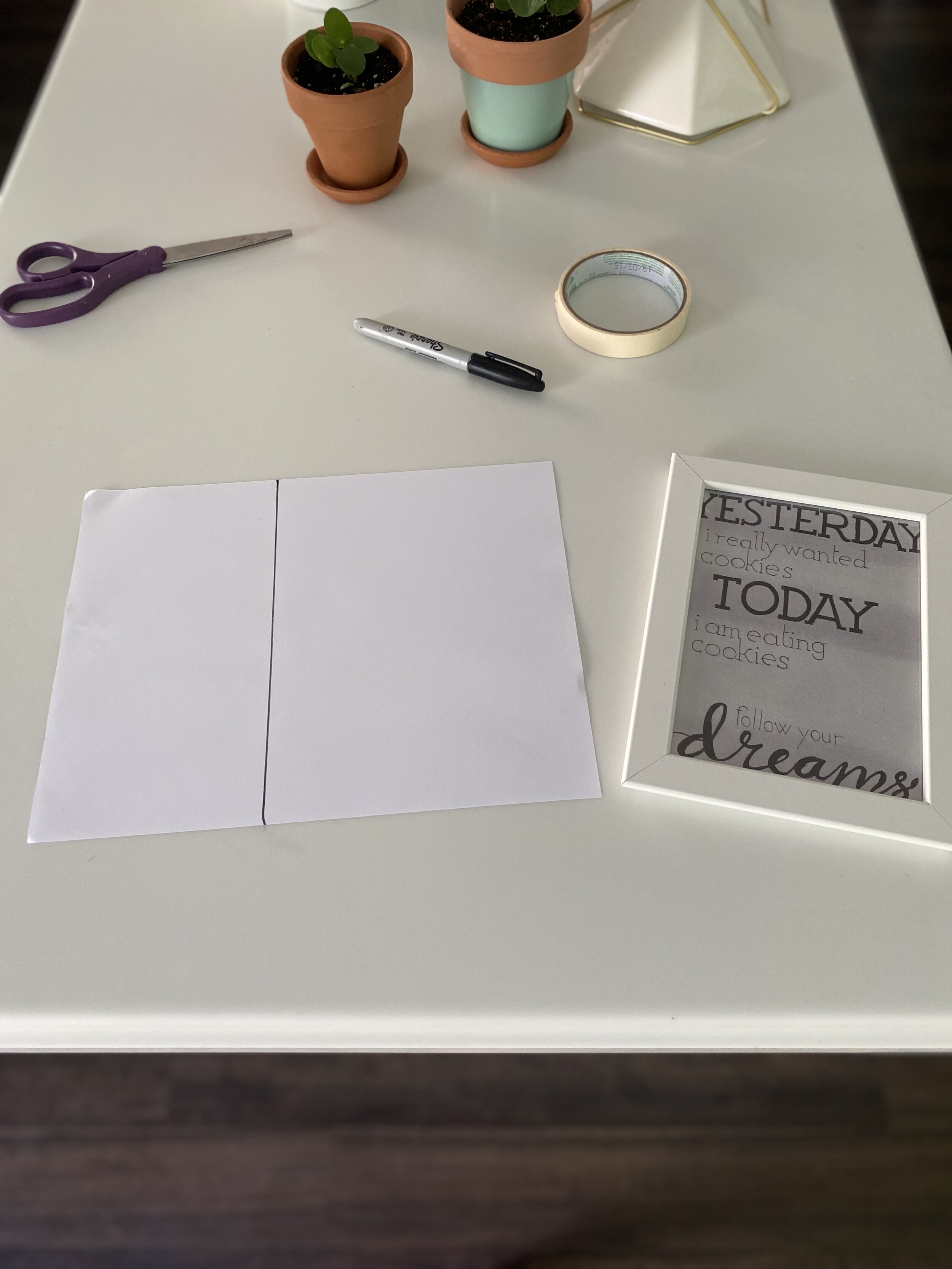
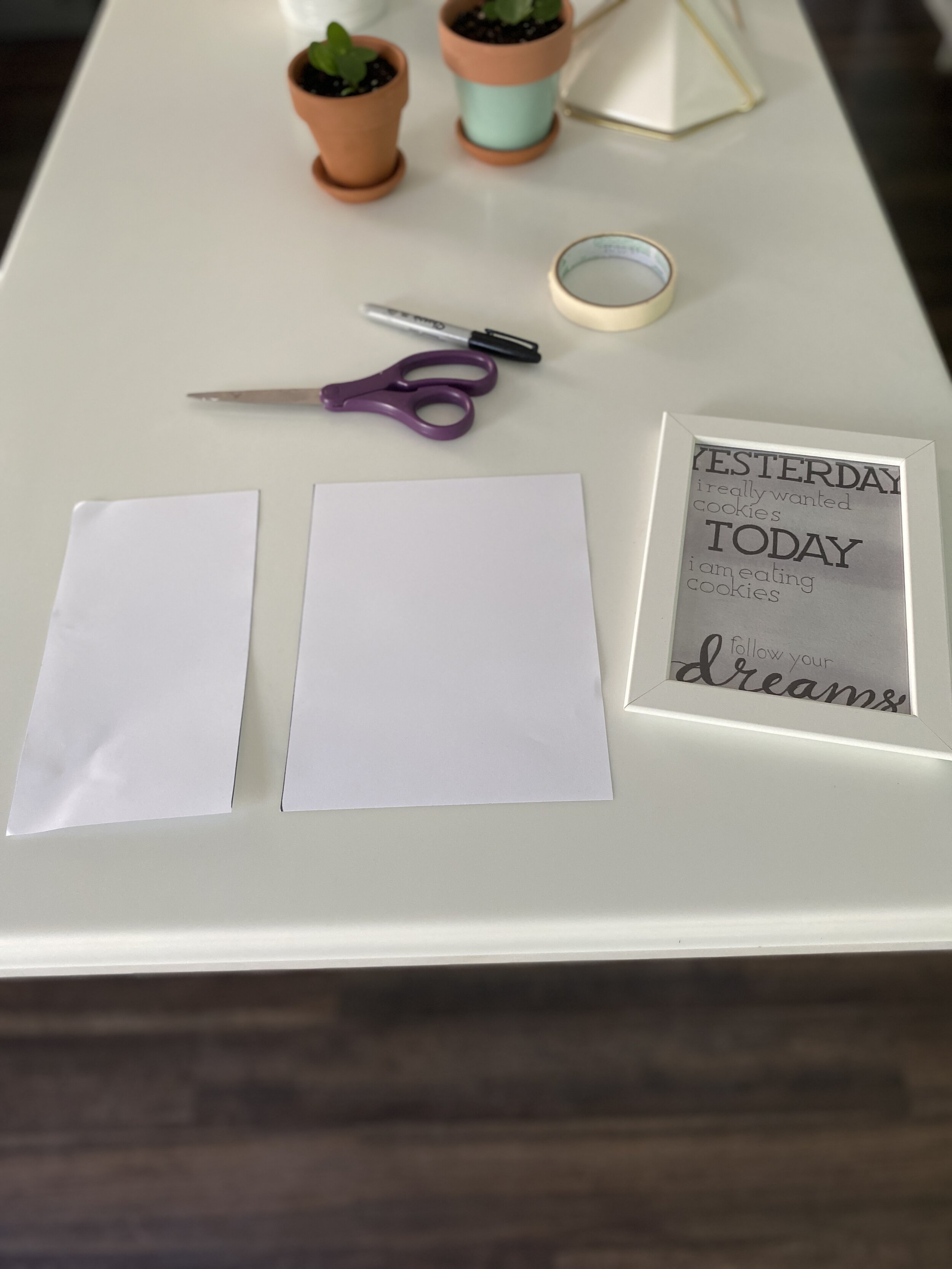
Regardless of if you’re creating a symmetrical or asymmetrical gallery wall, this step will make your life easier. Simply take a piece of paper (or tape a couple together if your frames are bigger than your paper) and lay your frames face down. Then trace around them and cut them out!
Find the focal point for your gallery wall
Measure your wall side to side and stick a piece of tape right in the middle. Then, measure up 57 to 60 inches from the floor. Move your tape to this spot. This should be where the center or your arrangement lies.
Plan your design

Now that you have templates of all your frames and you know where to center your arrangement, you can tape them up on the wall to figure out your design. Move them around as much as you need to. Take a step back and take a good hard look to make sure you like what you see.
Apparently, I didn’t take a picture of this step for this gallery wall, but oddly enough I still had a picture of the gallery wall from our previous house saved.
Space your frames
Okay, now things are getting serious… or, as serious as hanging a picture can get. Maybe tedious is a better word.
Once you have your design nailed down (figuratively speaking… we have a few more steps before we start nailing for real), you’ll want to consistently space your frames out. About 2 to 3 inches of spacing between each frame looks best. I spaced mine out 2 inches.
For asymmetrical designs, I recommend leveling your templates as you go and securing them down one by one.
For symmetrical designs, especially grid designs like mine, it’s a little more complicated…
To make sure everything was level all around, I first created a grid using masking tape.
I started by putting up one strip of tape alongside one of my templates and making sure that was level.
Then I lightly put up a second strip of tape and moved it as needed as I measured 2 inches and leveled as I went. Once I knew it was spaced evenly and level, I stuck it down harder.
I followed those same steps around each of my templates and ended up with this grid:

Tip: Don’t remove your templates yet like I did above. It’s better to leave them up until you’ve placed your nails.
Determine where your nail holes need to be
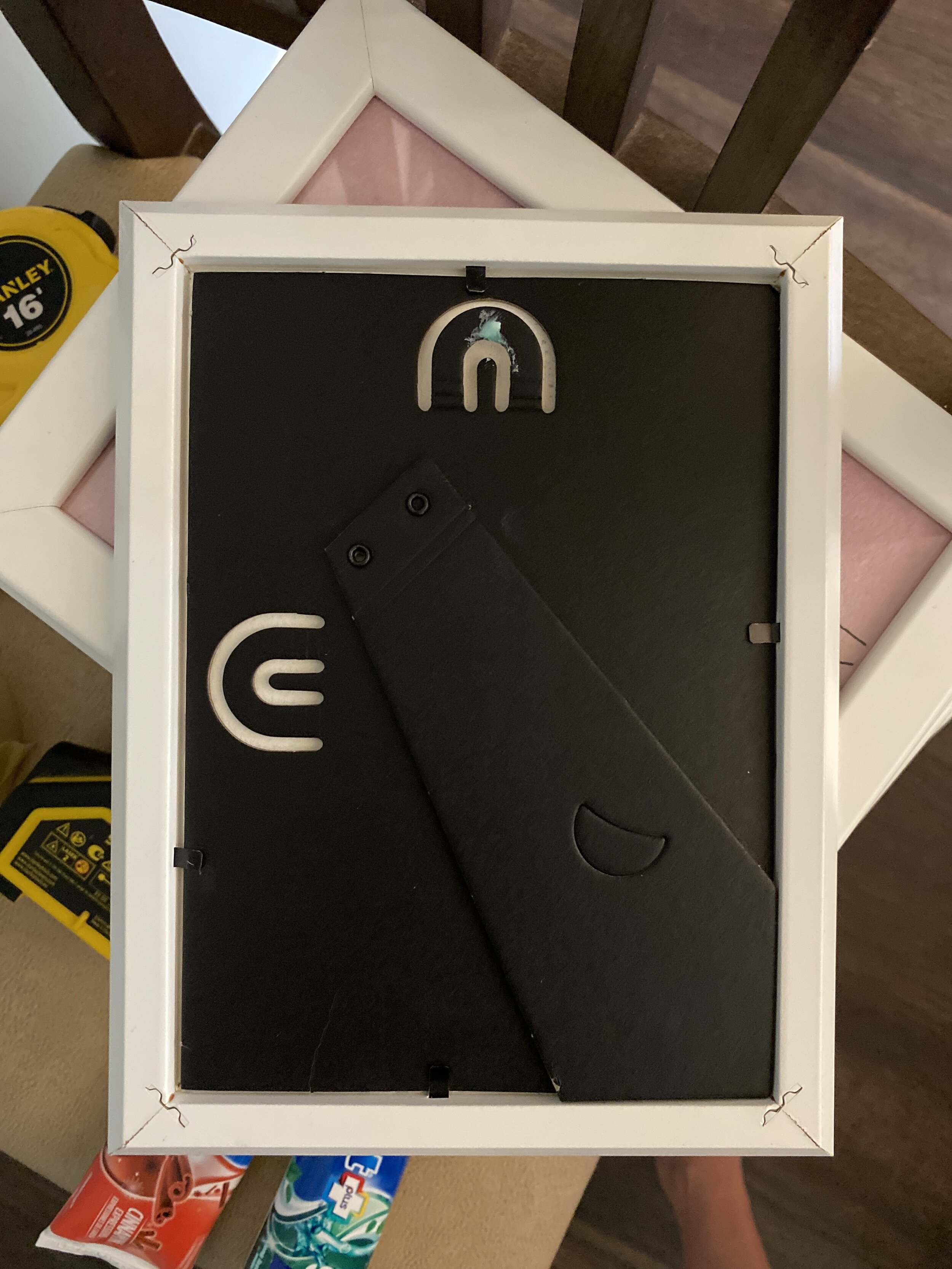
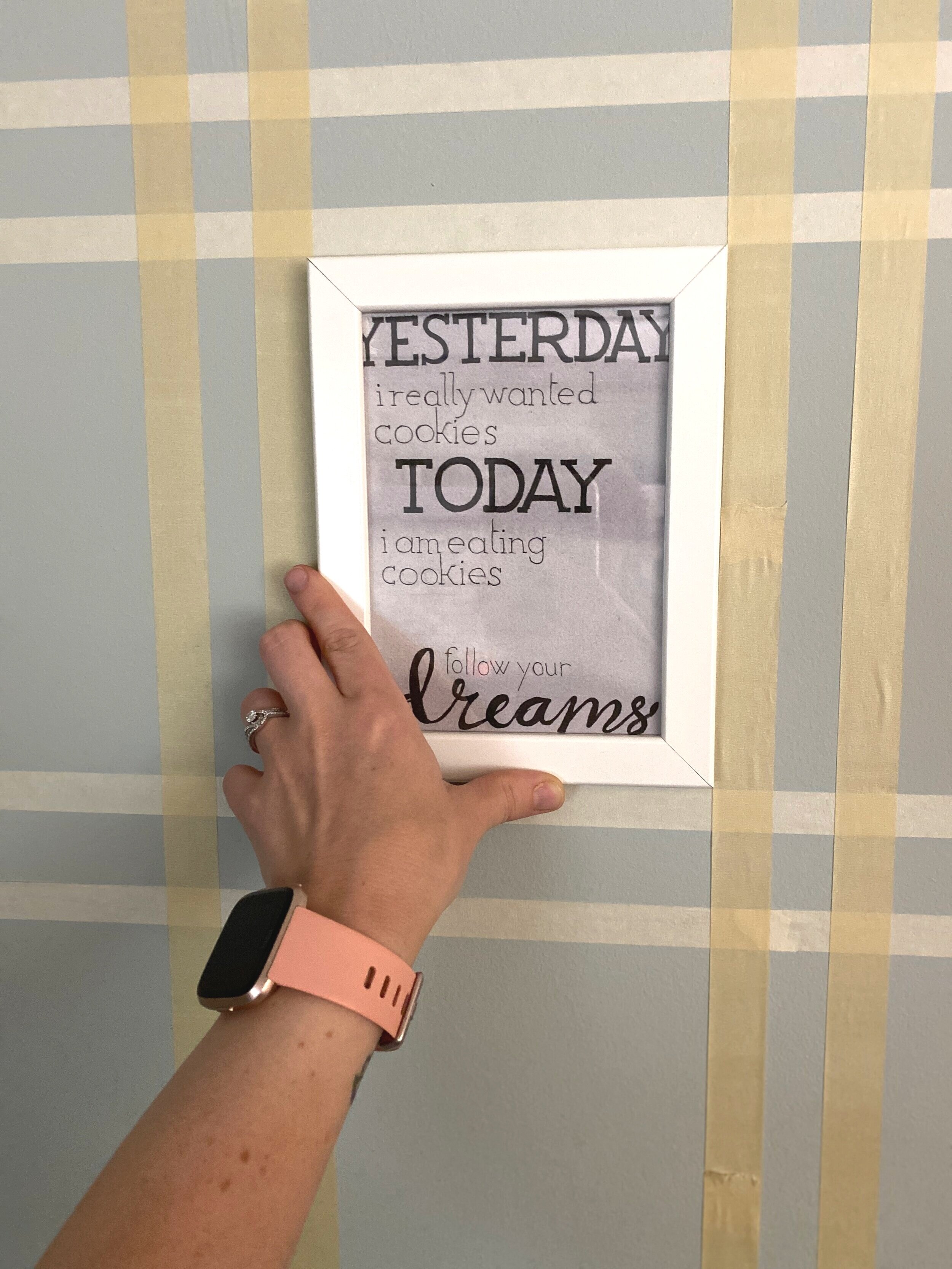
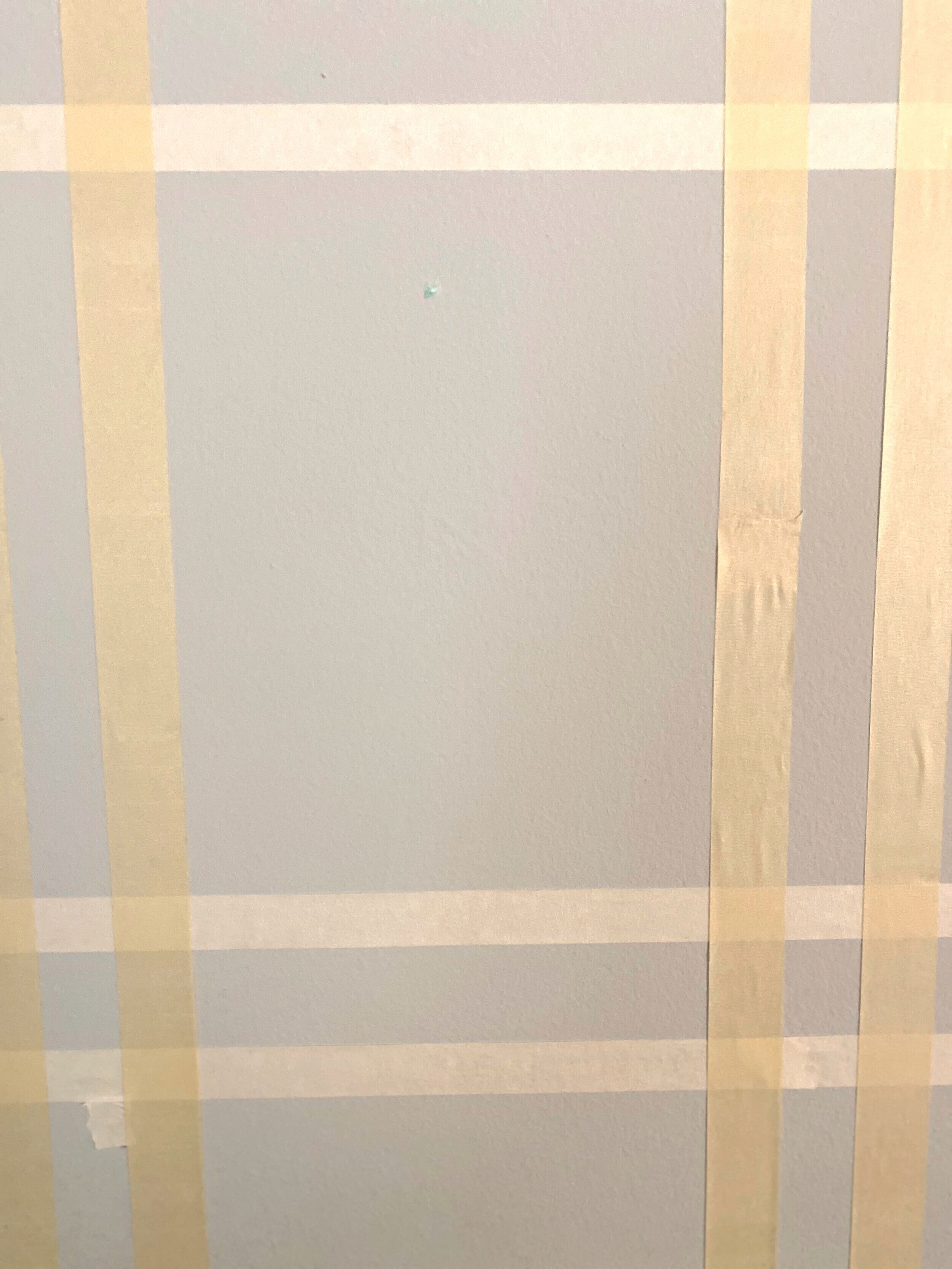
This is where the toothpaste comes into play! It’s such a simple trick that makes hanging pictures way easier.
Simply take your frame and put a dot of toothpaste on the hanger on the back. Then press it onto the corresponding template. This should leave a mark where you need to place your nail.
Level twice, nail once

Folks hanging asymmetrical layouts can skip this step. But if you have a symmetrical design, listen up!
I highly recommend breaking out your level once more before you commit to making a bunch of holes in your wall. I used a laser level to make sure all my toothpaste dots lined up vertically and horizontally, but a long, regular level will work too. If I found any that weren’t level, I leveled them and marked the new spot with a pencil.
Hang your pictures!

Alright, the moment you’ve been working toward… hang your dang pictures! You’ve taken the time to plan your design and mark where your nail holes should be. Now you can ACTUALLY nail them into the toothpaste dots you made and hang your pictures.
Bonus step: Secure your pictures

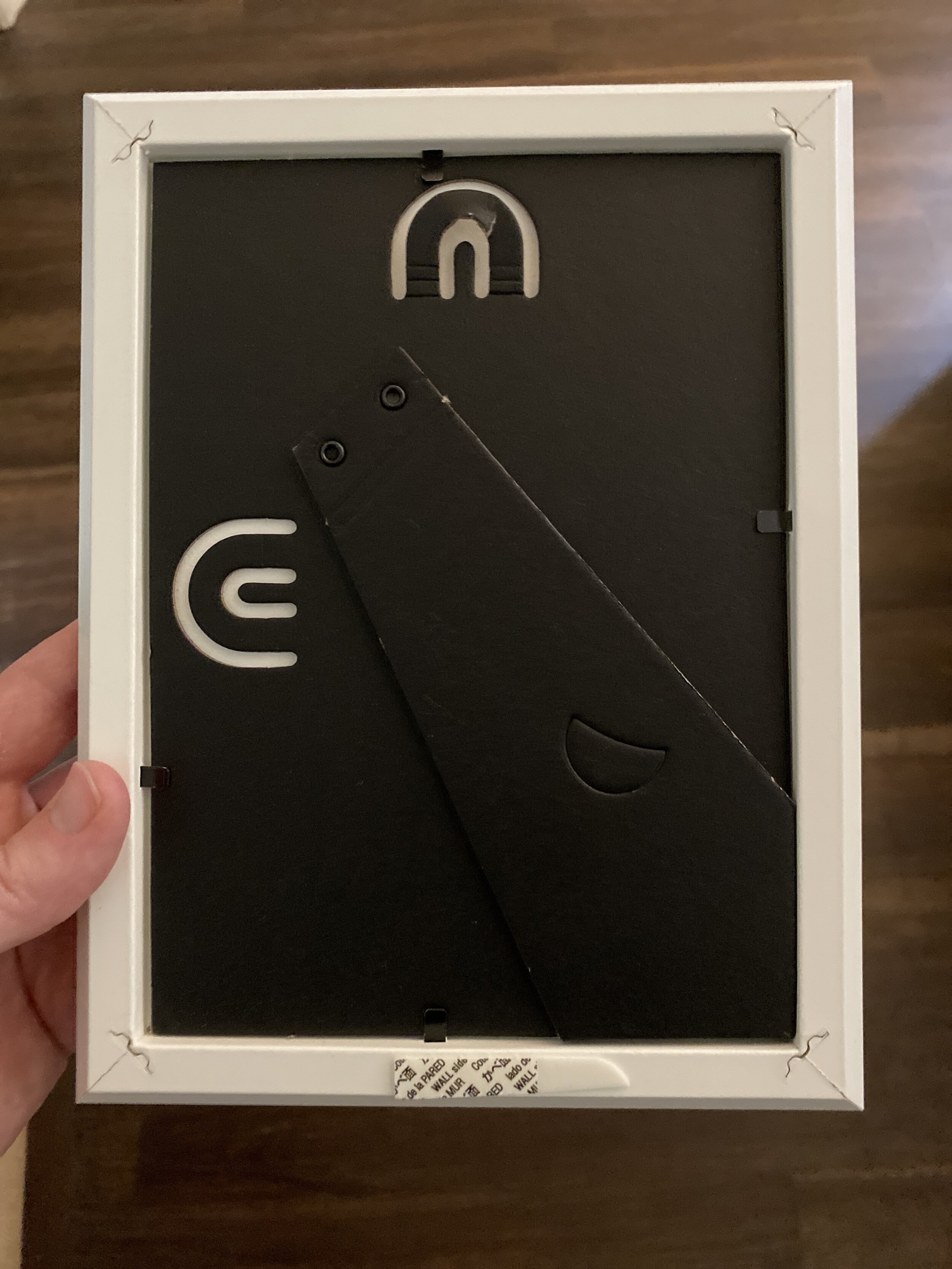
This isn’t required, but in a high traffic area like where my gallery wall hangs, this is a good tip.
Command Strips are your best friend here. I like to take a one, cut it in half lengthwise (a whole Command Strip will work too, but why waste them?), and stick it to the bottom of the back of my frame to hold it in place. That way, when someone inevitably grazes the frames as they walk by, they don’t shift them or knock them off the wall.
Final Thoughts About My Gallery Wall
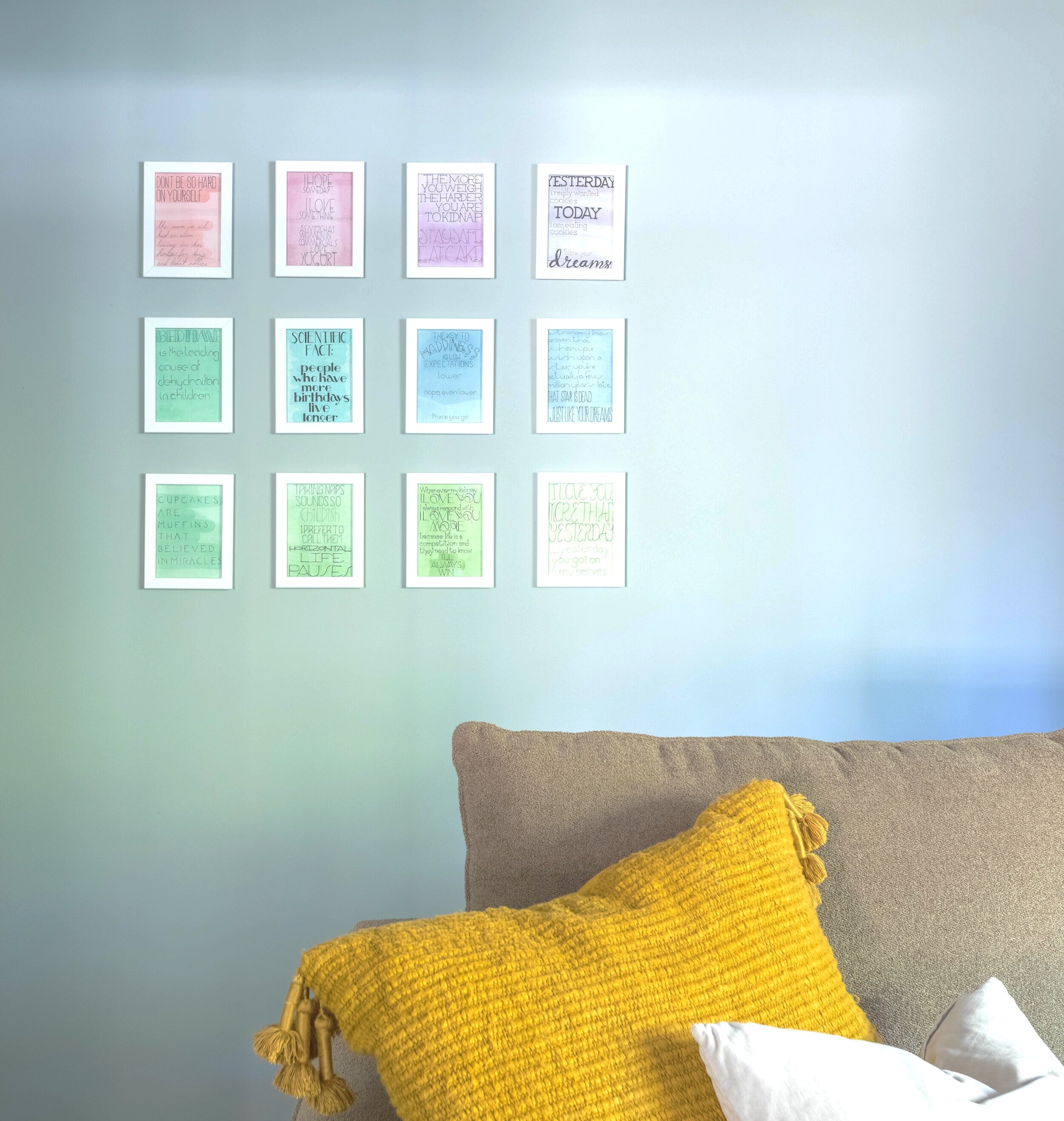
I’m loving having these pictures back up on the wall. They’re quirky and colorful and just add a bit of fun to the space. However, I admittedly should put them in larger frames with a nice white mat around them. There is more than enough space on this wall and the 4 x 6 frames they’re currently in cut off some of the text.
As I mentioned previously, I didn’t make these initially to create a gallery wall - that was just a happy coincidence. But now that they’ve become a focal point, why not make them the best versions of themselves they can be?
So, lucky for me, I’ll probably end up going through this whole process again before too long! In the meantime, there are PLENTY of other projects around the house to keep me busy - like our dining room renovation and master suite remodel. We’ve made good progress in both rooms and I’m looking forward to providing some updates really soon!
Related “How To” Posts
How to Hang a Gallery Wall (Without Creating Tons of Nail Holes!)

How to Pick the Right Size Lamp (Every Time!)
A lamp is a lamp is a lamp, right? WRONG. Although a lamp may easily serve its main purpose of lighting up a room, choosing the wrong size can really skew your design. But how do you pick the right size lamp? In this post, we’re going to talk all about how to choose the correct size table lamp, so you can select the perfect size lamp on the first try (and not try out a bunch like I did).
Choose the Perfect Size Lamp for Every Space
A lamp is a lamp is a lamp, right? WRONG. Although a lamp may easily serve its main purpose of lighting up a room, choosing the wrong size can really skew your design. But how do you pick the right size lamp?
You wouldn’t think picking out a lamp would be difficult, would you? I certainly didn’t… until I tried to pick one out for my desk.
As I was perusing my options, I quickly realized I have no clue how to choose the right size lamp! Standing in Target, I found myself with lamp paralysis, second-guessing every lamp I laid eyes on. (Don’t worry, I don’t think it’s contagious.)
You see, all these years, I’ve just been winging it. Sometimes I’ve bought the right size, but other times I’ve been way off base. But since I just ran into this issue, I figured other folks have likely had this conundrum before too - and that’s okay! There’s more to it than you’d think.
That’s why in this post, we’re going to talk all about how to choose the correct size table lamp, so you can select the perfect size lamp on the first try (and not try out a bunch like I did).
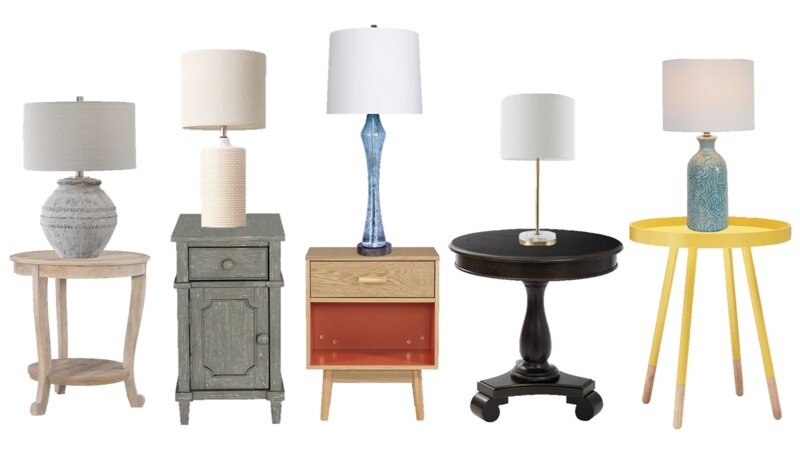
I’ve been researching this topic a ton, and I’ve learned that there are two main questions to consider: “what size lampshade do you need?” and “how tall should your lamp be?”. Simply picking out a lamp that’s pretty won’t cut it.
To buy the right lamp for your space, answering these two questions can make or break your room design. And the answer to both of these questions is more mathematical than I expected.
How to Choose the Right Size Lamp
Lamp base and shade requirements can vary depending on the room and what types of tasks are performed there. Height, width, and style all play an important role in choosing the best lamp for your space. And to demonstrate how these elements come into play, I’m going to regale you all with my astonishing photo manipulation skillz once again. You’re welcome.
Height
Height is one of the most involved factors in choosing the right lamp. Let me explain what I mean.
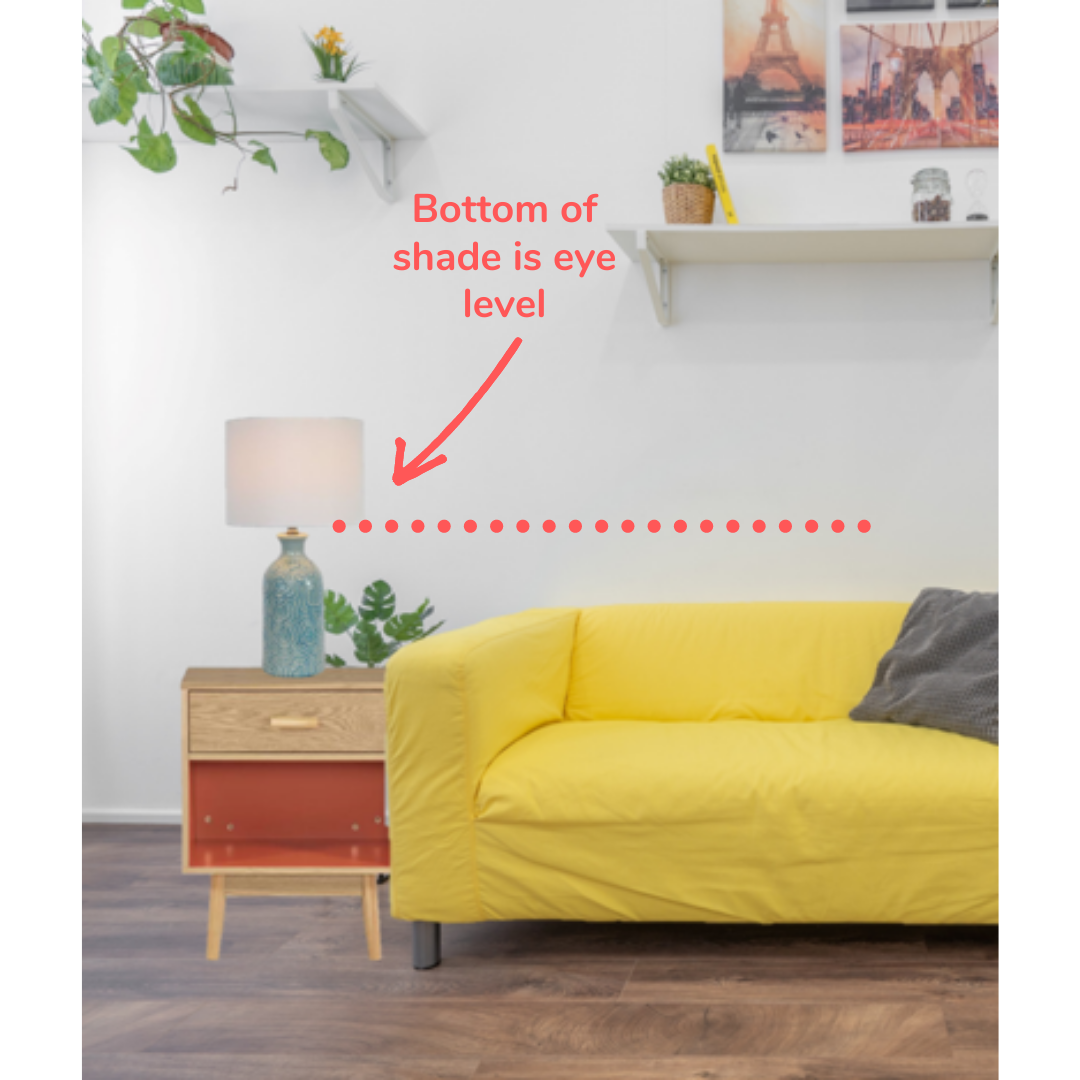
First of all, when considering the height of your lamp, you want to make sure that whatever surface your lamp is on, it isn’t so tall that it shines into your eyes. To prevent this, make sure the bottom of the lampshade is no higher than eye level. This should hide the glare from the light bulb and actually allow you to see. You’re trying to light the space - not blind yourself.
For example, in the image below, if you were to sit on the couch, the bottom of the lampshade should hit at or below eye level.
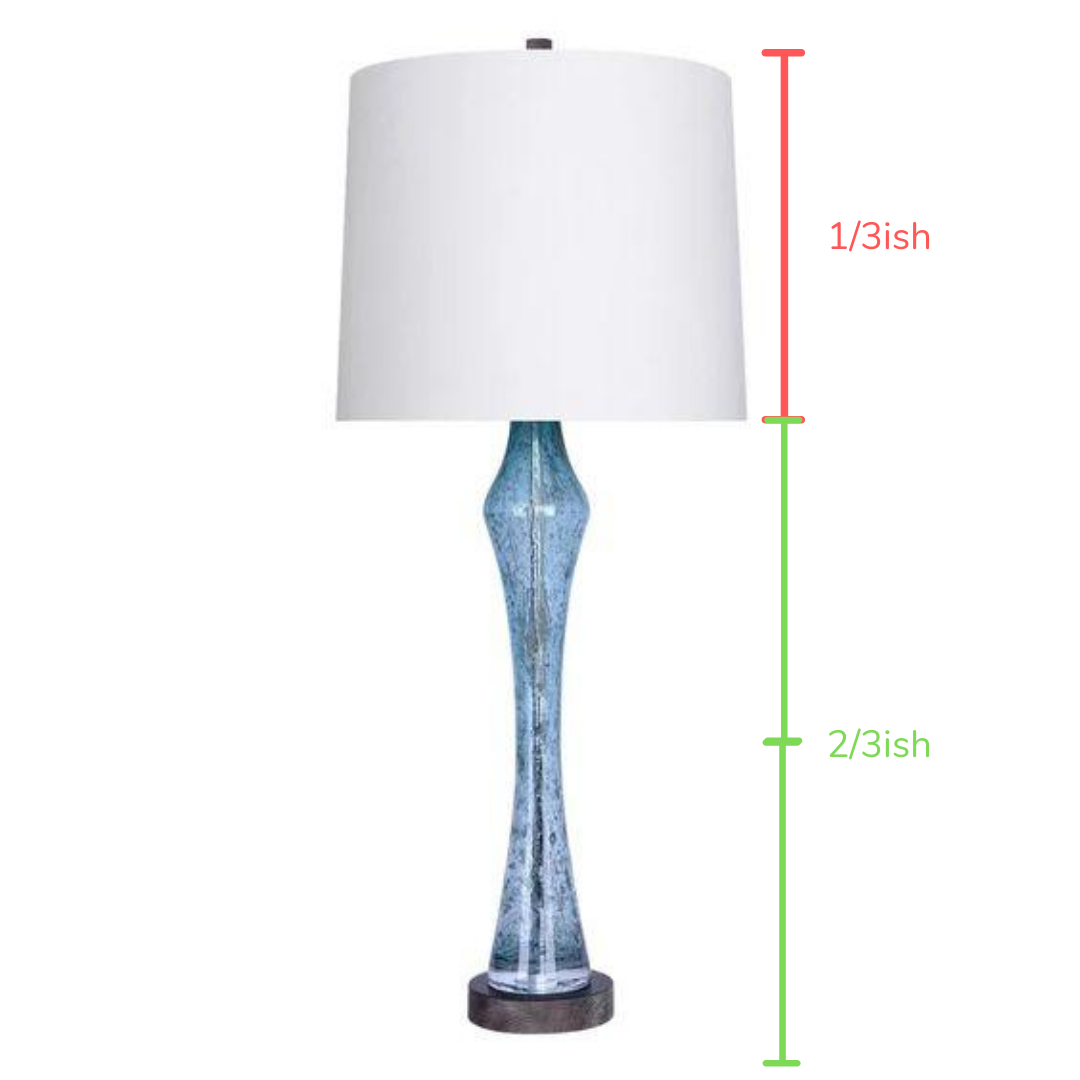
But you should also consider the ratio of the height of the shade to the lamp base. The shade should be approximately ⅓ the height of the entire lamp (including the bulb and/or harp). This means, if your lamp is 24 inches tall from base to bulb/harp, your shade should be around 8 inches tall.
I’m going to throw it out there up front - rarely will any base/shade combination have the perfect ratios, but as long as you’re within a couple of inches it’ll look fine. Take the below image for example. Although the shade is a little larger than 1/3 the size of the base, it’s close enough that it still looks okay.
Lastly, it’s a good idea to consider the scale of the table your lamp is sitting on in relation to the lamp base. If you had a small end table and a giant lamp, it would certainly look (and probably be) top-heavy, and vice versa!
As a rule of thumb, consider that your lamp should be a maximum of 1.5 times the height of your table.


Width
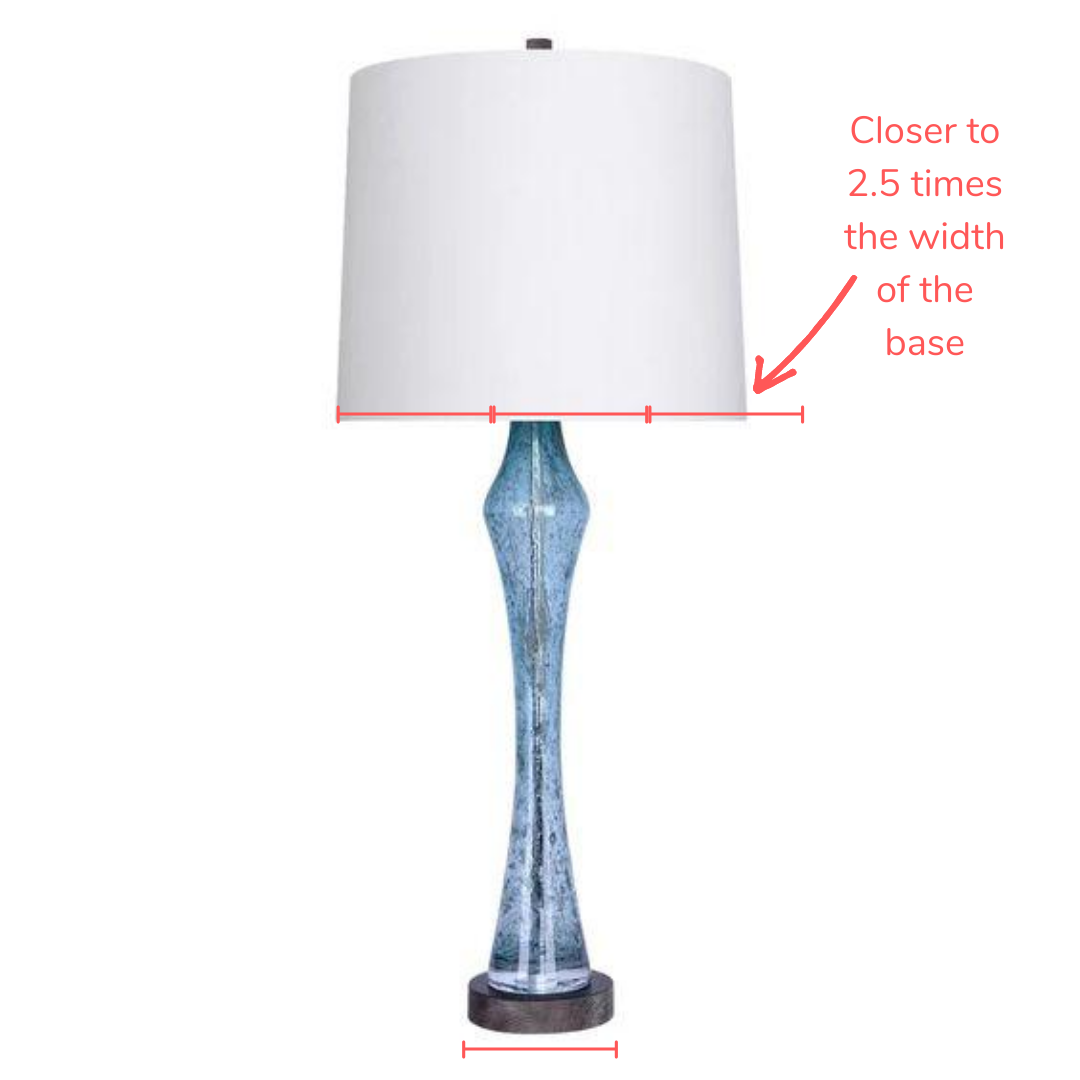
To make things more complicated, it’s also advised that the measurement across the bottom of the shade should be twice as wide as the diameter of the base of your lamp.
For example, if the base of your lamp is 6 inches wide, the bottom of your lampshade should be 12 inches wide (give or take an inch or two). For a square or rectangular lamp base or shade, measure diagonally.
But don’t give up yet! In the example below, you can see how that measurement isn’t exact. Remember - within an inch or two is close enough! No one is going to take a tape measure to your lamp - and if they do, do you really want that person in your house anyway?
One other, more straight-forward aspect to lamp width: you should also consider the width of the table your lamp is sitting on and make sure your lampshade is no wider than the table. This not only looks better but also helps prevent it from being accidentally knocked over.

Style
The last element of picking the right lamp is definitely the most intuitive, least math-involved (yay!), and dare I say most important? Simply enough, you want your lamp to “go” with the style of the table it’s sitting on (say whaaat?).
For instance, if you have a big, chunky table, you can probably get away with a big, chunky lamp. But a super skinny lamp (even if it was tall) would look odd.
I would also think about the style of not only the table but the entire room. Your lamp is essentially a functional design element - have fun with it - but make sure it fits the space.


Summary
I know I just threw a lot of information at you, so here are the main points:
The bottom of the lampshade should be no higher than eye level.
The lampshade should be approximately ⅓ the height of the entire lamp (including the bulb and/or harp).
Your lamp should be a maximum of 1.5 times the height of the table.
The shade should be twice as wide as the diameter of the base of the lamp.
The lampshade should be no wider than the table it sits on.
Your lamp should “go” with the style of the room.
Choosing a Lamp for my Office
So, following these rules, was I FINALLY able to find a lamp for my office? Well, allow me to tell you the story of my little lamp adventure.
Of course a few weeks after I posted about the DIY Sharpie wall in my office, I learn that I have the completely wrong-sized lamp in there!

Granted, I want to save some face by saying that a) I’ve always felt like something was “off” with this lamp but never quite knew what and b) I stole this lamp from our bedroom because I needed one in my office in a hurry. It was never meant to be permanent. Excuses aside, I figured it was a prime example of what not to do when choosing a lamp. And here’s why:
Mistake #1: The biggest no-no here, and the reason I now realize why this lamp has always felt “off”, is the giant lampshade. It’s half the height of the lamp! And it’s probably 3 times as wide as the base.
Mistake #2: I know the desk looks pretty in the picture above, but in real life, I have my giant desktop up there and it feels CROWDED. This lamp is way too big to be functional in this space.

Mistake #3: I know I mentioned above that this lamp was a temporary fix, but to really drive the point home I think it’s important to point out the mismatching styles going on. First of all, the wall is so busy that the lines on the lampshade almost make you dizzy. And second, the style of the base is a little more traditional than this room can handle.
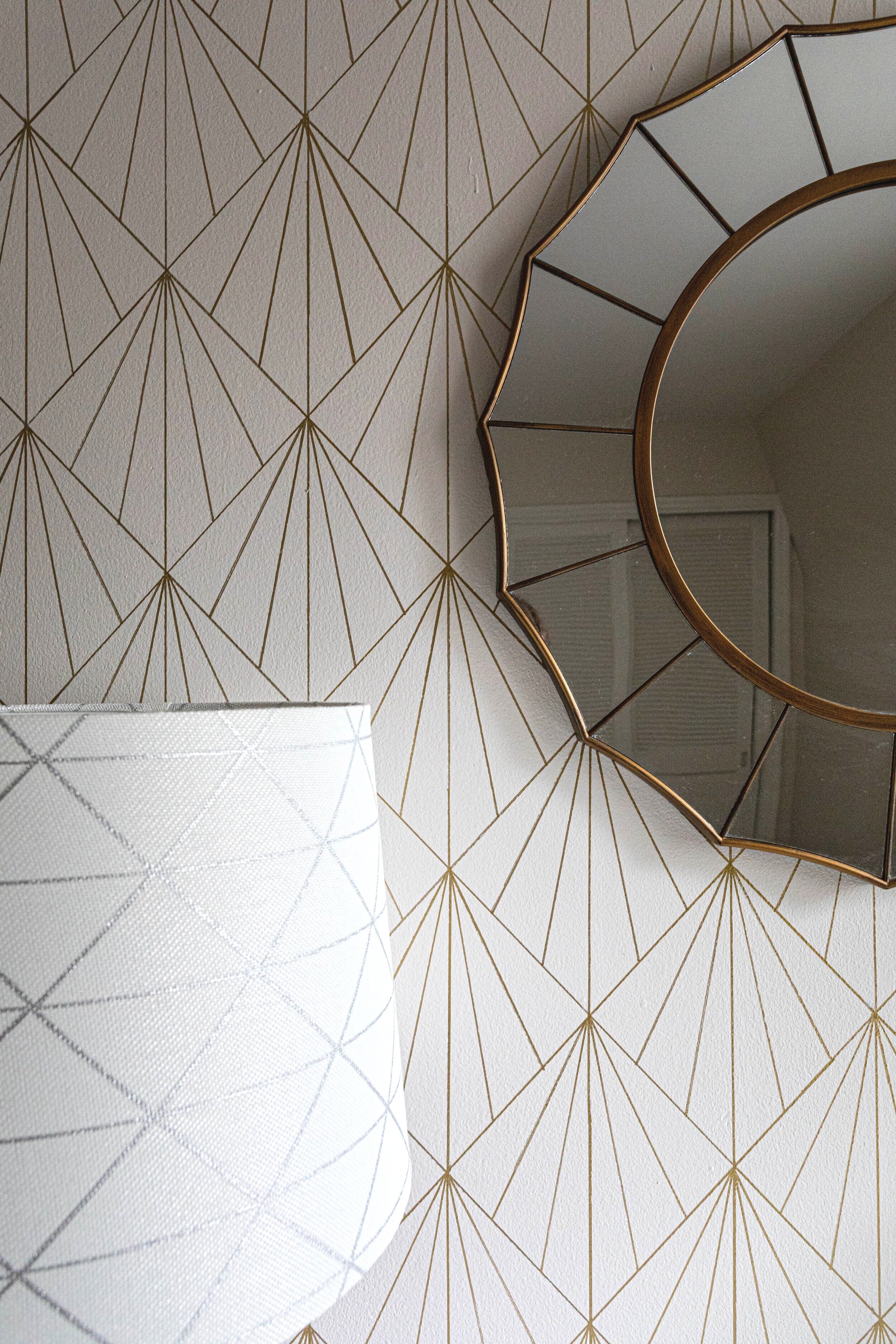
So while I was in Target on my lamp replacement adventure, I picked up this cutie, fully unsure of my purchase because I hadn’t yet written this post and learned all this valuable information! I came home and plopped it on my desk and had a couple realizations…
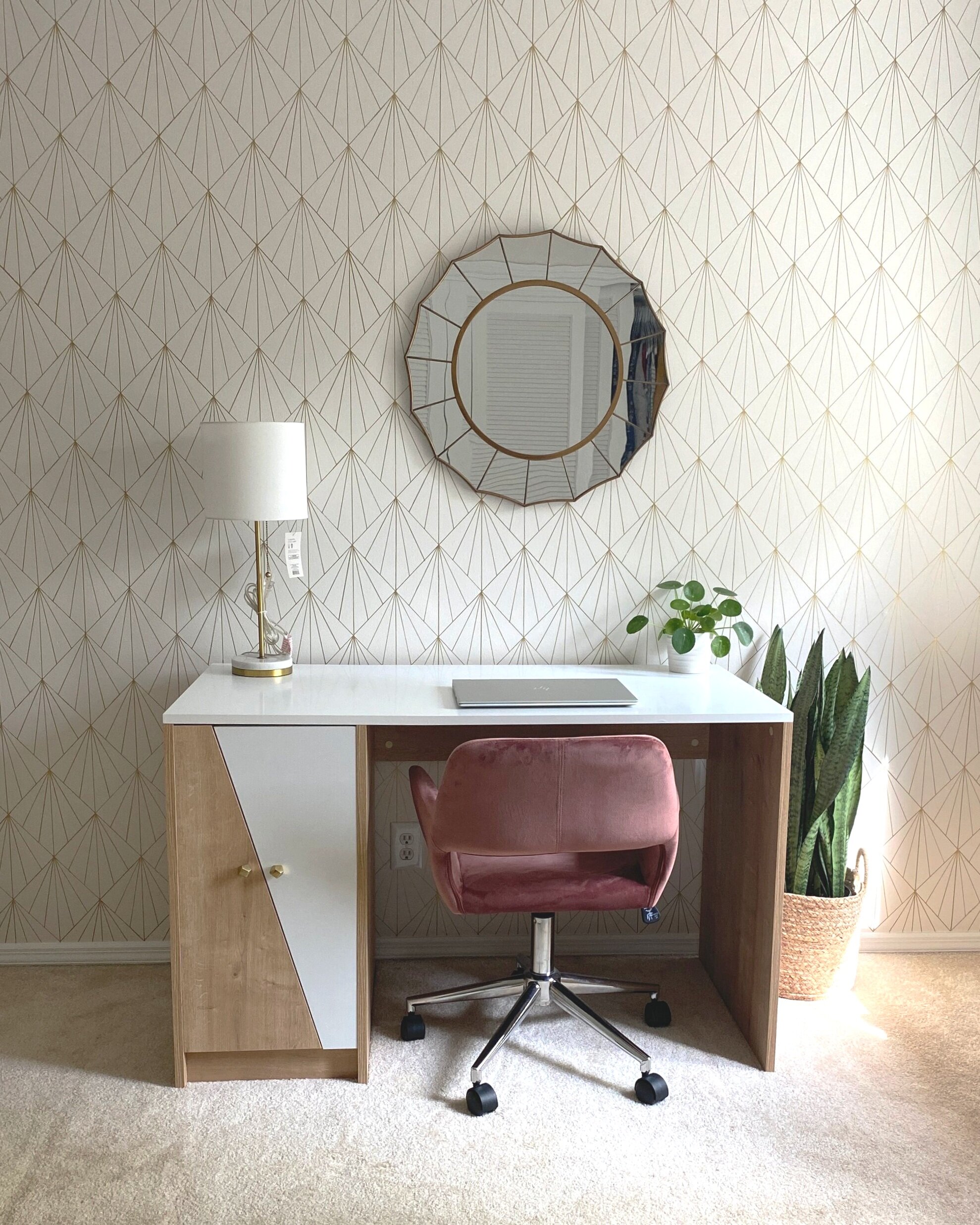
Remember earlier when I mentioned scale as an important element to consider? This is why.
While the style was okay (there are a lot of gold/blonde wood tones going on though), this lamp was way too dainty for this space. I could immediately tell I needed something bulkier.
And just to see if another size lamp that I already had would work better, I borrowed a lamp from one of my daughter’s rooms.
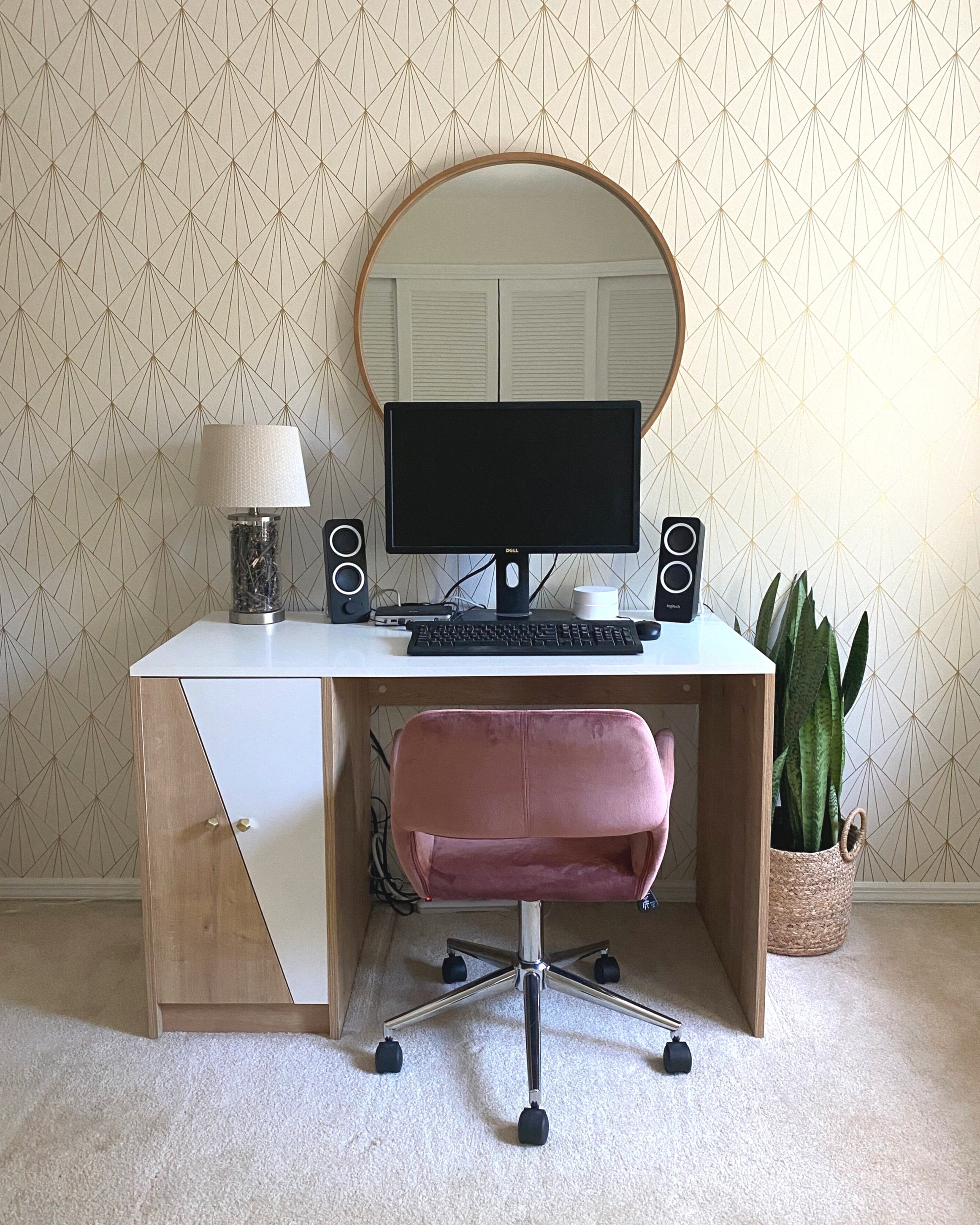
Right away it was glaringly obvious it wasn’t tall enough. At this point I started to feel a little like Goldilocks and started researching the correct lamp size… and a blog post was born. (Isn’t she beautiful!?)
Now, you may be wondering that since I’m putting the lamp on a desk why I didn’t just buy a desk lamp. And the answer is simply: I didn’t want to. A desk lamp would be fine, but I was more drawn to the table lamps so that’s what I went searching for.
So taking the information I learned about lamps, I took another stab at it and found this beauty!
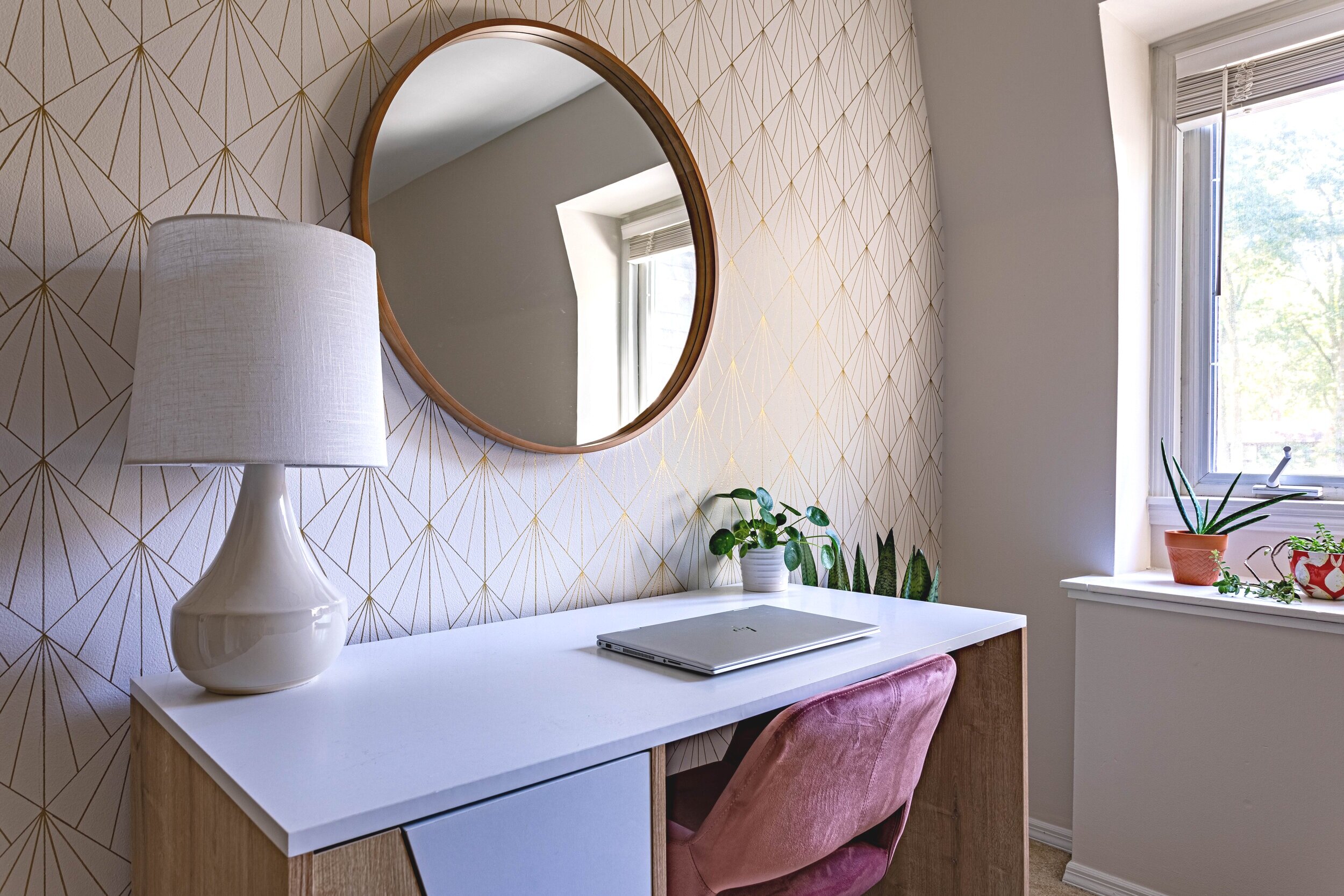
She’s the whole dang package.
The new lamp is weighty enough to ground the space, but not so big I bump into it all the time. It’s also a perfect height, and lastly, the style suits this room. The colors go well with the surrounding decor and the curved but sharp edges of the silhouette are a great contrast to all the straight lines on the wall and the angled line in the doors of the desk.
And remember how I mentioned above that style may be the most important factor? This is a perfect scenario because although the lampshade is pretty tall for this base, it “goes” with the style and makes sense. I think the fact that it’s a skinnier shade helps.

And here’s how the new lamp looks with my desktop. Because the lampshade isn’t so big, I have a few more inches of wiggle room so hopefully I don’t bump into this one all the time.

Who knew anyone could write so much about a friggin’ table lamp? But here I am! And I hope you were able to take away some valuable info to help round out your spaces.
Now, I’m going to go sit down by the warm glow of my beautiful new lamp and birth a new post. Ew… forget I said that…
If you enjoyed this post, you may also like:
How to Select the Perfect Size Lamp Every Time
How to Reupholster Dining Chair Seats
I recently took a little break from the current projects around the house I’ve been working on to reupholster the chairs in our eat-in kitchen - and wrote a little tutorial so you can do it too! This is a quick and easy upgrade that seriously anyone can do!
Easy DIY - Recover Your Chairs
I recently took a little break from the current projects around the house I’ve been working on, like redesigning my home office (HERE and HERE), updating the dining room (HERE and HERE), and remodeling our master suite (HERE and HERE), to reupholster the chairs in our eat-in kitchen - and wrote a little tutorial so you can do it too! This is a quick and easy upgrade that seriously anyone can do!
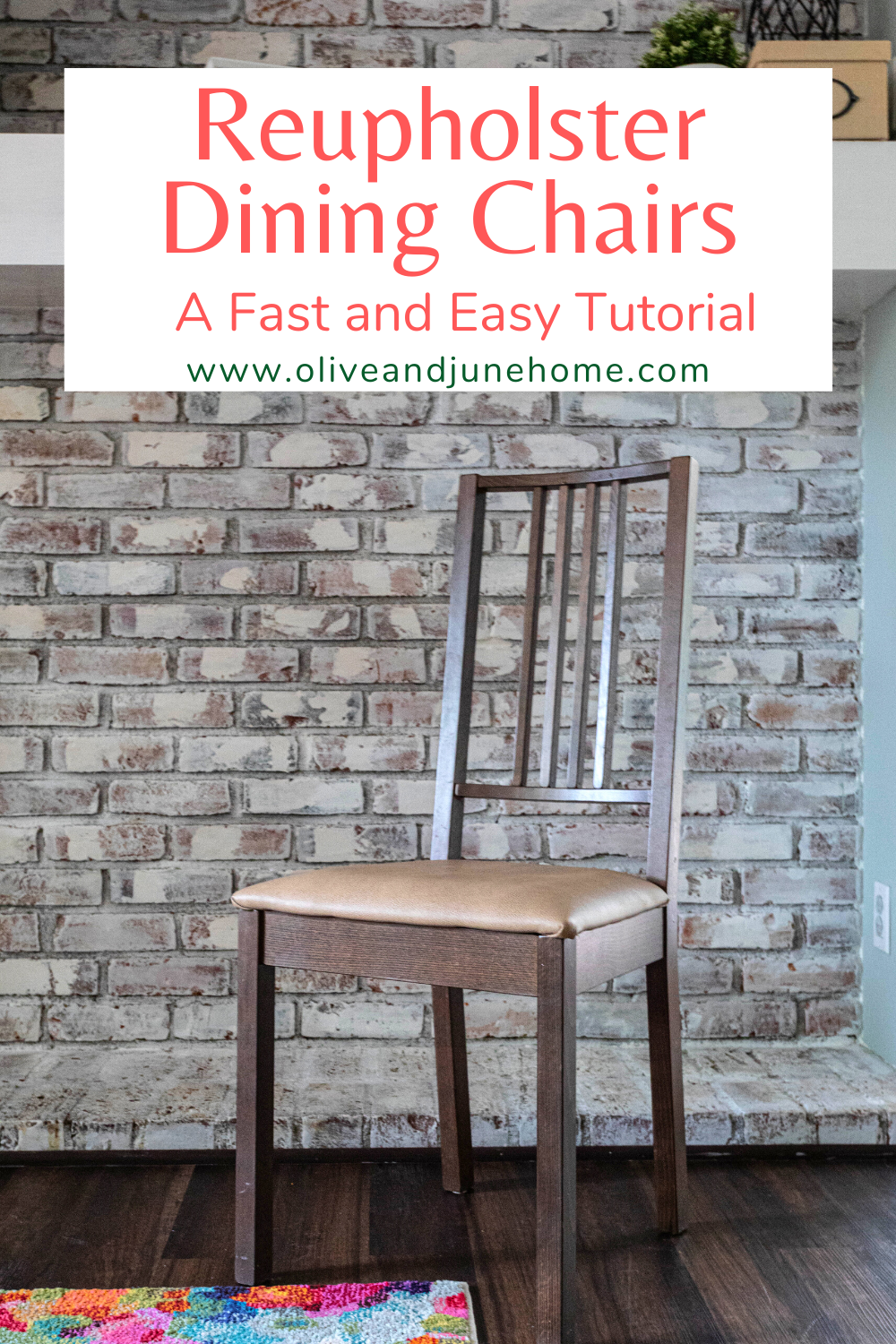
We bought the table and chairs in our eat-in kitchen from IKEA about 8 years ago when we bought our first house… and they have served us well! Unfortunately, the white cloth covers the chairs came with have seen better days (i.e. days before we had kids). I considered sharing a picture, but they were so stained and kinda embarrassing, so I decided not to. Just imagine two little kids eating and you get the idea.
I actually soaked the covers in OxiClean not that long ago and was pleasantly surprised by how clean they got. Then I stupidly put them back on the chairs and our four-year-old immediately dropped steak on hers. The next day, our one-year-old pulled a bowl of cereal on another one. It was a lost cause. So I’ve decided to reupholster them in a kid-friendly, wipeable vinyl fabric. Here’s how I did it:
Materials

As an Amazon Associate, I earn from qualifying purchases. This post may contain affiliate links, meaning I receive commissions for purchases made through those links, at no cost to you.
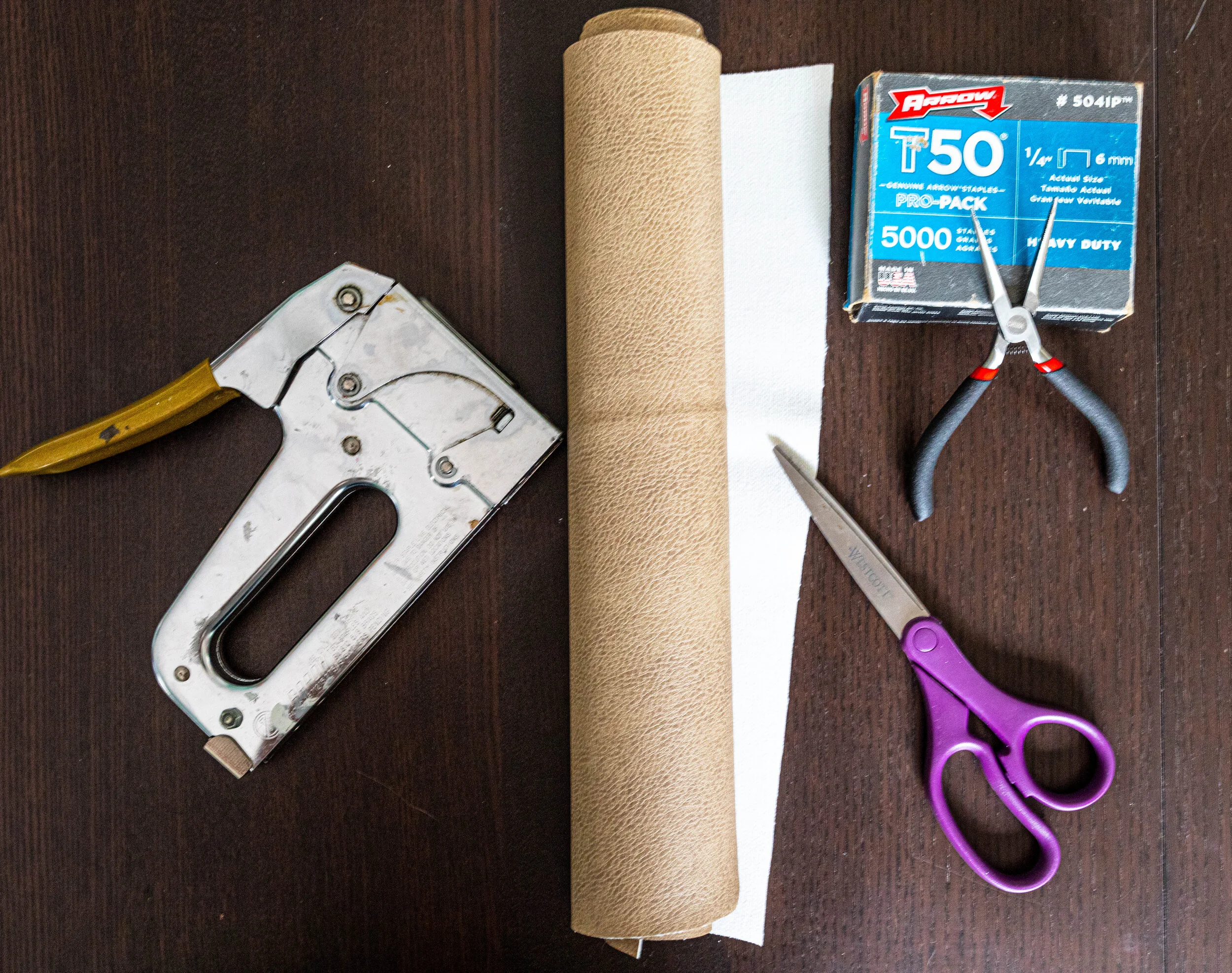
- Needle nose pliers
- Upholstery foam
- Batting
- Fabric - my seats are about 16 x 17 inches and 2 yards of fabric was way more than enough
- Staple gun
- Staples (1/4 inch)
- Scissors
- Chair (obviously)
- Box cutter (optional)
Step 1 - Remove Existing Covers
Since these chairs came with removable covers for easy cleaning (#thanksIKEA), I just unscrewed the seats and took the covers off. More than likely though, you’ll need to remove the fabric of your chairs by pulling out the staples with your needle nose pliers.
Step 2 - Cut Your Foam, Batting, and/or Fabric
Next, if you’re replacing the foam, lay the seat on top of a piece of foam and trace around it. Then using your scissors or a box cutter, cut it out - taking care to NOT cut into your floor or table.
Now, you’ll need to cut your batting (if it needs to be replaced) and fabric. I don’t actually measure anything when I’m reupholstering a chair. I just take the seat, lay it face down, and make sure I can pull the batting/fabric over the edge so that I have enough available to staple.
You don’t want a TON of excess fabric. It’s unnecessary and will just get in your way. Don’t go nuts here - just cut as much as you need to staple.
Once I have an idea of how much fabric I need, I cut it out. You can use this first piece as a template for your other seats.

Tip: If you’re using a patterned fabric, make sure you’re cutting your fabric with the design lined up the direction you want it on your seats.
If you’re replacing the batting, you can do one or two layers to give your seat more cushion. I recommend cutting your first layer for all the seats, stapling those down, then cutting your second layer, and following the same steps. Once that’s complete, follow the same process with your fabric. This will ensure you’re giving yourself enough excess batting/fabric to staple to the underside of your seat.
Step 3 - Staple
Now that you’ve cut your fabric, you can staple it to the seat. I’m going to share the process I use here that I was actually taught in college when I learned how to stretch canvas for my paintings. It helps ensure that your fabric is stretched equally all the way around the seat.
Tip: If you’re using a patterned fabric, you’ll need to be sure you’re pulling your fabric equally on each side as you staple so you don’t skew the design.
1. Start by placing one staple in the middle of one side of the seat (1). On the side opposite of that, put another staple (2). Then do one staple on each of the other two sides, rotating the seat as you go (3 & 4).

2. From here, to the far left of one of your staples, place another staple (1). On the opposite side of the seat, do that again (2). Then do the same on each of the other two sides (3 & 4).

3. Follow step 2 but starting on the far right of each side of your seat.

4. Follow step 2, but place a staple between the middle and far left staples on each side.
5. Follow step 3, but place a staple between the middle and far right staples on each side.

My seats were small enough that 5 staples on each side were sufficient. If your seats are larger, you’ll want to use more staples - shoot for 1 every couple of inches - using the same idea of the steps above.
You’ll likely see the fabric pucker as you add your staples - and that’s okay! It just means you’re pulling your fabric taut.

Step 4 - Corners
Once you have your edges stapled, you can work on the corners. I suggest gathering the fabric and trimming some of it off.
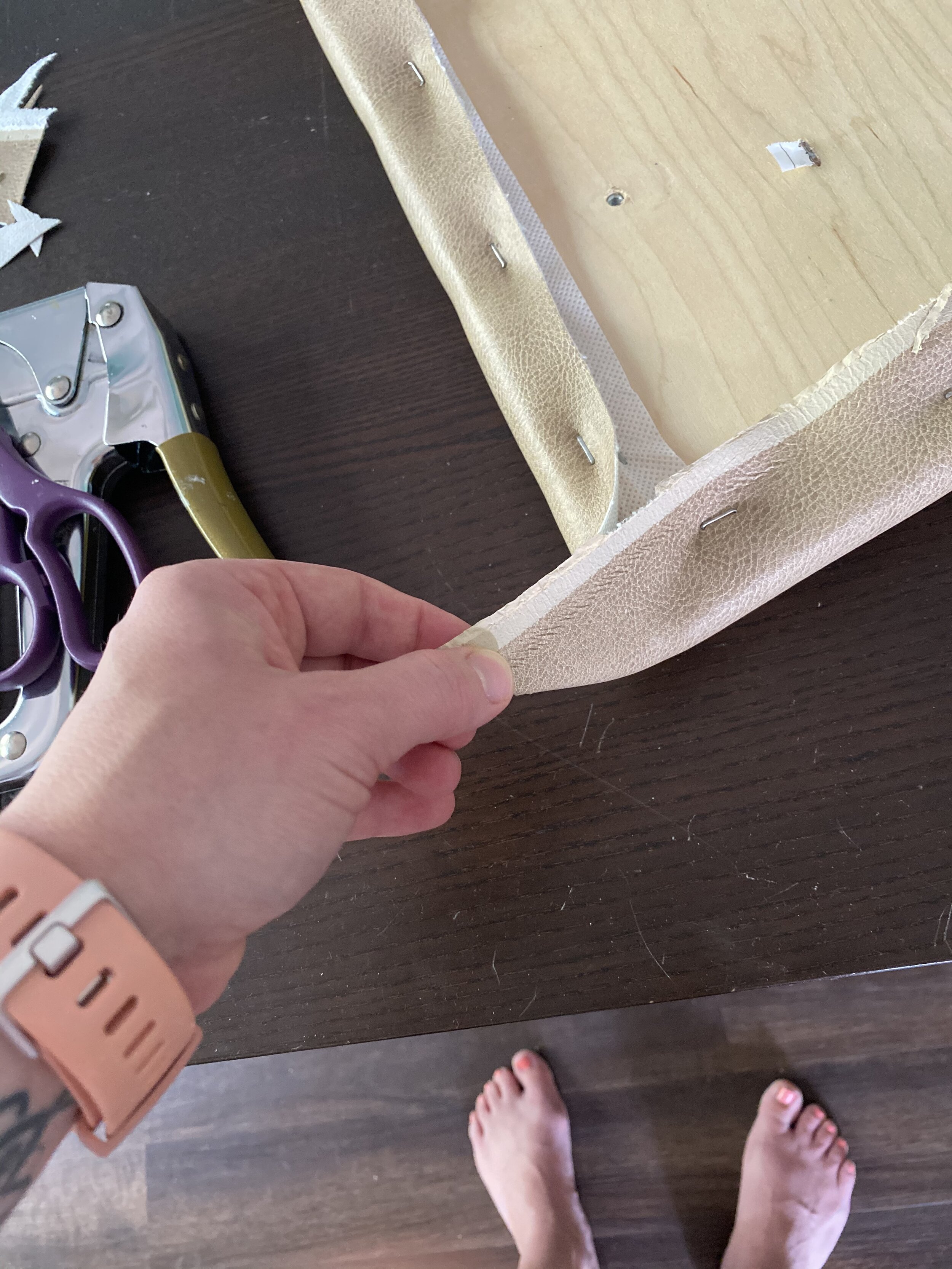
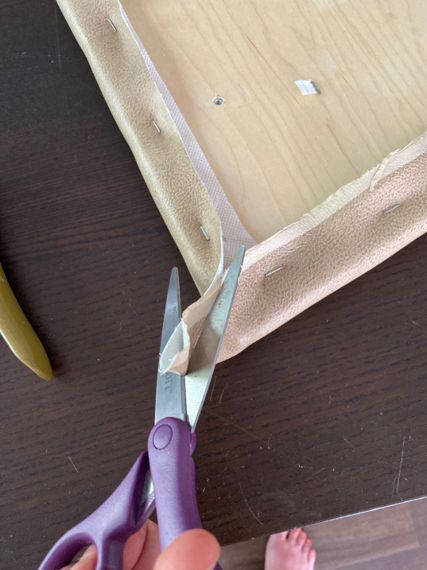
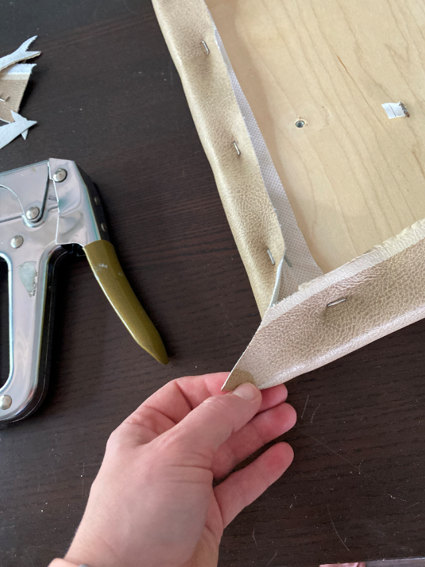
Then you can wrap your fabric around the corner and staple it down.
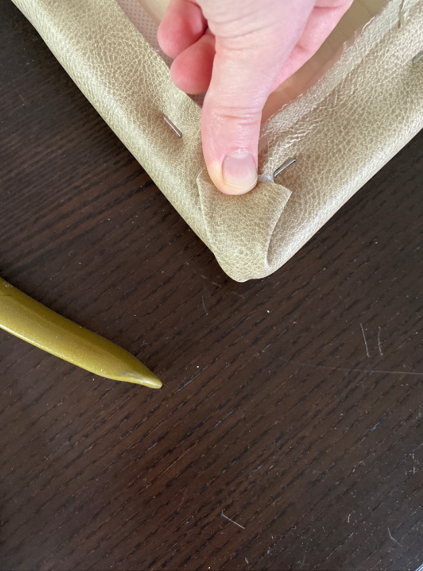
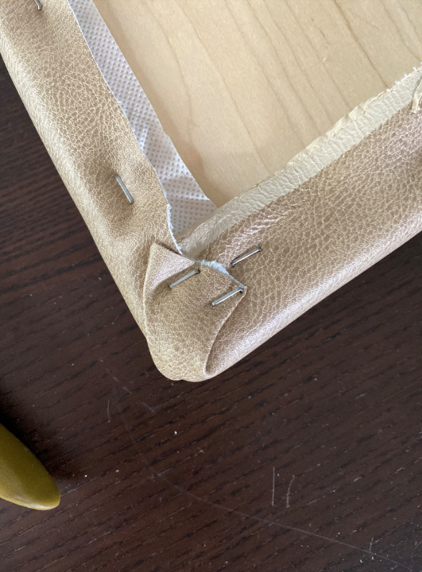
Tip: When you’re placing your fabric on the corner, keep in mind where you want the crease to hit. It doesn’t really matter if it’s on the front or the sides of your seat, but you want to be consistent.
Step 5 - Trim and Secure
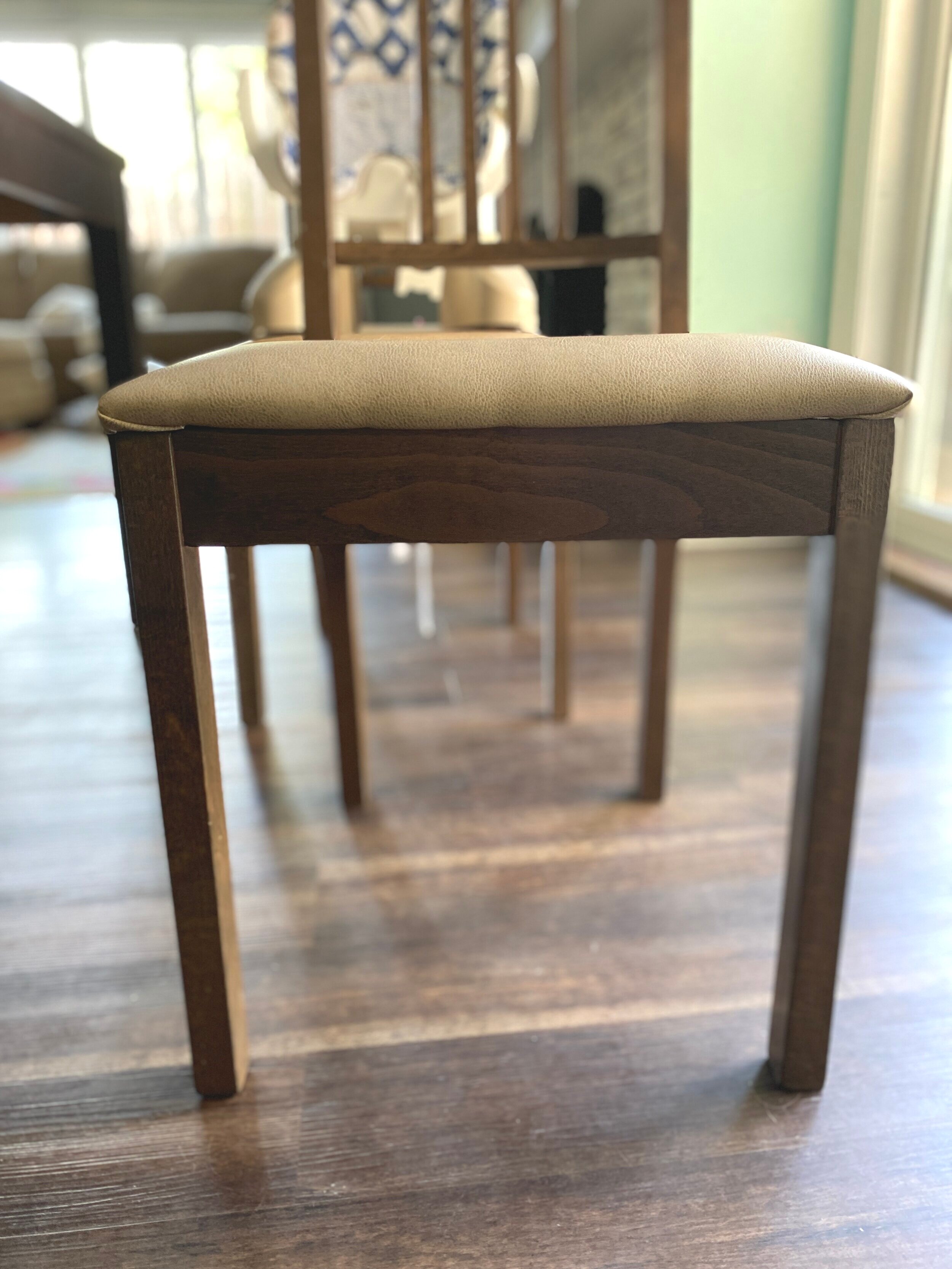
At this point, your seats should be reupholstered! But all that work is kind of pointless if you don’t actually attach them back on the chairs. If you find yourself with some excess fabric, especially if it’s covering the holes you’ll use to screw the seat back onto the chair, trim the excess off.

Then, all you have left to do is screw your seats back on and enjoy!

Just look how happy I am in my newly reupholstered chair!
I’m very happy with the wipeability of my new seat covers, although admittedly I don’t looove the color. I was hoping to find a white vinyl - something that would pop a little more - but unfortunately, this was the lightest color I could find. However, The fact that this dining set blends in with the flooring bothers me so much I’ve been considering painting the table and chairs anyway, so that project might be on the horizon!
In the meantime, I’ll continue to see the silver lining in being able to easily clean off the chairs. Hope this tutorial was helpful for you!
For more easy DIYs, check out the posts below:
Revamp Your Dining Chairs

Chandelier and Area Rug Roundup + Dining Room Mood Boards!
Now that the DIY Sharpie wall in my office is complete, and while we’re waiting for materials for the master suite to arrive so we can start rebuilding, I feel like I can finally turn my focus back to the dining room.
I’ve developed a pretty good vision of how I want it to look, but, as I’ve mentioned before, I’m very indecisive. So, I put together some mood boards of the dining room with different lighting and area rug combinations to help quell my indecisiveness. And MAN, did I get nerdy with it.
This post may contain affiliate links, meaning I receive commissions for purchases made through those links, at no cost to you.
Now that the DIY Sharpie wall in my office is complete, and while we’re waiting for materials for the master suite remodel to arrive, I feel like I can finally turn my focus back to the dining room.
I’ve developed a pretty good vision of how I want it to look, but, as I’ve mentioned before, I’m very indecisive. So, I put together some mood boards of the dining room with different lighting and area rug combinations to help quell my indecisiveness. And MAN, did I get nerdy with it.
But before I jump into the mood boards, I wanted to share with you a roundup of affordable chandeliers and rugs that I’ve considered for this room - and that you might enjoy too!
RELATED: If you want to see how this room started, visit these posts HERE and HERE.
Chandelier Roundup
All of these chandeliers are below $250 except for numbers 11 and 13, which are just a hair over $250, but they’re so beautiful so I had to include them - plus, number 11 is a steal since it’s 40% off right now!


1 / 2 / 3 / 4 / 5 / 6 / 7 / 8 / 9 / 10 / 11 / 12
I feel like I need to state that although I love all the light fixtures and rugs above, Lucius does not. He’s really not a fan of Sputnik light fixtures, so numbers 2 and 4 were an immediate no-go, and I’m still trying to win him over on Oriental rugs. That’s one of the challenges of decorating with a significant other - you have to think of their style too.
As with most projects, including this one, I tend to narrow down my favorite items using Pinterest and then show them to Lucius so he can tell me which ones he hates the least. Using that process, most of the time we can come to an agreement pretty easily! #winwin
A couple of quick notes before I share the mood boards:
The dining room set I have in these mood boards isn’t our exact set, but it is similar in style and color, so I figured it was a good placeholder.
I’m using a paint color similar to what was used in my inspiration picture, so I just used that image as the background in my mood boards.
I have specific requirements for dining room rugs - mainly that they can help hide stains because kids + food = alllll the stains. That being said, I mostly went for patterned and/or colorful rugs that would hide/camouflage some of those inevitable stains.
And lastly, I didn’t create a mood board for all the light fixtures and area rugs - that would be crazy. But I was tempted! Instead, I created them for just some of the combinations until I felt like I was getting a clearer picture of how I want the room to look.
Okay? Okay! And now for the fun part…
Dining Room Mood Boards
Option 1 - Oriental Rug/Industrial Chandelier

Pros: Although incorporating oriental rugs into our house is one of the design struggles I have with Lucius, even he agreed that he didn’t hate this one. Even though it has some geometric shapes, it’s a softer, distressed finish and I think that allows it to work with the lines in the accent wall, rather than compete against them. I also like how modern and contemporary the chandelier is and how it ties the different design elements together.
Cons: The carpet is on the dark side, which makes me nervous since the dining table and the laminate in the rest of the room are pretty dark. I’d like to lighten the space up some.
Option 2 - Oriental Rug/Farmhouse Chandelier

Pros: I think the farmhouse style can be done really beautifully, but it’s just not my jam. However, I’m really drawn to this light fixture. And of course, I love me an Oriental rug.
Cons: There’s a LOT going on with this combination. The pattern on the rug is too defined and definitely competes with the wall. Also, it’s still darker than I’d like. Additionally, I think the lines in the chandelier compete with the lines in the wall as well.
Option 3 - Abstract Rug/Geometric Chandelier

Pros: Although I’m really trying to find a way to get an Oriental rug to work in this room, this abstract rug makes me really happy. I think it’s the bright pop of gold/yellow that seems like it really brightens up the room. Plus, that light fixture is gorgeous!
Cons: I’m concerned that the rug will have too much blue in it in real life and will clash with the call color. I also have some hesitations about the light fixture being a little too geometric for the space.
Option 4 - Oriental Rug/Farmhouse Chandelier

Pros: I’ve been swooning over this rug forever, but just haven’t found a place in our home that it makes sense. I love the colors and design. And I actually think the pink/orange color in it goes nicely with the green accent wall. The chandelier I think helps pull out some of the curved lines in the rug and the color ties in nicely with the dining set.
Cons: Lucius hates both the rug and the chandelier - but sometimes I like to throw ideas out there even if I think he’ll hate them - sometimes he doesn’t! (Most the time he still does.) And honestly? This combination just doesn’t catch my eye as much as I thought it would.
Option 5 - Oriental Rug/Brass Chandelier

Pros: I’m loving the contrast that the bright rug and brass chandelier bring to this space. And I actually think the pattern of the rug and the curves of the chandelier work nicely against the straight lines in the accent wall.
Cons: I’m still trying to win Lucius over as far as incorporating brass into our house goes. I’m not quite there yet (don’t worry - I’ll wear him down), so this light fixture was definitely a no-go. Besides that, we currently have very little orange in our house decor so bringing in such a bold rug would be tricky without adding more orange throughout the house.
Option 6 - Oriental Rug/Brass Wagon Wheel Chandelier

Pros: I LOVE this light fixture. The more I look at it the more I like it. I love how the curves in the chandelier break up the straight lines in the wall and brass/oil rubbed bronze finish adds some more dimension. The rug is pretty but…
Cons: I actually don’t like the rug in this space at all. I’m not fond of the purple in the rug next to the green in the walls and I think there are way too many areas without a pattern that would definitely not hide food stains.
Option 7 - Abstract Rug/Industrial Chandelier

Pros: I had to try out another abstract rug, and I’m actually liking this one quite a bit too! It’s a lot brighter than a lot of the other rugs I’ve looked at, which would be great in our dining room since it can be pretty dark sometimes. The chandelier is also pretty great. I love the curved lines and the brass/oil rubbed bronze combination.
Cons: I worry a little that this rug has more blue than green, which could look weird against the accent wall. As for the chandelier, I’m not sure I can convince Lucius to go with it.
Final Thoughts
There are ENDLESS combinations that I could have put together, but I know eventually I have to just make a decision and run with it. We’re still working on reinstalling the trim and installing the accent wall so I have a little time, but while I continue thinking it over, I’d love to hear which option or combination you like most! Let me know if the comments! Who knows? Maybe you can sway my opinion.
Related Dining Room Renovation Posts

Master Suite Remodel - A Change in (Floor) Plans
I posted two weeks ago about our master suite remodel, including what we had demoed and the new floor plan. After that post, we were finally able to take some time and officially tape off the floor to REALLY get a feel for how the space would work. Unfortunately, we quickly realized there were some issues that we had to solve for.
Master Bedroom Renovation
Well, that was a quick change in plans…
I posted two weeks ago about our master suite remodel, including what we had demoed and the new floor plan. After that post, we were finally able to take some time and officially tape off the floor to REALLY get a feel for how the space would work. Unfortunately, we quickly realized there were some issues that we had to solve for.

Before we get into the problems we encountered and how we’re working with and around them, as a quick refresher, this is what our master looked like before demo.
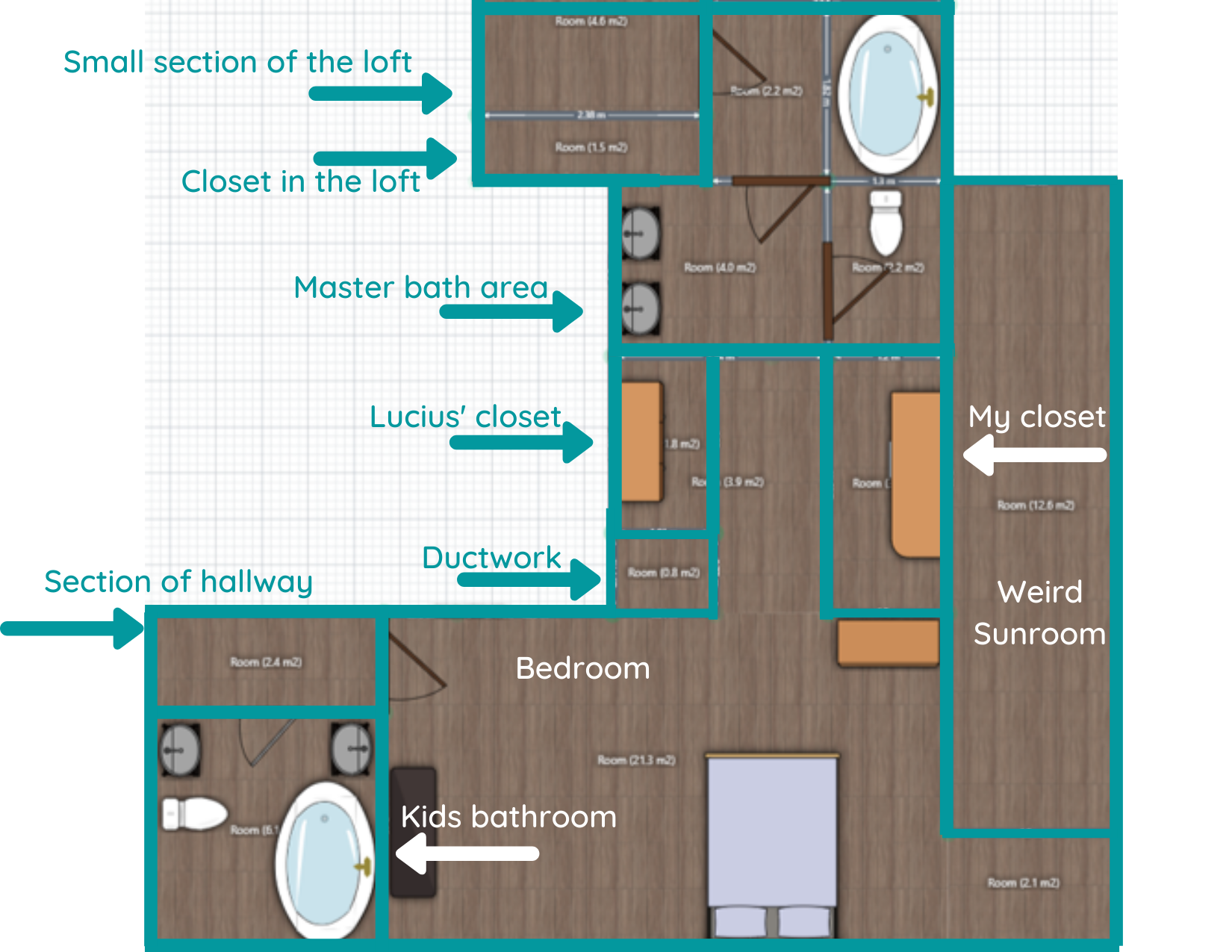
This was the floor plan we originally mocked up for our renovation.

And this is our NEW new floor plan.
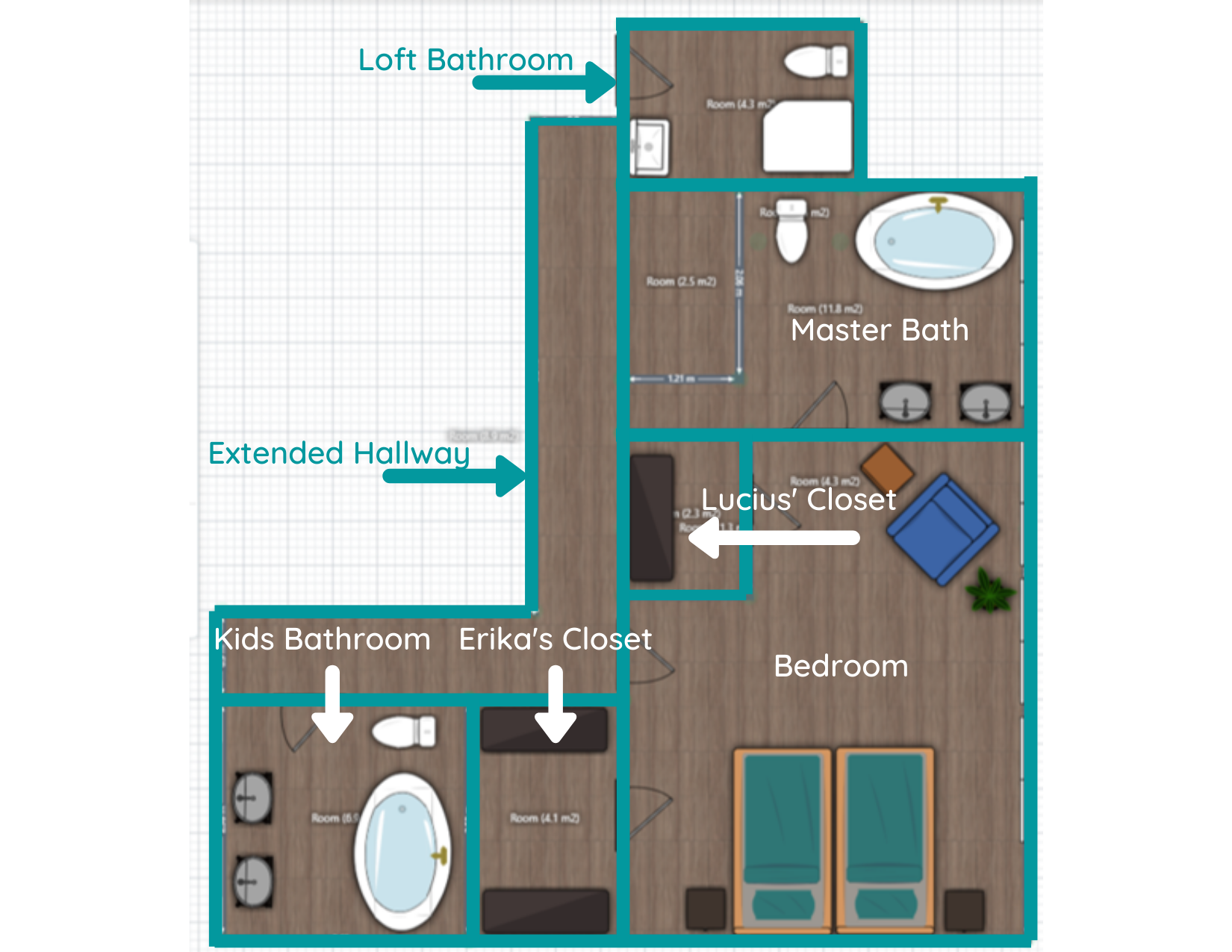
The biggest change is that the large, walk-through closet is being moved and split into two smaller closets. My closet will be where we were planning on moving the laundry room and Lucius’ closet will be separated and placed in the same vicinity that we originally planned to put our big joint master closet.
All caught up? Okay, now let’s get into the why we’re making this change!
I Suck at Measuring
Cut me some slack here - the floor planner I used had me converting meters to feet for every measurement!
Anywho, once we taped it out, I noticed that the space I envisioned as a laundry room would have been much smaller than what I was originally thinking. I could still make it work with the amount of space we would ACTUALLY have available to us, but I wouldn’t have been able to include the counter space I was hoping for, and that was definitely part of the appeal!

Not only that, but I mentioned in my previous post about this remodel that we didn’t know what we’d do with the current laundry room once we moved it upstairs. We could turn it into storage, but it would be a somewhat awkward space. Besides, Lucius didn’t seem too pumped up about the thought of moving the laundry room upstairs anyway.
While it’s a little bit of a bummer for me to have to lug the laundry up the stairs when it’s done (or, more realistically, continue to listen to Lucius complain about having to do it), we’re compromising by putting in a laundry chute!
Lucky for us, the current laundry room is right below our master suite area, so it shouldn’t be a big deal to install while we have all the walls opened up anyway. We had a laundry chute at our last house and LOVED it. Plus, the kids get a kick out of it too. Now, if only we could figure out where to install a dumbwaiter….
Window Placement
I love natural light, and this space has FIVE generously sized double windows.

Because the original layout was so weird with that sunroom/loggia built into the house, we were never able to really take advantage of the windows before. While we would have had access to more of the windows with our first layout design, we would have had to remove some of them to put up the walls for the closet.
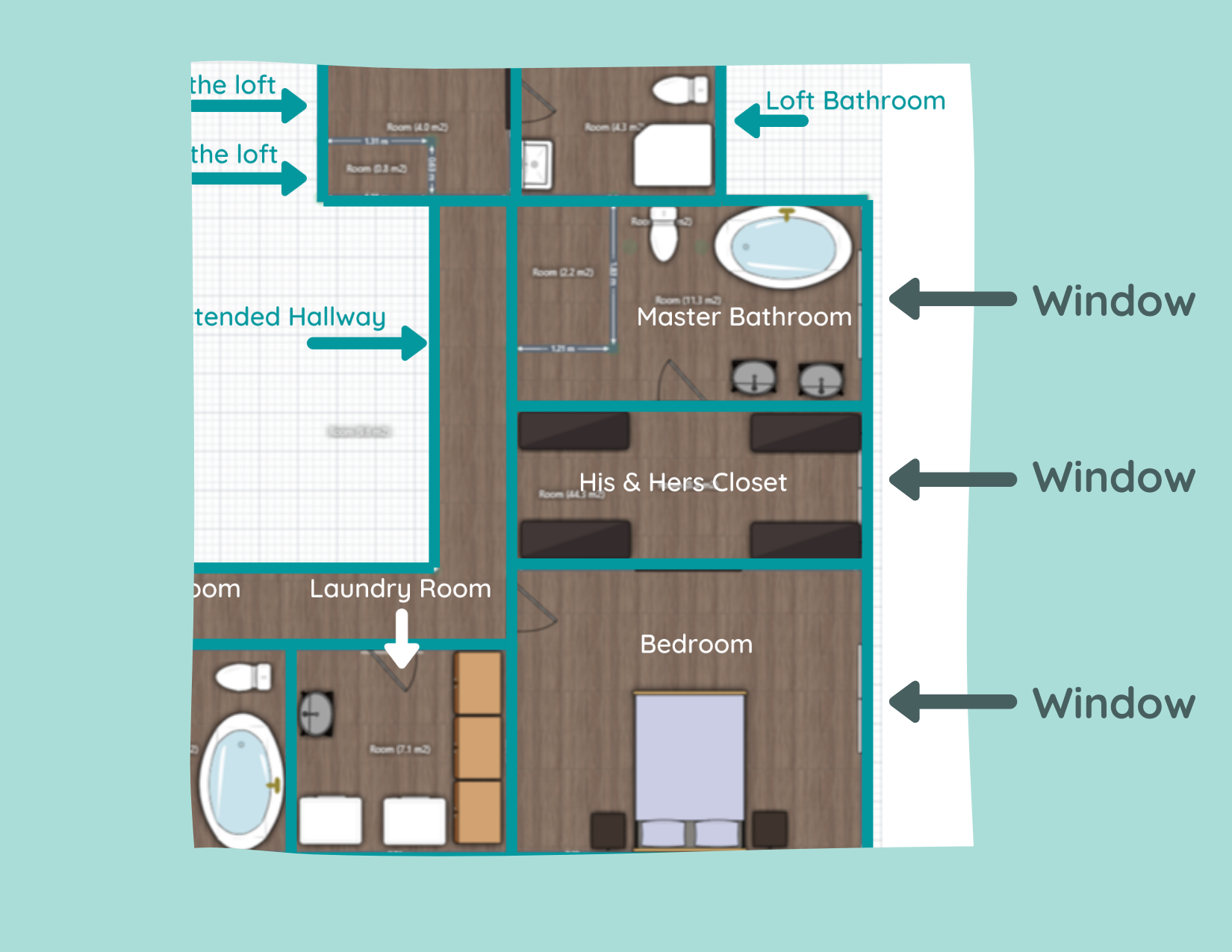
This concerned me for more than one reason: 1) I didn’t want to lose the natural light! and 2) the cost and all the unknowns about removing windows had me a little nervous.
But our new layout allows us to keep ALL the windows! Both Lucius and I are pretty happy about that. Especially me. I can just picture myself curled up on the floor with the cats in a big patch of sunlight. Mmm… livin’ the dream.

“Blah” Master Bedroom Floor Plan
With the previous floor plan, the only furniture in the bedroom would have been our bed and nightstands. While we were originally planning on having a large doorway to the walk-through closet to make it feel more integrated with the bedroom, it still seemed like it was going to be pretty boring.
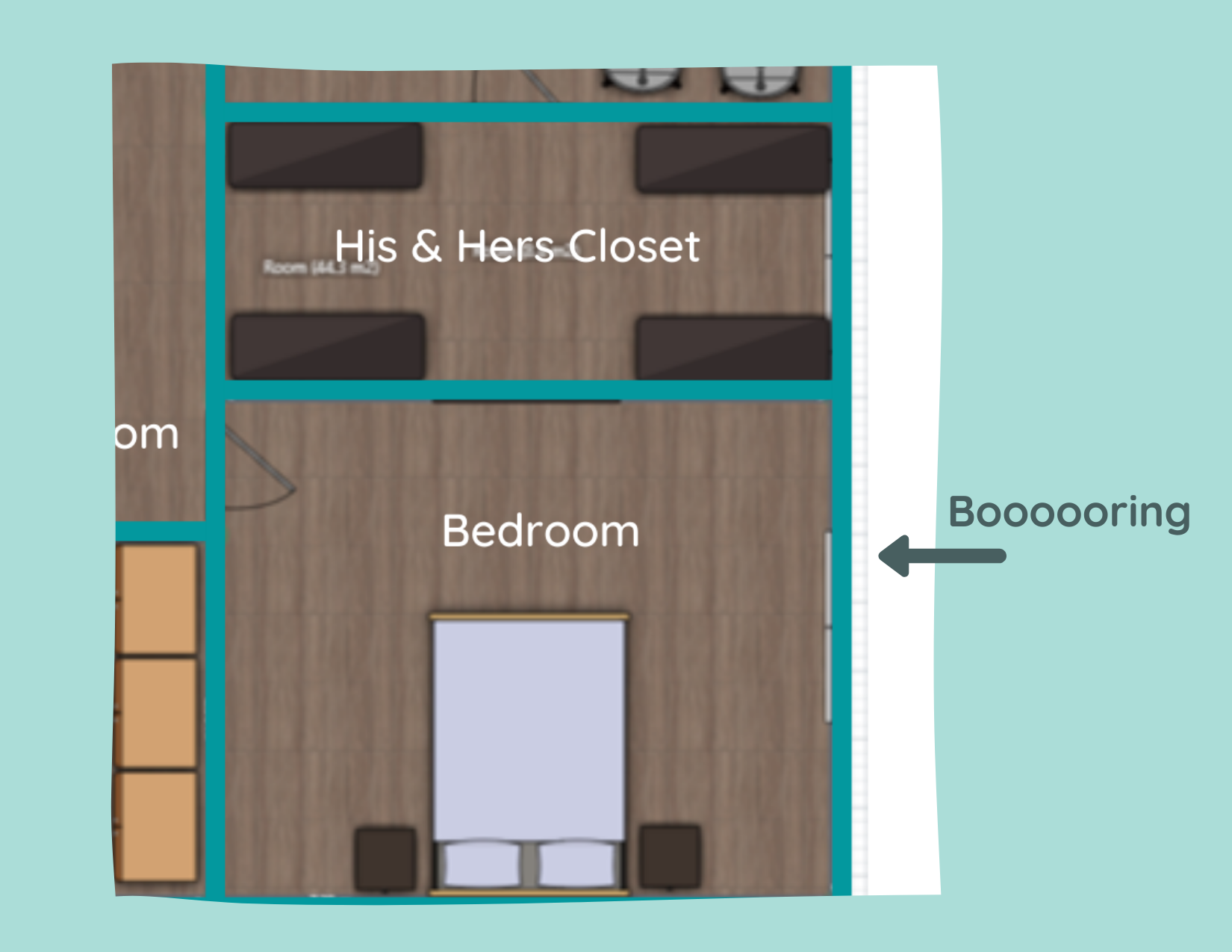
In the new floor plan, we’re able to expand the space to create a nice little sitting area right next to the windows that I’m really excited about. I think this is a good move to make the bedroom more inviting and another opportunity to really take advantage of those windows. Also, plants. Do you know how many plants I’ll be able to put in front of those windows!? SO MANY.
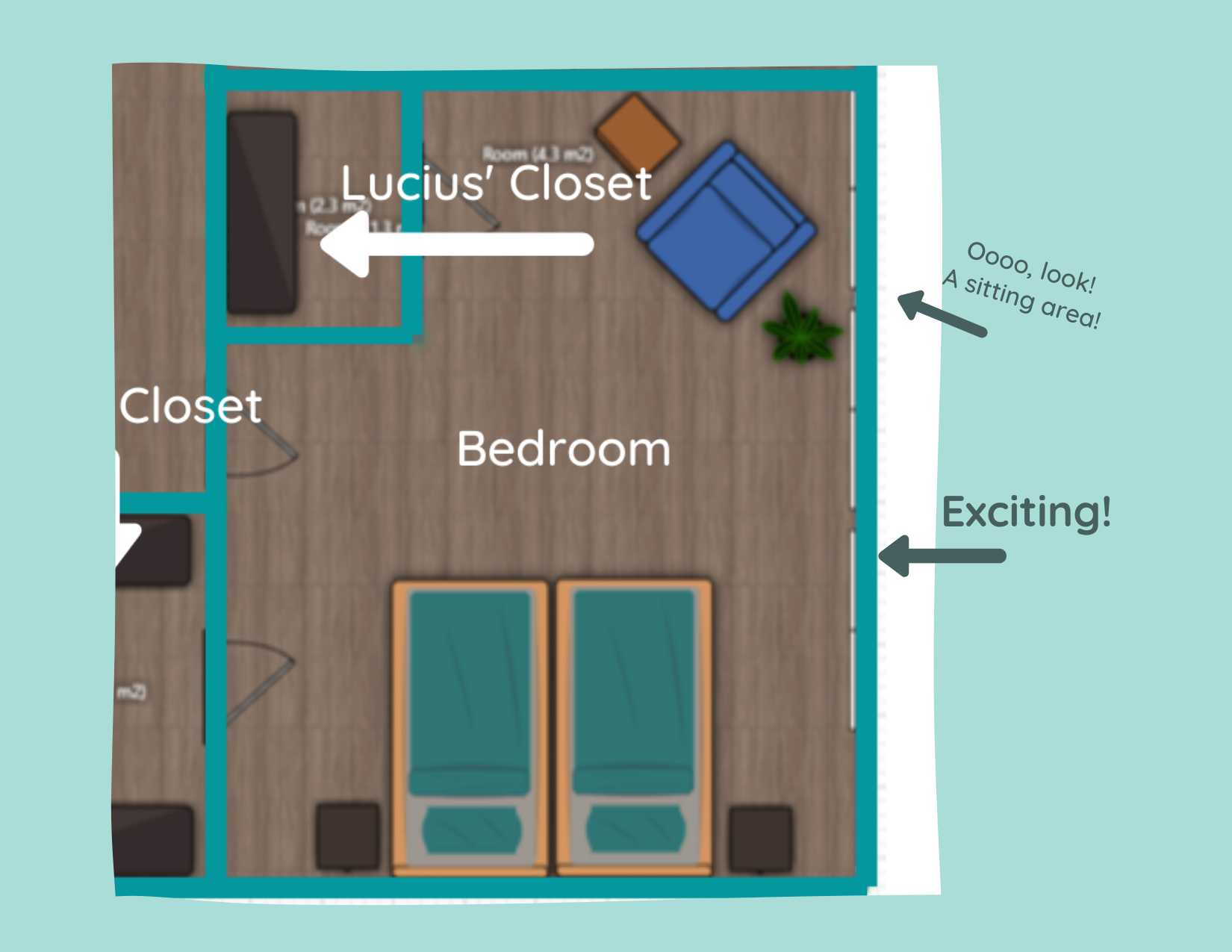
While our new layout has a lot of silver lining, I have to admit I’m a little sad to see my big walk-in closet go. Not to complain - my new closet will still be plenty big! However, I was dreaming about a closet like this or this. But that’s definitely something I’m learning as we do more and more renovations - you have to expect the unexpected and be flexible when curveballs come your way.
With that being said, I’m not making any promises this will be our last edit to the floor plan. We have a ways to go before anything is permanent and who knows what other game changers we’ll encounter. Now excuse me while I go find new inspo pictures for my closet…
Related Master Suite Renovation Posts:
Master Suite Floor Plans

DIY Sharpie Wall Tutorial
HOT DAMN, it’s been a minute since I shared an update about my home office redesign. Well, don’t you worry your pretty little head. That doesn’t mean I haven’t been working on it!
I’ve finally painted this room and created a killer DIY Sharpie wall that I can’t wait to share with you (including a tutorial)!
How to Make Faux Wallpaper with Sharpie
HOT DAMN, it’s been a minute since I shared an update about my home office redesign. Well, don’t you worry your pretty little head. That doesn’t mean I haven’t been working on it!
I’ve finally painted this room and created a killer DIY Sharpie wall that I can’t wait to share with you (including a tutorial)!

But first, a quick refresher:
There was a lot to do to get this room prepped. If you recall, I started with this beauty of a space.
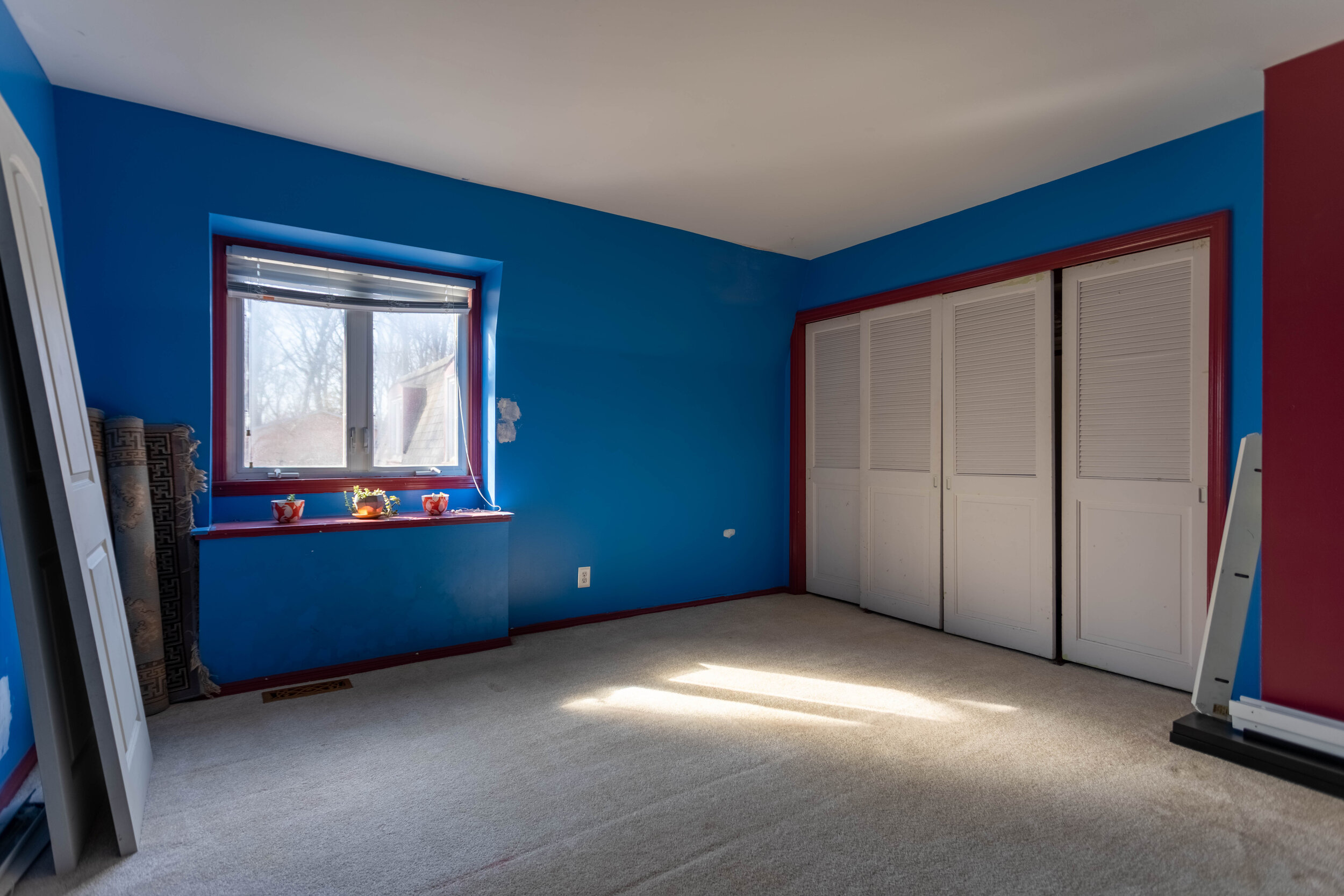
In my kick-off post, I shared the beginning stages of my redesign and my design inspiration to ultimately round out the room. When all was said and done, I had purchased a desk and chair and shopped around my own house to find a few items to make this room at least a little more tolerable, especially since it’s become my office since COVID started.

Baby PhotoBomb and all
As an Amazon Associate, I earn from qualifying purchases. This post may contain affiliate links, meaning I receive commissions for purchases made through those links, at no cost to you.
Of course, that wasn’t my final design plan though! Over the last several months(!!!), as we’ve been working on the dining room renovation (HERE and HERE), the flip (HERE, HERE, and HERE), and the master suite remodel (HERE), I’ve been stealing any free time I can find to work on this room - and it’s finally coming together!
In the kick-off post for this room, I mentioned how I was loving the design below and I planned to use Sharpie Paint Pens to create an accent wall.

Well, I’ve done it! And of course, I’ll show you how I made it happen with a DIY Sharpie wall tutorial. Let’s go!
Materials
- Sharpie Paint Pens
- I ended up using 3 medium point oil-based gold metallic pens
- Make sure you’re using Sharpie Paint Pens and NOT a regular Sharpie or you’ll have a helluva time painting over it if you ever want to.
- Level
- Pencil
- Ruler
- Patience
- I’ll warn you, this project isn’t necessarily quick. But I think the end result is worth it for sure!
Step 1: Create a Template
I jumped into this project with a vision, but there were a few things I needed to do before I could get to the fun part. First things first, I needed to figure out the scale of my design. To do this, I simply drew one of the diamonds for the design in approximately the size I was imagining on a piece of paper and taped it up on the wall.

I’m glad I took this simple step, too, because the first diamond was larger than I wanted.
Once I figured out the sizing, I created a mocked-up design on some paper and taped that up as well. This helped me feel more confident to move forward.

Step 2 - Draw your Vertical Lines
Next, I worked on penciling my pattern onto the wall. I started by marking every 4 inches along the bottom of the wall by the baseboard.
I actually started in the middle of the room so I didn’t end up with a full diamond on one side of the wall and a partial diamond on the other. Now, both sides have partial diamonds and I think it flows nicely.
The mocked-up design was created out of 6x6 squares, but that doesn’t translate to 6 inches from corner to corner - it’s more like 8.5. To make it easier on myself, I didn’t fret over the diamonds being that EXACT dimension as long as they were close. I ended up making my diamonds 8x8 from corner to corner.
The image below hopefully helps show that the diamonds themselves are 8 inches, but because they all have a vertical line running through them as part of the design, I marked along the baseboard every 4 inches.

From here, I used a laser level that I hooked on to a laundry basket to lightly pencil in my vertical lines. This is the level we have. You could also use a traditional level for this step, though it’ll take you a little longer.
Pro tip: As you’re drawing your vertical lines, measure along the way every once in a while to make sure they’re still 4 inches from one another. I didn’t do this and had to fix quite a bit because of it (I think my level may have shifted a couple of times). I’ll show you what I mean a little further down.


Step 3 - Draw your Diagonal Lines
Once I drew my vertical lines, it was time to pencil in my diagonal lines. For this step, I measured up 4 inches from the bottom of every other vertical line and made a tick mark. Then, I went back and measured up 8 inches from the bottom of the remaining vertical lines and made a tick mark.

Once you’ve marked your vertical lines along the bottom accordingly, you can make a tick mark every 8 inches on each line until you hit the top of the line where it meets the ceiling.
When you’ve finished making all your tick marks, lightly (again, emphasis on the lightly part) connect your tick marks diagonally.
Step 4: Fix Your Mistakes
You will inevitably have measured a little off here and there. NOW IS YOUR CHANCE TO FIX THAT.
Remember how I said to check that your vertical lines were 4 inches apart all the way up the wall? Well, this is why I specifically called that out.

It’s super important to make sure that your vertical lines intersect with the points of your diamonds. Otherwise, when you add your remaining lines to each diamond, they’re going to look weird if the vertical line isn’t centered (or mostly centered. We’re not robots, after all).
So before you go gung-ho and bust out your paint pen, correct your lines or you’ll have to paint over a bunch of them like I did.

Bwomp Bwomp #DIYfail
Yeah, there were quite a few that didn’t line up as well as I wanted them to. It was a huge time suck that could have been avoided if I had corrected them before I traced over my pencil lines with Sharpie. Learn from my mistakes!
Once your lines are nice and centered, you can trace over them with your Sharpie Paint Pen. I recommend starting with your diagonal lines, as you can cheat the vertical lines here and there a little if needed. This design is so busy, it’s hard to tell if they don’t line up perfectly.
Step 5 - Add Lines to Each Diamond
This is where it starts to get more exciting (yet, also more time-consuming) because you can really see your design start to come together. To save my arms from falling off, I did this part in sections over several days.
Starting at the bottom tip of each diamond, make a tick mark at 2 inches and 4 inches along the bottom two sides.

Then, draw a line connecting the top point of your diamond to each of your tick marks.

It’s kind of an ugly little mock-up, but it gets the point across
Soon, you’ll see it start to come together. This is where I got a little excited and just HAD to see what a few of them looked like grouped together.

Eeeeeee, so exciting!
Step 6 - Finish the Edges
No matter how you plan out your design, you’re going to have pieces of the pattern that are incomplete where the design meets an adjacent wall. These sections are a little tricky to finish. Here’s what I did.
The bottom row: Because of how I started my design along the baseboard, there are half diamonds that needed to be finished. But since the bottom half of the diamond was missing, I had to figure out how to work around that.
To do so, I simply took a piece of paper, held it up in the middle (horizontally) of one of the completed diamonds, and marked where the lines were. I then used that to mark where those lines would be in the middle of each half diamond.

Then, I drew a line from the top of the diamond to each tick mark.

The top row: I followed similar steps on the top row. I took that same piece of paper and held it up in the middle of each diamond to identify where the line would intersect.

Then, I drew a line from the tick marks on the bottom edges of each diamond (remember how we made marks 2 inches apart in an earlier step?) to the tick marks I made in the middle of the diamond.

The sides: Along the sides of the wall where I only had a small section of a diamond to work with definitely took a little noodling to figure out. Since I didn’t have the rest of the diamond to use to make my tick marks or lines, I had to come up with another solution.
I ended up tracing one of my diamonds and cutting out a new template that I could wrap around the side of the wall. I made tick marks at the tip of the diamond and where any lines within the diamond would touch the bottom edge using the lines on the template as a guide.

Next, I used a piece of paper to wrap around the corner and connect my dots in pencil.

Then, I was able to use my ruler to trace my pencil line in Sharpie to the edge of the wall.

Step 7 - Touch-ups
There will most certainly be areas that you goofed up here and there (you can even catch some of my goof-ups in the pictures above!). Now that your design is complete, take a craft brush and touch up any lines that are a little wonky or any stray marks.
Bonus Step - Stand Back and Enjoy
Man, you just spent a lot of time creating an accent wall - relish in it because it looks AWESOME! I know I’ve spent a ridiculous amount of time admiring my handiwork. You should too!

Now, let’s be real. Would it have been easier to just use wallpaper? Probably! I found lots of similar wallpaper designs, but on many of them the design was way bigger than I wanted or the colors weren’t right. And don’t get me started on the cost! By DIYing my own design, I was able to completely customize it FOR CHEAP! Plus, I love a challenge and it feels good to know I created this wall with my own two hands.

This space has undergone such a huge transformation. It’s hard to believe it was once red and blue. Now it’s so much brighter and more inviting. I definitely don’t mind working in this office anymore and actually prefer to work in here now! Especially since I get to share my space with my sweet little plant babies all day long while I work.

I definitely don’t consider this room “complete” yet. Heck - I still have the whole other side of the room to furnish! But that’s a post for another day…

Related Home Office Design Posts:
How to Create a Sharpie Accent Wall

Master Suite Remodel - Demo and Floor Plans, Oh My!
We have officially demoed our bedroom, bathroom, and closets!
Yes, it looks absolutely nuts. Yes, I’ve had more than a few “ohhhh noooo whatdidwedo!?” moments. But every time I walk into this space I get a jolt of excitement that easily puts those fears at bay. Also, LOOK AT ALL THAT NATURAL LIGHT!
Master Bedroom with Floor Plans
Several months ago, before we put our renovation shoes on, I shared a tour of the interior of our house. In that post, I talked about (and tried to show) how utterly weird the layout of our master suite was.
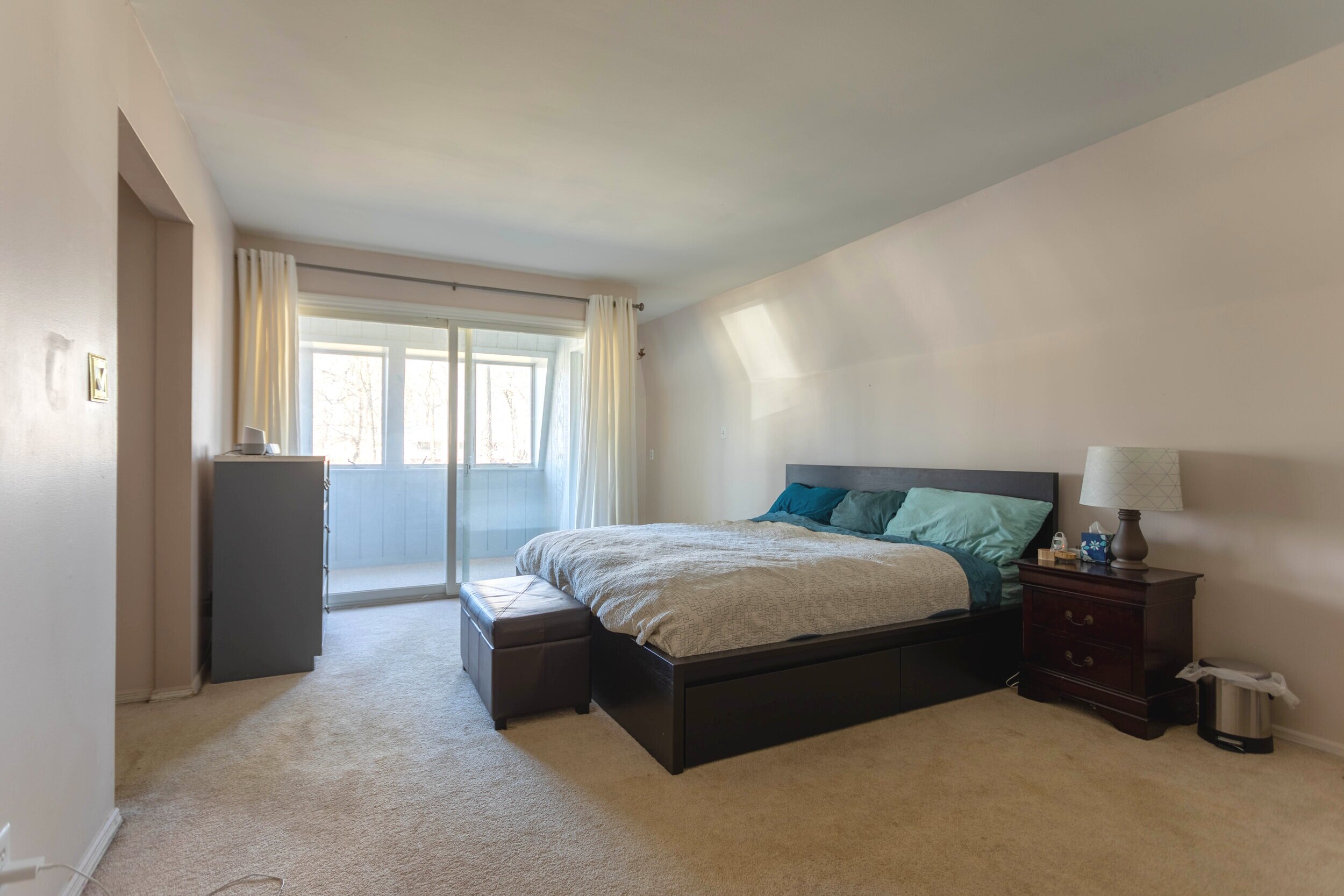
In fact, one of my hesitations with buying this house was that I knew we would want to reconfigure that space and it honestly intimated me. I mean, what if we couldn’t do it? What if we pulled up the floor and found termite damage? What if we got in over our heads!?
Enter Lucius, with his big dreams and dripping with confidence, who was quick to tell me exactly what I wanted to hear: that we could knock down this wall and that. That we could create a walk-in closet and the master bathroom of our dreams. Annnd as per usual I was hypnotized by the picture he painted.
Even several months ago, during the house tour, you could see pictures of where Lucius just couldn’t help himself and started tearing paneling off the wall in the sunroom (which I have learned is actually called a “loggia”). He’s been hinting at wanting to rip into the master suite more and more recently and finally, I caved. A few weeks later and our master looks like this:


We have officially demoed our bedroom, bathroom, and closets!
Yes, it looks absolutely nuts. Yes, I’ve had more than a few “ohhhh noooo whatdidwedo!?” moments. But every time I walk into this space I get a jolt of excitement that easily puts those fears at bay. Also, LOOK AT ALL THAT NATURAL LIGHT!
Since the pictures in the house tour are probably a little hard to follow (there’s a video in there too that explains the layout better, but still not perfectly), I’ve created a floor plan of what it looked like before demo, and how we’re thinking it’ll look when we’re done.
Before the Remodel

I’ve tried to outline each “room” to help it make more sense. Certain objects (vanities, the bed) aren’t to scale but are good placeholders to get the point across.
There are a couple of things that I want to point out before we get this “future plans” party started though.
First of all, you can now see how INSANELY DUMB this layout was. The “loggia” was the only source of natural light in the whole suite and it really wasn’t an inviting space - super long and skinny. I’d LOVE to talk to the architect and figure out whyyyyy they built the loggia at all. And then flick them in the forehead. Also, that little alcove at the end of the loggia in the corner of the room. What even is that!?
Secondly, the bathroom situation was all sorts of broken up craziness. Not only that, but we hated that the only way to get to the loft from this side of the house was to walk through our shower room. (Also, the fact that we had a shower room.)
Lastly, the floor plan doesn’t include our entire second story, but since this remodel actually impacts more than just the master suite, I’ve included snippets of the adjacent impacted areas. For instance, at the top of the layout, you’ll notice I labeled a small section of the loft. The loft is actually MUCH larger than that (it spans the entirety of our 3-car garage), but we’re only modifying a small corner of it for this project. You’ll also notice on the bottom left that I’ve labeled the hallway and kids’ bath. You’ll see why in the “after”.
Get excited! (I know I am!)
After the Remodel

Allow me to walk you through the changes because there are a lot!
Loggia Removal and Hallway Layout
One of the biggest improvements in the new layout is that we completely removed the loggia and pushed the master suite to the right. Now we’ll not only get to enjoy all the windows along this wall, but it’ll allow us to extend our current hallway so it runs past (rather than through) the master suite to the loft.
But don’t worry, the hallway won’t be a dark, closed-in tunnel. It will actually wrap around the staircase. We plan on putting up a railing, or at the very least a pony wall, all the way from where it starts on the left of the floor plan to the wall between our closet and bathroom. The orange arrows below should help you visualize.
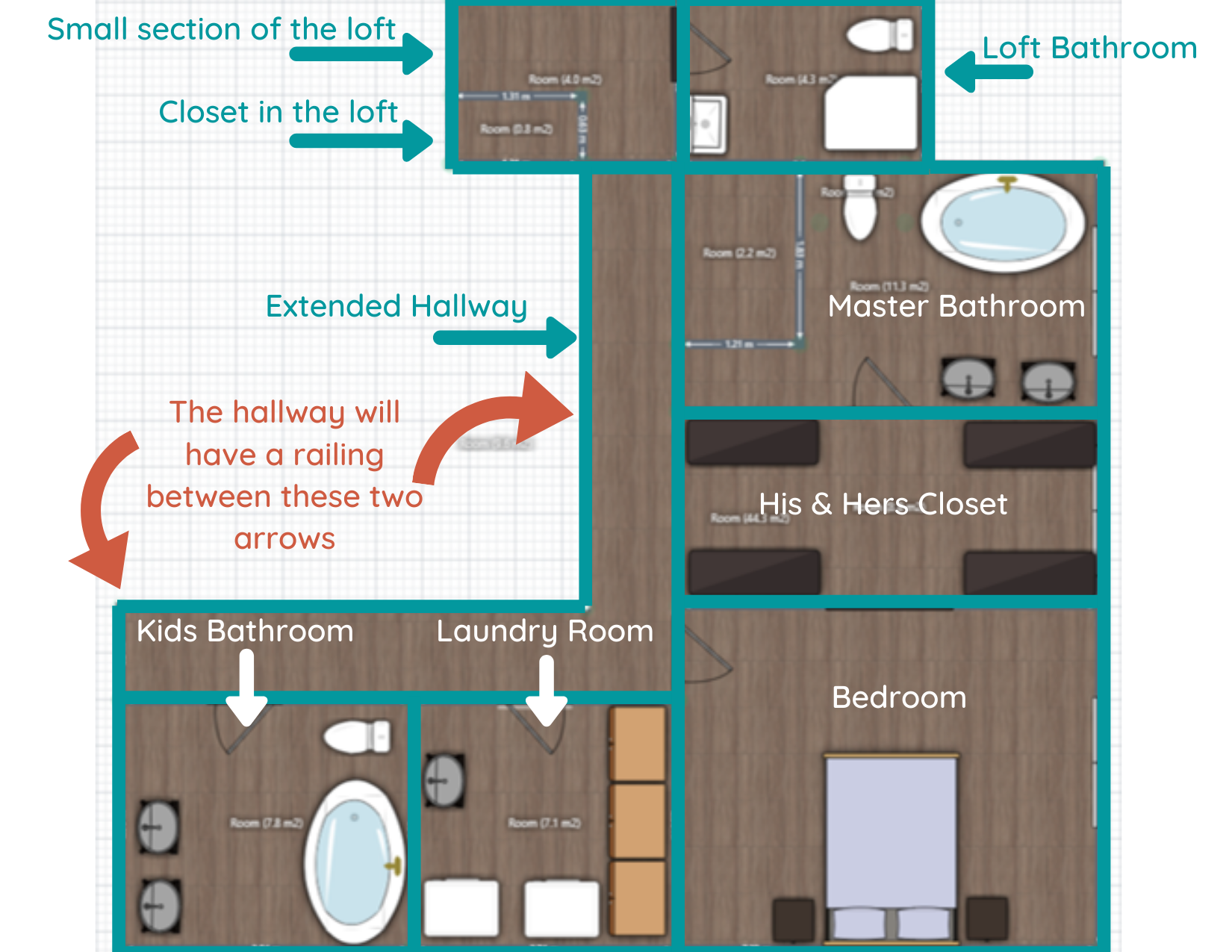
Master Bedroom and Closet
Other significant changes - you’ll notice that the master bedroom is MUCH smaller in the new layout. Considering we’re gaining a decent amount of functional closet space (we plan on installing an IKEA PAX system with TONS of storage), and the only things we really need in the bedroom are the bed and a couple of nightstands, we weren’t concerned about losing the square footage.
Even if we wanted to expand the room some, we’d be limited since the wall between the bedroom and closet is a support wall. But we’re not concerned. Even with the reduction in size, our bedroom will still be about 12x15 feet!
Kids’ Bathroom and Laundry Room
A big chunk of the space off to the left of the bedroom will instead become a new laundry room. We have a laundry room downstairs currently, but with all the bedrooms being upstairs, and the fact that we have the space to do it, why not move it? We haven’t decided what we’ll use the current laundry room for just yet. Probably a storage closet of some sort.
You may also notice that the kids’ bathroom will get a little bigger. For being such a big house, this bathroom is oddly cramped! While the kids' bathroom and the laundry room are in the plan, they’re definitely a phase II project. The priority is getting our master suite back in order.
Master Bathroom and Loft Bathroom
Lastly, a brand-spankin’ new master bathroom is on the horizon! And it’ll all be in one room! (We’re innovators like that) Because we’ll have a decent amount of space, we hope to install a nice large vanity and a soaker tub. Oh, and that rectangle in the top left-hand corner of the bathroom? That’s a 4x6 walk-in shower!
And if you’ll notice, there’s no more shower room! That’s because we’re closing off that doorway and turning what was once the shower room into a bathroom for folks who are hanging out in the loft. I honestly don’t want another full bath, but that room might be so large it’ll look weird as a half-bath, so we’re going to have to play that by ear. Because that area isn’t an immediate concern, much like the kid’s bath and laundry room, it will also be a phase II type of deal.
Final Thoughts
At this point, demo is just about done. Once everything is cleared out, we can tape off the floor and REALLY get a feel for how the spaces will work. I’m so excited for that step! It’s difficult to visualize how each space will look and feel with walls and clutter in the way. Even looking at the floor plans, the scale can be off or not quite what you’re expecting in real life. With that being said, I’m keeping an open mind and am fully prepared to have to tweak our plan.
Once we determine our final layout, then comes the hard part: putting everything back together. We plan on starting with the master bedroom first as we’ve been displaced to the loft for the foreseeable future. Since our clothes have been relocated to the spare room, we’ll likely start on the closet next. Lastly, we’ll tackle the most challenging (and expensive room): the bathroom.
I love sitting in my office every day listening to the sweet, sweet sounds of demo as Lucius rips apart that side of the house, but it’ll be even more exciting to listen to it being put back together. Soon I’ll be able to really dig into the design and I can’t wait to share it with all of you! But there’s still quite of work to be done before I can get to that point.

Related Master Suite Remodel Posts:
Master Suite Floor Plans

Feast Your Eyes on This 100-Year-Old Victorian Mansion
Each summer, our city has a festival in the historic district where homeowners open up their beautiful old houses for curious eyes like ours to stroll through. Well, one of those houses is for sale, and Lucius, being a local real-estate agent and all, is fortunate enough to be the listing agent! That means I have an “in” and absolutely HAVE to share this house with the world because it’ll BLOW YOUR MIND!
Home Tour - 1901 Victorian Mansion
If the fact that Lucius and I bought and updated a 1927 American Foursquare isn’t an indication that we love old houses, I don’t know what is. We simply swoon for them.
Each summer, our city has a festival in the historic district where homeowners open up their beautiful old houses for curious eyes like ours to stroll through. It’s certainly a treat to see all these gorgeous houses up close and personal - original woodwork and wallpaper galore! We love it.
We’ve wandered through loads of houses on that tour over the years, but some just stick in your mind more than others. Well, one of those houses is for sale, and Lucius, being a local real-estate agent and all, is fortunate enough to be the listing agent! That means I have an “in” and absolutely HAVE to share this 100-year-old Victorian mansion with the world because it’ll BLOW YOUR MIND!
So without further ado, welcome to The Charles Over Mansion:

This incredible house was built in 1901 and is chock-full of original charm. It has 5 bedrooms, 3 bathrooms, more fireplaces than I can keep track of, 12,000 square feet, and is probably one of the most gorgeous historic homes I’ve ever seen.
I mean, just LOOK AT HER!
But before we dive in too deep, I’d like to introduce you to the homeowner, Jonathan.

Jonathan radiates creativity. He runs his own company right out of this house as a talented mask maker (many of which you can see as part of the decor around the house). He has put in countless hours of work restoring this house to its original glory after he bought it 5 years ago in a pretty neglected state. In fact, he handcrafted plaster molds for some of the exterior detail that was in disrepair!
Now, let’s head back to the tour so you can see some of the incredible details of this house and the sweet touches Jonathan has incorporated.
The Entryway and Foyer
First off, before you even walk through the front door, you’re greeted with this wildly spacious front porch. I mean, I can just TASTE the lemonade I would be sipping out here if I owned this place.

As soon as you step foot inside, you’re met with a giant foyer and an ultra-grand staircase. These features are only made grander by the 16-foot ceilings on the first floor! And that large doorway you see below? That’s one of many giant pocket doors that can be found throughout the house!


You guys, I felt like straight-up royalty walking down this MASSIVE staircase. No joke. I felt like the queen! And a little historic tidbit - this house actually was built for a prestigious family back in the day. True to this era, there’s actually a second, smaller staircase near the kitchen for “the help”. Tucked right next to the dumbwaiter, which has been turned into a cold air return. Amazingly, this house actually has modern amenities (including 4 HVAC units), which is hard to find in houses this old!
Now back to the details - check out that intricate, pristine woodwork! Not to mention the coffered ceiling in the foyer and those stained glass windows in the staircase. Am I dreaming?


And while we’re at it, let’s take a quick stroll up the stairs to get a closer look, shall we? (I promise we’ll head back downstairs in a moment.)

A fireplace on a landing? If you have space, why not!?
Okay, heading back downstairs…
You know how I mentioned the coffered ceilings? Well, check this out:
Not only is that chandelier absolutely beautiful, the pattern on the ceiling is gorgeous too! You’d think it’s wallpaper, wouldn’t you? But it’s most definitely not - it’s all hand-painted! And that’s a detail you’ll see all over this house.
The Sitting Rooms and Dining Areas
As you wander through the house, to the right of the staircase you have a sitting room with another insanely intricate original fireplace.

And just behind the sitting room is the breakfast room.

Check out those high ceilings, giant windows, and don’t even get me started on the chunky trim!
If you were to turn to the left after entering the foyer, you’d walk into another sitting room.

Through this sitting room, you’re led into the most epic dining room I’ve ever seen. I can’t decide which angle of this room is best so I’m just gonna show you all of them.
That wainscoting is simply flawless and I’m in love with the dramatic mural above it. Yep, it’s not wallpaper. The mural and the ceiling in this room were also hand-painted.
Because this room is so large, it would be easy for it to be cold and uninviting, but the use of dramatic and dark colors complements the orange in the wood and creates a really warm space. The oriental rug under the table is also a really great, dramatic touch.


The Kitchen
Through the dining room is one of the pantries (this house has two!) and then the kitchen. Houses from this era typically don’t have very functional (in terms of this day and age) kitchens. The kitchen in this house has been updated and is now not only functional but still flows nicely with the rest of the house in the use of wood tones and ornate wall finishes.


The Bedrooms
Heading back on up that amazing staircase… Once you make your way to the top and catch your breath, you’ll realize that you’re not in a room - you’re on a giant landing, which leads to five large bedrooms.

Our first stop on the bedroom tour is Jonathan’s room, which is simple, clean, and modern.
The other four bedrooms are decked out in true Victorian style, which is a good thing because they can be rented for an AirBnB stay! Yep, you can book your stay in your pick of one of the four beautiful bedrooms.
Your first option is what Jonathan affectionately calls The Rose Room (aka “Grandma’s Room”). It’s dressed in sweet, floral wallpaper and a delicate quilt.

Option number 2 is what has been donned The Circus Room due to the red, yellow, and green striped wallpaper that was hung before Jonathan got his hands on it. In here you have two twin beds and a fireplace (and no more circus wallpaper!).

Bedroom number 3, The Gilded Room, might be my favorite with its intricately stenciled metallic walls. Jonathan explained his multi-step paint application process to me (involving 5 layers of paint!) and man, it was a labor of love at an estimated 60 hours of work.

And lastly, you have The Purple Room, one of the more Victorian-inspired bedrooms including, you guessed it, another fireplace!

The Bathrooms
There are two full baths on the second floor (and one half bath on the first floor), that of course aren’t lacking in charm and detail.
Both bathrooms are spacious and feature beautiful stained glass windows. At the time of day I was able to visit, the sun was hitting this window just right to light the whole room in a surreal yellow glow.

And of course, in a house from this era, you HAVE to have a clawfoot tub. Also, check out the legs on that vanity!
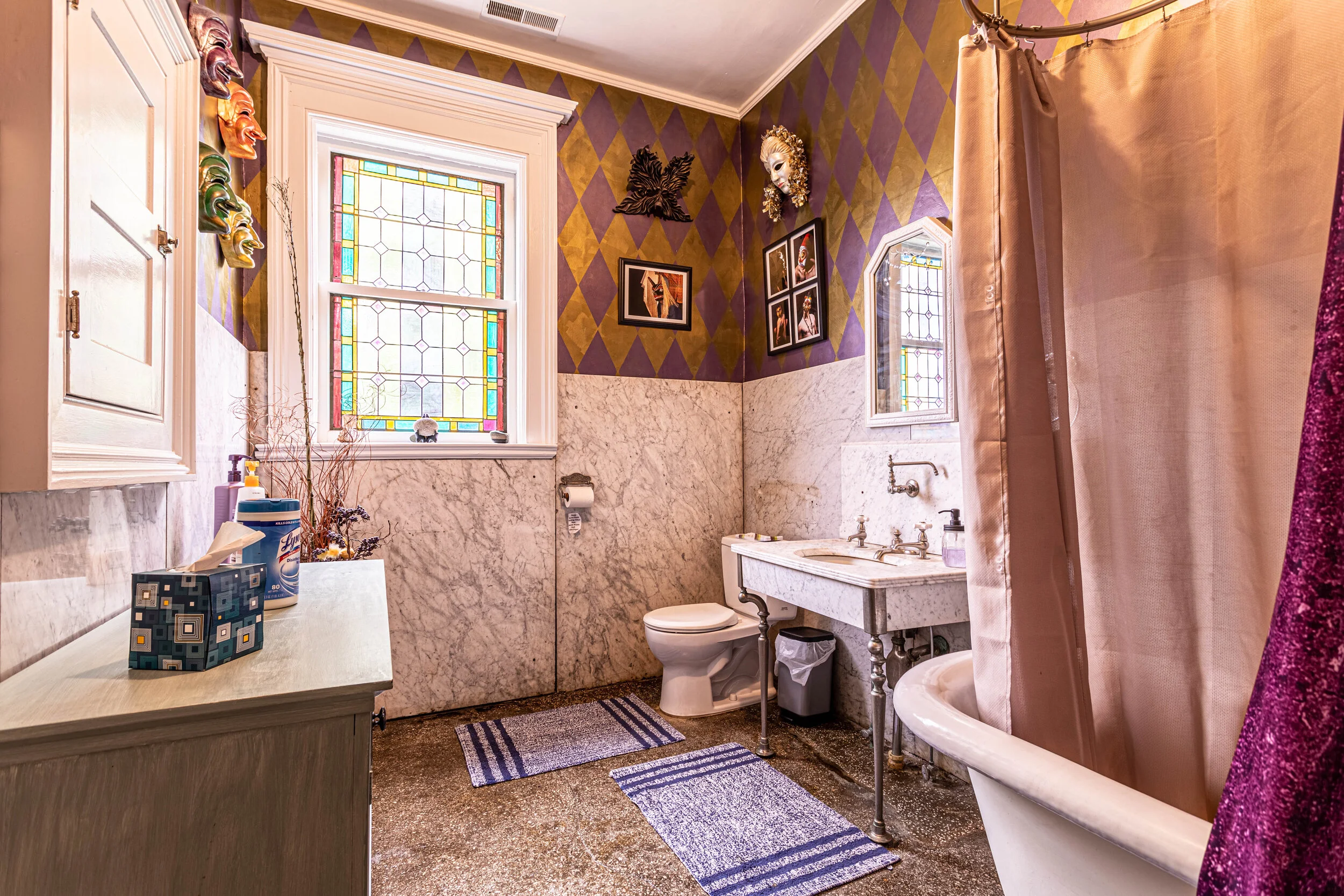

The Third Floor
And for the grand finale, we’ll mosey up yet another set of stairs to the third floor, which is currently used as Jonathan’s workshop. However, in its heyday, it was used as a ballroom - and you’ll see why.

WOW! What a whirlwind of a house - I hope you enjoyed it as much as I did. What was your favorite part? The woodwork? The stained glass? The whole dang house!?
And don’t forget - until it’s sold you can stay here on your next trip! In case you didn’t catch the AirBnB links above, here they are: The Rose Room, The Circus Room, The Gilded Room, The Purple Room. And here’s the link to the listing.

Related Home Tour Posts:
1901 Victorian Mansion Home Tour

Dining Room Renovation Progress - A Dusty Improvement
Back in March, I posted about the beginning of our dining room renovation. In that post, I shared the progress of what we had accomplished so far and our plans for rounding out the room.
Since then, we’ve slowly been working on the dining room (while getting sidetracked with working on my office and the yard) and it’s about time for a progress report - especially because we’ve made some pretty big changes recently!
Back in March, I posted about the beginning of our dining room renovation (holy cow, it’s been that long!?). In that post, I shared the progress of what we had accomplished so far and our plans for rounding out the room.
Since then, we’ve slowly been working on the dining room (while getting sidetracked by my office and the yard) and it’s about time for a progress report - especially because we’ve made some pretty big changes recently!

A very dusty change in plans
It may be hard to immediately tell what’s different without some background. Here’s a picture of the “before” from this angle.

And here’s an “after” from a similar perspective.

Yup - we took out a wall! - well, mostly.
Here’s a comparison of the before and after from inside the dining room.

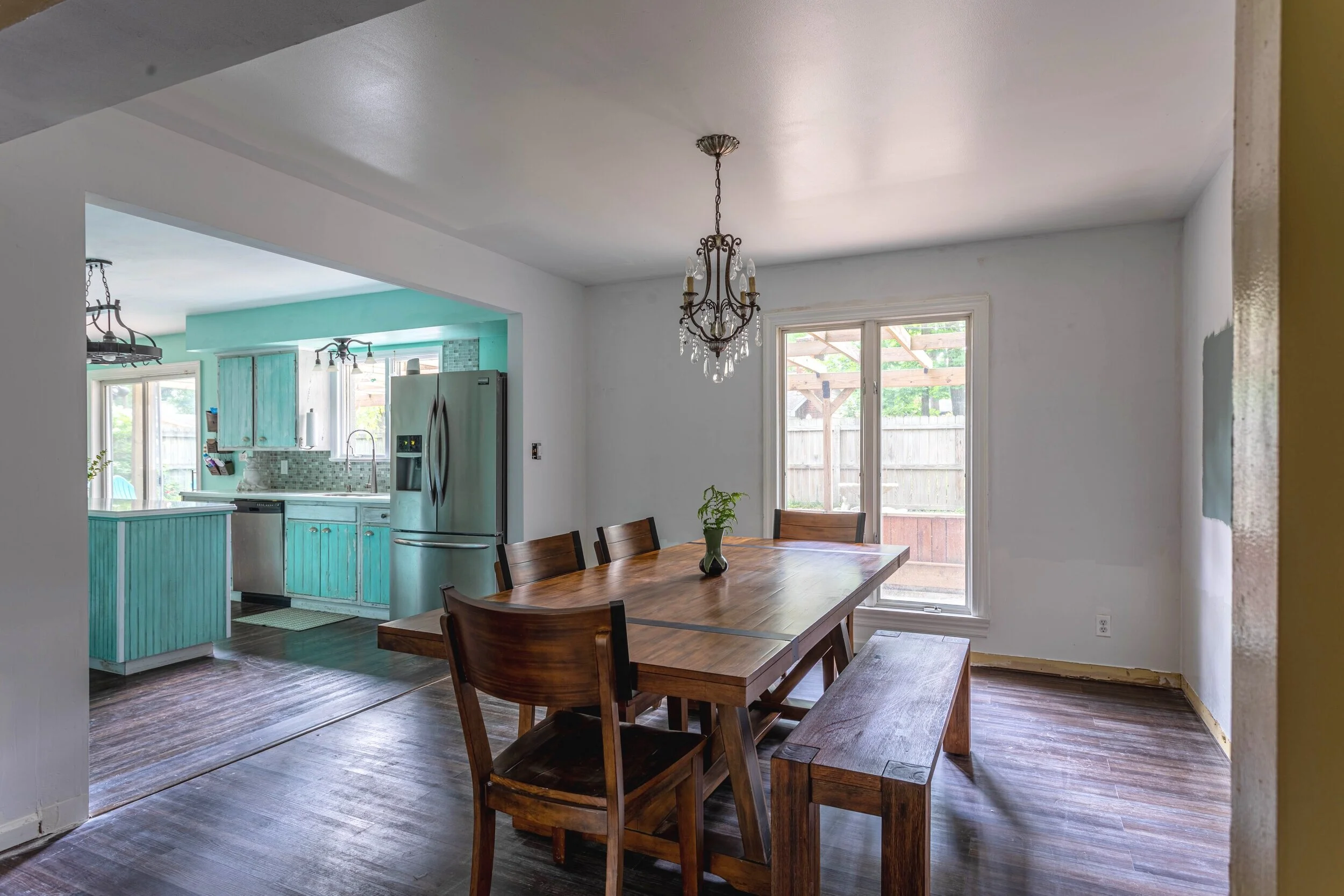
Lucius and I started daydreaming about opening that wall up shortly after we moved in. We used the pocket door that was there occasionally to wrangle our one-year-old, but it was infrequent and we knew it would be short-lived. We didn’t exactly know when we would swing the hammer, but as I was working on this room, I started to think about the order that I would need to tackle each area to avoid rework.
I previously wrote about the order of operations for painting a room efficiently for this exact purpose. But the dining room has a curveball to consider that I mentioned in the kick-off post - an accent wall! Something like this is what I have in mind:

To make the accent wall flow better, we decided to temporarily remove the trim anyway (that will make more sense when I cover that project). So I figured if we were removing some of the trim and painting the dining room, why not bite the bullet and open up the wall at the same time? Once I committed to the idea and put the bug in Lucius’ ear, there was no stopping him.

Check out the wallpaper we found under the trim.

Yowza


Unfortunately, before we decided to open this doorway, I had already stripped the wallpaper and evened out the walls. So we had to do a little bit of rework, but that’s showbiz, baby.
The big bummer is how much work I put into closing off the dining room to maintain the dust when I started the reno and how impossible that was to do when opening the doorway. Our house is covered in a fine layer of dust. We keep sweeping and mopping but drywall dust is relentless.
Benefits
Anywho, the rework that we’ve had to do is worth it. Having the wall opened up makes our dining room so much more functional. It’s not like the room moved closer to the kitchen, but just having it in plain view makes it way more inviting.
It has also improved the flow of the house. While our downstairs was pretty conducive to entertaining before, this update has elevated that functionality. Now whether you’re in the kitchen, dining, or living room you can see everyone in plain sight.
Not only has opening the wall improved the functionality and flow, but now I’ll be able to see my accent wall even better than I would have before!
And maybe the most important part - we can now open the right-hand door of the refrigerator all the way! #winwin
I read not too long ago that because of the coronavirus, open-concept floor plans might become a thing of the past as people try to distance themselves from one another (both for their health and sanity). That concern crossed my mind for a minute, but this house is pretty large so I don’t think any future residents will have issues getting space from one another. Plus, we don’t have plans to move anytime soon. Bring on the open-concept!
Future Plans
The Accent Wall
I mentioned above that I still plan on installing our accent wall. To get an idea of how the wall will work in our house and with the dimensions we have, I drafted a few different designs on graph paper. I used 1 square per 6 inches.
I love the design in the inspiration picture so I drew that out using the dimensions of our wall (the little shaded box in the top right-hand corner is the bulkhead that runs through the dining room).

Then I drafted three more designs to give myself some options.


I haven’t decided which design I’ll go with just yet. I’m not necessarily married to any of them and it’s probable that whichever design I choose will be modified as we install it, but I’d love to hear which design is your favorite!

Paint Colors
You also may have noticed in some of the demo pictures above that I’ve been testing paint colors. I mentioned in the kick-off post that this room lacks natural light (though that’s improved a bit by opening it up) so I wanted to avoid a super dark color like I had originally wanted. Instead, I’m planning on using something in a more medium tone.
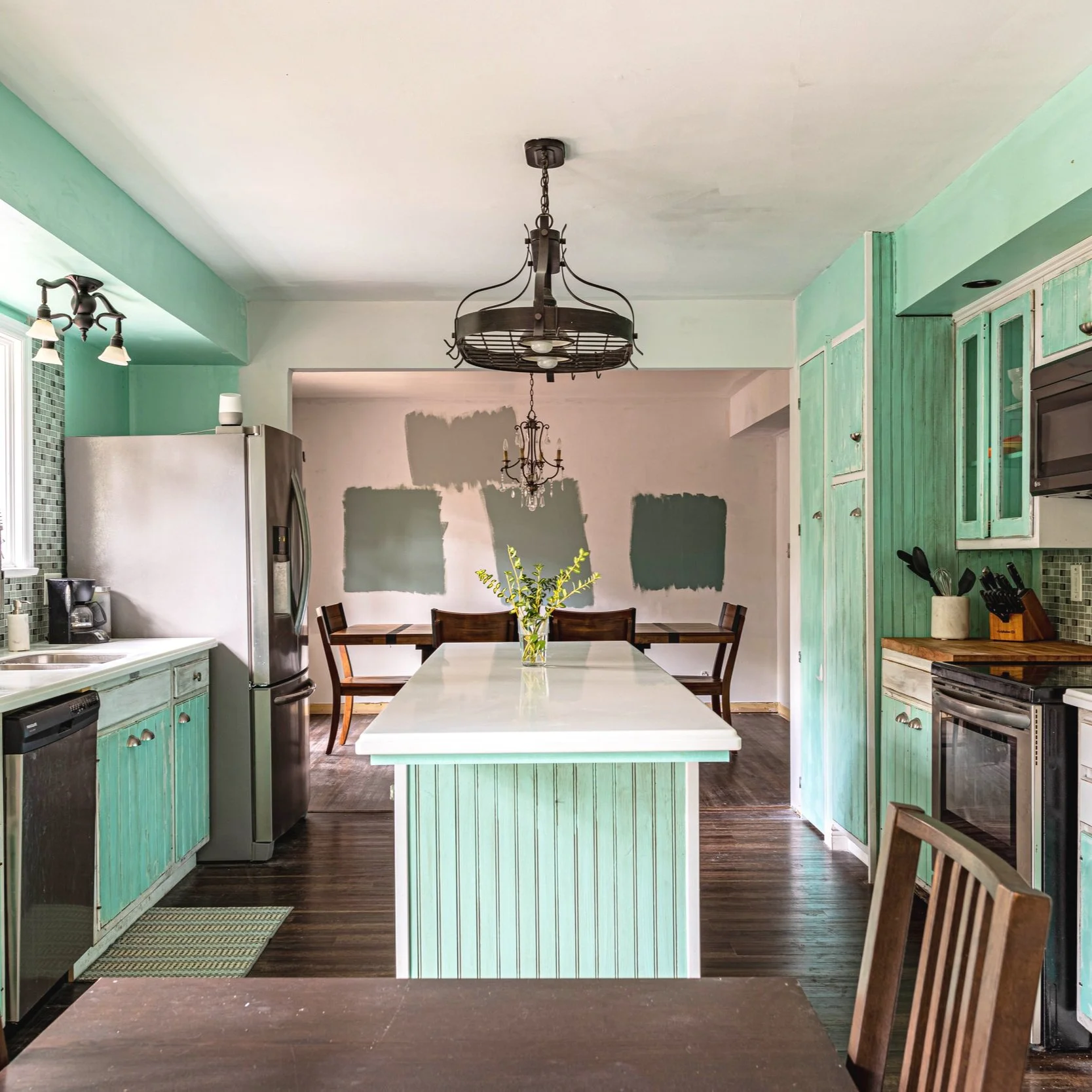
On the top is Smoke Infusion by Valspar (which is one of the colors we used in the flip). Left to right is Blue Seagrass then Desert Lake both by Sherwin Williams, followed by Secluded Garden by Valspar.
I’m leaning towards the Desert Lake color in the middle. The fact that I coincidentally bought new running shoes that are the same color solidifies my attraction to that color.

It’s probably important to note that we plan on changing up the colors in the kitchen too. Eventually the two rooms will flow seamlessly rather than feeling like two completely different houses.
The Area Rug
In my initial post about this renovation, I talked about adding an oriental rug. While that idea isn’t entirely off the table, I’m considering switching it up and putting a more abstract rug in this room instead. I still love oriental rugs and would like to use them elsewhere. But I have my hesitations that some of the strong lines in an oriental rug will compete with the accent wall. Instead, I’ve been ogling rugs like this:

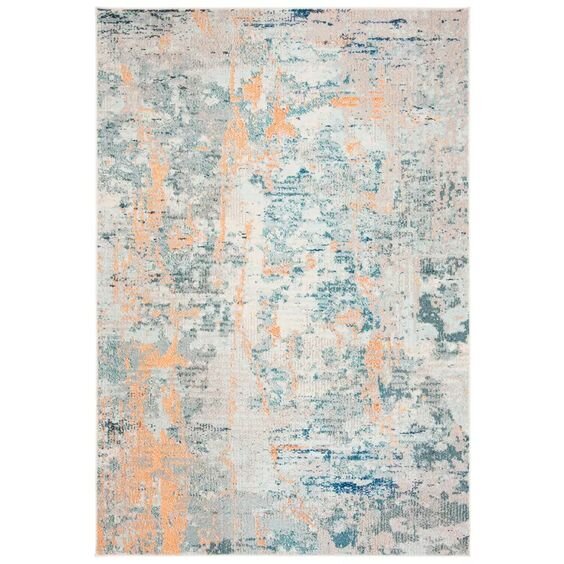
Source - Rug 1; Source - Rug 2
Now that this room has made some big strides, I’m even more excited to get it done (and to finish drywalling so we can finally get rid of all this dust)! There’s still a lot of work to do, like replacing the trim and crown molding, painting, installing the accent wall, and about a million other little steps between there, but the end product will absolutely be worth the effort. I can’t wait to share another update soon!
Pst - don’t forget to weigh in on which accent wall design you’re most drawn to!
Related Dining Room Renovation Posts

Choose the Best Paint Finish for Every Room
Sometimes I forget that not everyone has painted several houses worth of rooms and may not know what to say when the person at the paint counter asks, “what finish do you want that in?”. So this week, I’d like to bring back the basics and break down how to choose the best paint finish for every room in your house.
Ahhh… I remember the first time I painted a room. cue the “going back in time” squiggles I was a junior in high school and we had just moved into a new house. I was ecstatic because my parents let me paint my room however I wanted. I chose a soft, minty green color in a satin finish and flat black trim.
The color of the room was actually pretty classy and surprisingly the finish wasn’t too off-base either, unlike my mom who painted the rest of the house in semi-gloss even though I told her it would look weird (and it did).
But although I got lucky and made a couple of good decisions, they weren’t educated. And I certainly didn’t get lucky with all my painting decisions in my room, considering I painted the trim in a flat finish and painted the ENTIRE room (ceiling too) with the same paint I used on the walls. I’ve learned a lot since then.
My point is, we all have to start somewhere. Sometimes I forget that not everyone has painted several houses worth of rooms and may not know what to say when the person at the paint counter asks, “what finish do you want that in?”. So this week, I’d like to bring back the basics and break down how to choose the best paint finish for every room in your house.
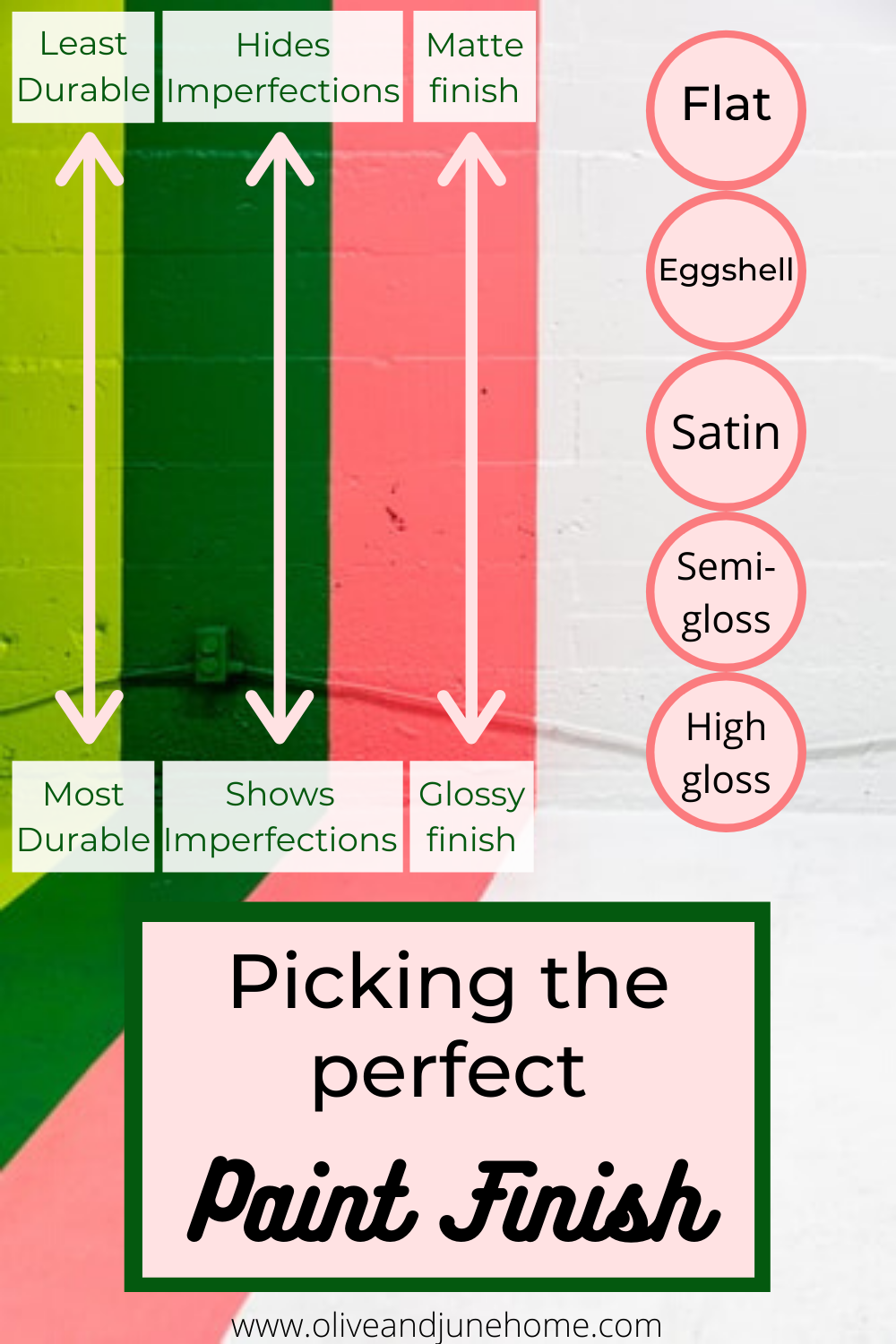
How to choose a paint finish
When choosing a paint finish, you can most definitely just choose what you think would look good (it’s your house, after all). But there are different finishes for a reason. It’s important to know what the purpose of each finish is before committing if you want a nice looking end product.
There are 5 main finishes: flat, eggshell, satin, semi-gloss, and high gloss, and 3 main aspects of each paint finish: sheen, imperfections, and durability. Below I break down how each finish stacks up and where in your home they should be used.
Flat
Sheen: Flat paint is… well, flat. Pretty self-explanatory. It’s a matte finish and doesn’t reflect light.
Imperfections: Because of its matte finish, flat paint is very good at hiding imperfections.
Durability: Flat paint tends to hold on to dirt and is difficult to clean and wipe down.
Where to use it: Low traffic areas, ceilings, or on walls with lots of imperfections (like old plaster walls)
Eggshell
Sheen: Low sheen, like an eggshell. Also pretty self-explanatory.
Imperfections: Still pretty good at hiding imperfections.
Durability: Slightly easier to clean than flat paint.
Where to use it: Low to moderate traffic areas - living rooms, dining rooms, adult bedrooms
Satin
Sheen: Moderate sheen
Imperfections: Less good at hiding imperfections
Durability: Easier to clean
Where to use it: Moderate traffic areas, like kids’ bedrooms and hallways or in areas with moisture, like kitchens and bathrooms.
Semi-gloss
Sheen: Moderate to high sheen, slightly glossy and reflective
Imperfections: Not good at hiding imperfections
Durability: Easy to clean
Where to use it: Moderate to high traffic areas like on trim, doors, and cabinets or in areas with moisture like kitchens and baths.
High gloss
Sheen: High sheen, very glossy and reflective
Imperfections: Bad at hiding imperfections
Durability: Easy to clean
Where to use it: High traffic areas, like on trim and doors
If you’re still not quite sure what these finishes look and feel like, just ask the associate at the paint counter if you can see a sample of the different finishes. A lot of times they’ll have a little sample with each of the finishes displayed to better help you make your decision.

Now that you know the “rules” of choosing a paint finish, you can have some fun with it and throw those rules out the window!… with caution.
A great example of this is painting a design on a wall using the same color in two different paint finishes.

Or painting an entire room - walls, trim, molding - with the same color and finish.
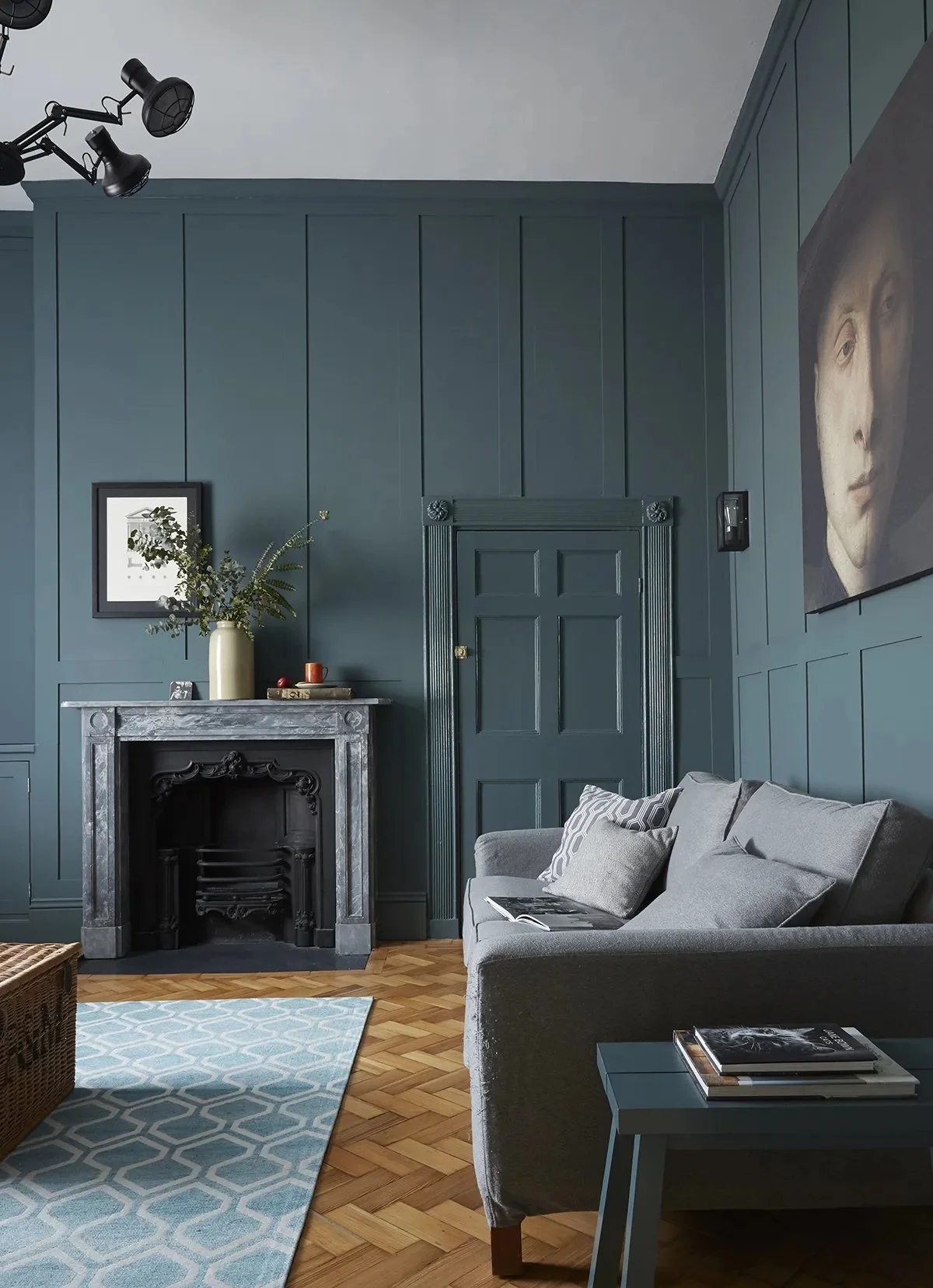
Or even painting the whole room (including the ceiling) the same color in a high gloss finish.

At the end of the day, it’s your house so do what speaks to you and makes you swoon. But at least now I’ve taken the guesswork out of it for you, so the next time you order a gallon of paint you won’t be caught off guard. Happy painting!
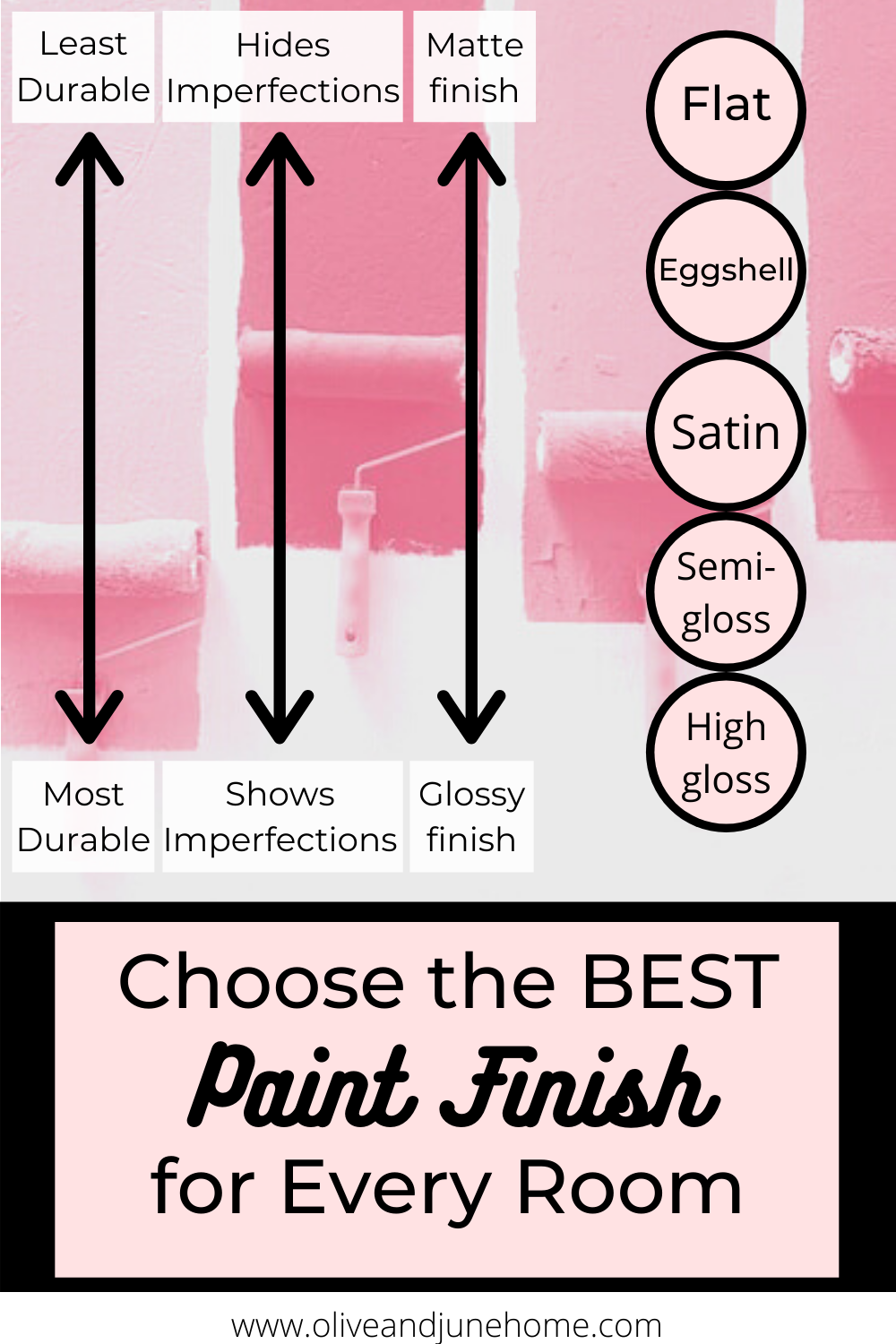
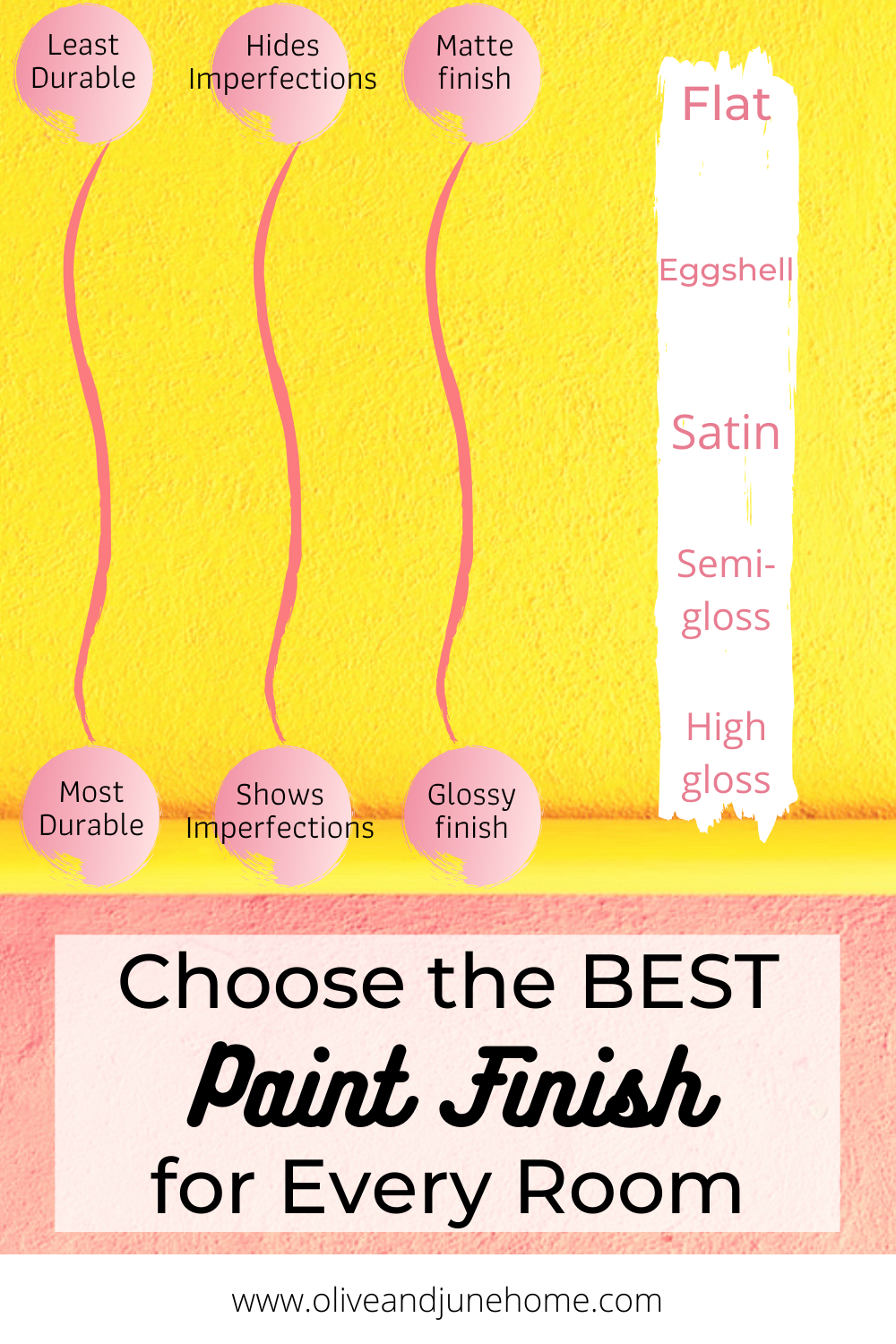
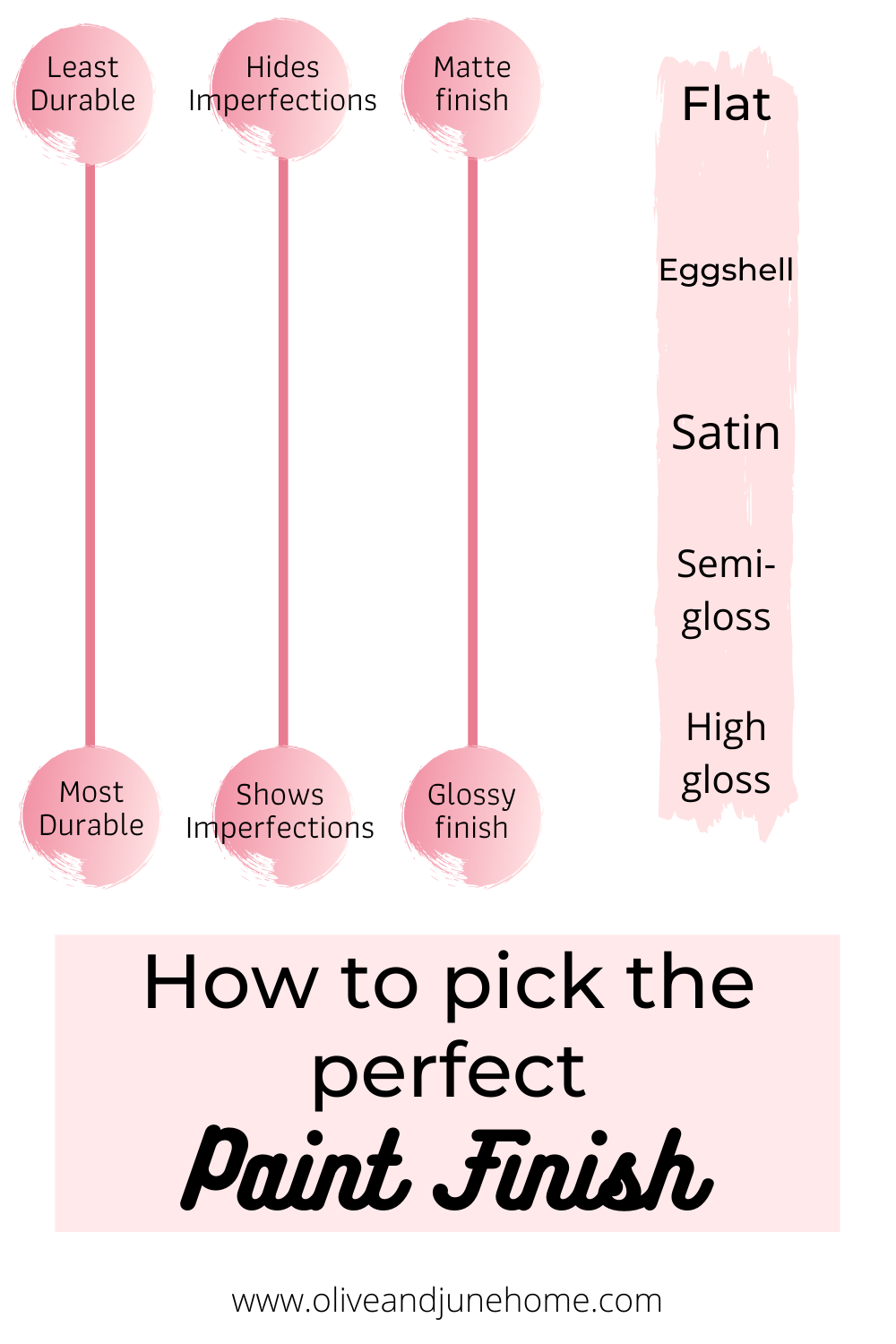


Tour the Exterior of our Mansard House: The Before
Back in March I posted a tour of our current house and promised to take pictures of the exterior once everything was in bloom again. Well, now that it’s summer and everything is lush and green it’s about time I followed through on my promise.
Back in March I posted a tour of our current house and promised to take pictures of the exterior once everything was in bloom again. Well, now that it’s summer and everything is lush and green it’s about time I followed through on my promise.

As you may have read in prior posts, we moved into this house last October. This was a very exciting purchase because although I loved our last house and miss it dearly, this house is in one of my favorite neighborhoods filled with families, kids, and TREES! GLORIOUS TREES!
The look of the exterior of the house isn’t my favorite - I don’t love mansard roofs and I’m not a big fan of the colors - so it took a while for me to really start to feel like this was home. It definitely didn’t help that right when we moved in all the leaves fell and everything died. But now that the trees have leaves on them and flowers are blooming, it’s growing on me. At the same time, all the plants being in bloom is also pretty overwhelming when it comes to this yard of ours.

The front of the house doesn’t look too bad at a glance, but there are a lot of overgrown areas that we don’t really know what to do with. For instance, on the right-hand side of the picture above there’s a ton of green - but we have no clue what are weeds and what are plants and how to keep the weeds at bay once we figure it out.
I definitely don’t have the greenest of thumbs and I’m hesitant to spend money on plants that I might very likely kill. On the bright side, we have well-established boxwoods for days!
We’re trying to take advantage of the nice weather and get this yard in shape little by little, or at least accomplish as much as we can in a summer. So far in the front yard Lucius has rebuilt the rock wall in the picture above, filled in some uneven areas of the yard, and relocated the basketball hoop to a more practical spot (and leveled out the yard to do so).

Before we head to the back yard, I figured I’d show you the general layout of our house on the lot with a very quick and basic digital drawing. Looking through the pictures, I think it’s pretty tricky to get a good understanding of the layout without an overhead view, so hopefully this rudimentary drawing helps.

Alright, now that I’ve wowed you all with my drawing abilities, let’s take a stroll into the backyard, shall we?
Something worth noting is that while the front yard looks okay, the backyard is a hot mess. We don’t have any grass back there - just weeds and lots of rocks! We think that this yard probably had some pretty impressive landscaping at one point but it has since been neglected and left to run wild. Because we have so many giant, beautiful trees in this neighborhood, it’s likely that prior owners let the leaves fall and accumulate and eventually they killed the grass and decomposed to create mounds of dirt.
Coming through the gate on the right-hand side of the yard we’re greeted with this overgrown mess. Lucius has actually been spending quite a bit of time taking all these plants out and trying to level the dirt so we can have a nice, clean slate, but the picture below is what we started with.

If you continue walking, you’ll quickly turn the corner to see the rest of the yard.

There’s a pretty brick path that leads from the driveway, through the gate, and alongside the deck. As you can see in the picture above, we have lots of rocks and weeds, but very little grass.


The deck is a pretty great outdoor space and spans this whole side of the house. We’ve been told by several neighbors that it used to be an atrium kind of like the picture below.

Source unknown
It probably wasn’t quite that lavish, but you get the picture.
Apparently it was a sunken atrium that you would step down into from the house or the yard. Because of this, there was an entire drainage system built into the yard to prevent flooding. You can see some of the drains running parallel to the deck a couple pictures above.
To pump the drain water out, there was a cistern installed. Lucius is absolutely giddy that he got it working recently.

It’s a little bonkers because this thing is about 6 feet deep and probably 4-5 feet wide at its widest point and it’s just chillin’ in front of our shed in the backyard.
But back to the deck! It’s a great space, but needs some work. And let me show you why…

Yup… there’s a giant hole for a hot tub in our deck. We considered putting a hot tub in, and actually had a friend offer to give us theirs that they no longer use, but it was too small so we kabashed that idea altogether. Our plan now is to extend the deck to cover the hole and just make this an additional seating area.
And don’t worry, there’s a hole inside the hot tub hole that has a sump pump. Lucius has plumbed it to drain into one of our many backyard drains so this won’t turn into some kind of disgusting swimming pool every time it rains.
Once we cover up the hole, we’ll be painting the deck.
On the flip side, the part of the deck that doesn’t have a giant hole is functional! But we definitely need to upgrade our patio furniture and build a contraption so we can hang the tire swing from one of the trees instead of the pergola.

Heading around the other side of the deck you’ll see the brick path continued and more crazy, overgrown, weedy yard. And rocks! Yay… more rocks.

And lastly on the far side of the house we have our bocce ball court… or putting green… or whatever you do with a really long, narrow stretch of yard.

Once again, the green you see is most definitely not grass.
Next summer I might plant a garden in this area. Our older daughter has shown interest in starting a garden with me, but with a very clingy 1-year-old I don’t think it’s feasible this summer. But a garden will only take up a small section of this weird part of the yard so maybe the rest will end up being a bocce ball court….
Anywho, there you go! Our insanely overwhelming, in-need-of-so-much-love yard.
I’d love to hear suggestions on how you’d go about taming this beast - we sure could use them! And hopefully with some perseverance (and advice) we’ll make some progress over the next couple of months and I’ll be able to share our improvements at the end of the summer!

How to: Paint a Room Top to Bottom Efficiently
Remember back in math class when they taught you the order of operations - PEDMAS (or, Please Excuse My Dear Aunt Sally, as I like to remember it)? I've never been good at math, but I do know that the order of operations is an integral part of it. Well, I believe there’s an order of operations to painting a room that makes it easier and faster to complete. And I’m here to break it down for you!
The Best Way to Paint a Room
Remember back in math class when they taught you the order of operations - PEDMAS (or, Please Excuse My Dear Aunt Sally, as I like to remember it)? I've never been good at math, but I do know that the order of operations is an integral part of it. Well, I believe there’s an order of operations to painting a room that makes it easier and faster to complete. And I’m here to break it down for you!
Not all of these steps apply to every room, but you can skip any unnecessary steps for your specific project and just hop on over to the next applicable one.
And just for fun, here’s the acronym for the steps and some weird phrases to help you remember it (because I clearly have too much time on my hands): Prep work, Prime, Caulk, Trim, Ceiling, Walls - PPCTCW
Pretty People Call Tom Cruise Weekly
Punk Princesses Create Tortured Comic Worlds
Philosophical Penguins Cry To Callous Wombats
Okay, I’ll get to the post now… (but feel free to send me any phrases you come up with because they make me laugh).
As an Amazon Associate, I earn from qualifying purchases. This post may contain affiliate links, meaning I receive commissions for purchases made through those links, at no cost to you.
Prep work
First thing’s first - to get a great-looking finished product, you have to put in the time and effort of creating a solid foundation. That means prepping your walls (and ceiling if you’re painting that too) by patching any holes. Once your holes are patched, make sure to sand them smooth. If you’re patching a large hole and it isn’t smooth on the first go-round, slap another layer of spackle on it and sand again once it’s dry.
I get it, it’s frustrating not to be able to just jump into painting your room, but that uneven spot will drive you nuts if you don’t fix it now.

Once everything is sanded, vacuum/wipe down surfaces to remove any dust build-up, especially on the tops of door frames, window frames and sills, and your trim. And don’t forget to remove any outlet or light switch covers!
Prime
This is where you get to have a little bit of fun if you’re repainting the whole room because you can go nuts and you don’t have to be careful at all.
In my office, for example, I knew I was getting rid of the red trim and blue walls. So I slapped a coat of primer on everything. And because I had to patch a few areas on the ceiling anyway and I was therefore going to have to repaint that too, other than making sure I wasn’t getting any paint on the floor, there was no need to carefully edge around anything. It was kind of liberating, in a way.


If you’re not painting everything in a room, you’ll obviously need to be more careful in how you apply your primer. Or, you may not even need primer at all if you aren’t drastically changing the paint color. In my office, I plan on using white paint on the walls and trim, so primer was a must to cover up the bold colors it was painted when we moved in.
On the flip side, if you are drastically changing the color in a room but you’re going from a light to a dark paint or from a bold to a more muted paint (like we did in our loft) save yourself some time and money by having your primer tinted.


Bonus: primer is a great way to highlight any nail holes you may have missed initially. If you find any stragglers, just spackle over them, sand, and call it a day!
Caulk
To create a nice, seamless look, caulk any gaps between your trim and your walls. I like this kind.
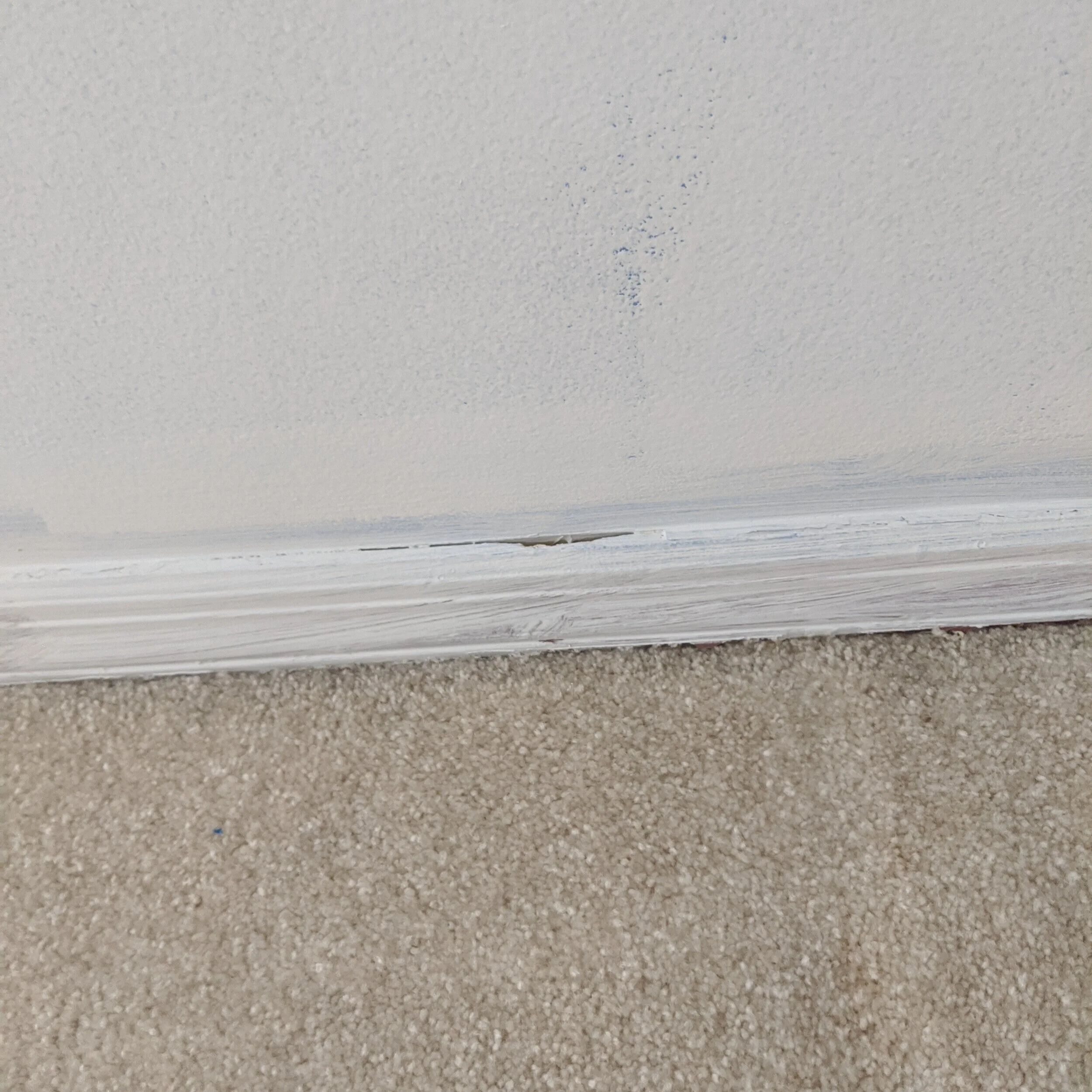
I’m coming for you, gap.
Caulking is simple. Just cut the tip at an angle, run a bead along where the wall and trim meet and smooth it with your finger. I like to keep an old rag handy to wipe off my hands, and it’s helpful if you wet the tip of your finger before you smooth it out.
Trim
As with primer, if you’re painting the whole room, you really don’t have to be careful to cleanly cut in your edges. If you’re painting your walls, paint the trim first and go to town.
I love to paint, but painting trim is one of my least favorite things. What makes it even worse is that the trim in our current house is small and thin and it’s really hard to not get any on the walls. At least when I use this order of operations it makes the chore of painting trim a little easier. Since I’ll be painting the walls once the trim is complete anyway, when I paint the trim I don’t worry about using tape to keep any paint from getting on the walls.
Here’s a picture of our daughter’s room in progress. The wall color wasn’t changing drastically so I didn’t worry about primer. Because I knew I was going to paint the walls later, I painted the trim first and didn’t worry about “staying in the lines” while doing it!

You do, however, want to make sure you’re not going so crazy that you paint your floor. You can put some painter’s tape on the floor to protect your surface, or even use a large putty knife to block your brush from touching the floor as you paint your trim.
Ceiling
Unless you have crown molding (that would have already been painted in the last step), or you’re only painting the ceiling (and not touching the walls), you don’t need to worry about carefully cutting in your edges in this step either!
Walls
FINALLY, the moment you’ve been waiting for that will make all the difference in your room and straight up blow your socks off: you can now paint your walls! At this point, you’ll definitely want to be careful when cutting in because you just spent all that time painting your ceiling and trim.
I like to start by cutting in my edges, but some people prefer to roll their paint first and that’s totally okay! I prefer to use a short 2” angled brush. Definitely feel free to use painter’s tape if you don’t have a steady hand.
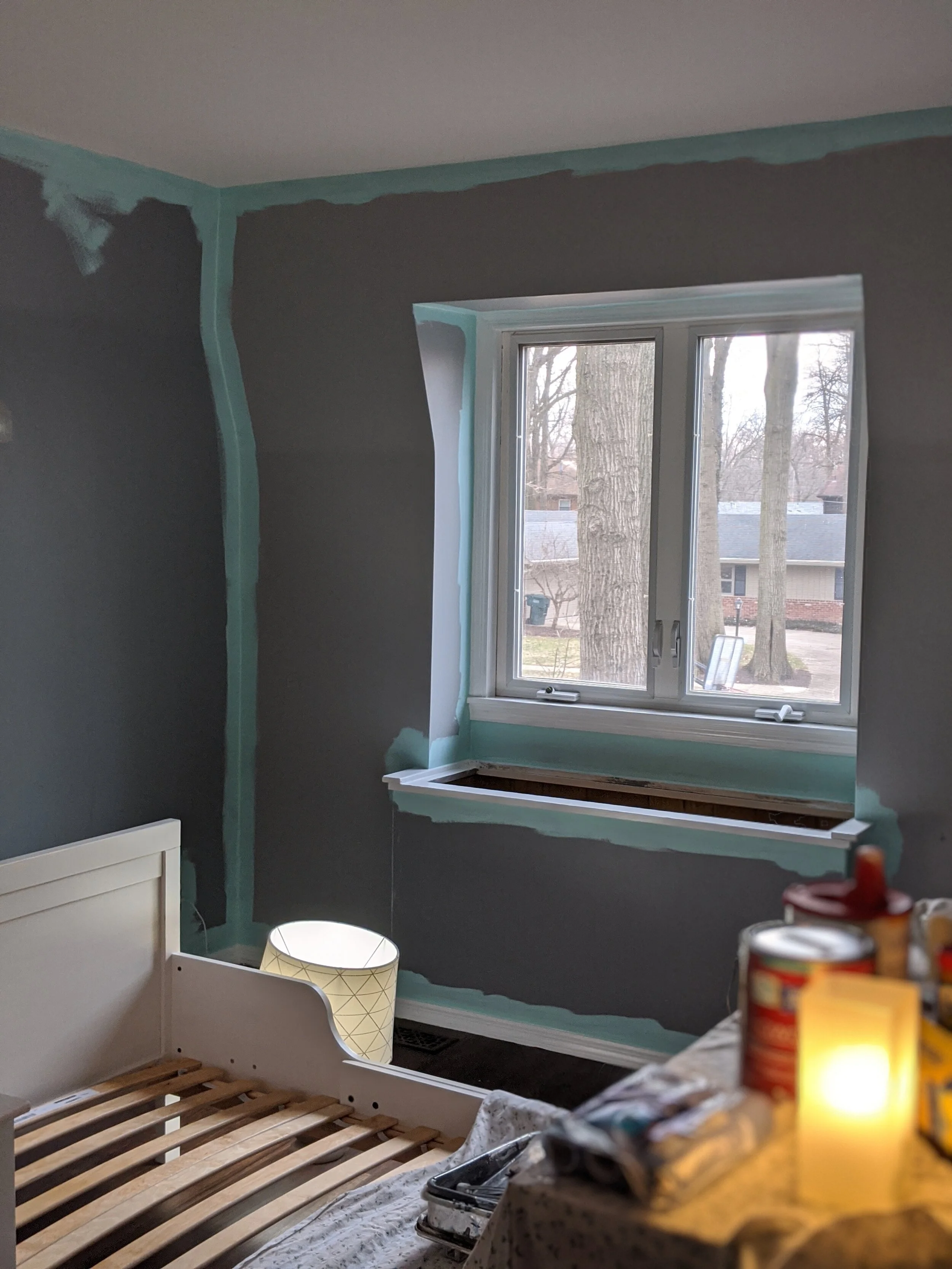
Then use a roller to roll the rest of the paint on your walls.
I don’t care what the paint companies say: I will never believe that “one-coat coverage” is a thing. Yes, the paint may cover well with one coat, but I guarantee there will be areas where you may have left the paint a little thin or didn’t quite get into the texture of the wall enough. Do your walls a solid and just paint two darn coats.
Sit back and enjoy
Now that you just put a ton of work into your room, ENJOY IT! You earned it!
For more painting-related posts, check out the articles below:
Tips and Tricks for Painting a Room Quickly

How (Not) to Stain Butcher Block
While working on the flip recently we had one of those “oh crap” moments when we realized we ruined the brand new butcher block counters. It would be easy to pretend we didn’t screw anything up and post a perfectly flawless “how-to” post, but where’s the fun in that? So follow along, because in this post I’ll share what went wrong and how we made it right so you can avoid making the same mistakes!
Staining My Butcher Block Counters
One of my goals for this blog is to be real - showing the good, the bad, and the ugly. Of course, I wish every project turned out perfectly the first time and that I could walk on water and teleport, but that’s just not how it goes. This is one of those “bad and ugly” posts.
While working on the flip recently we had one of those “oh crap” moments when we realized we ruined the brand new butcher block counters. It would be easy to pretend we didn’t screw anything up and post a perfectly flawless “how-to” post, but where’s the fun in that? So follow along, because in this post I’ll share what went wrong and how we made it right so you can avoid making the same mistakes!

It was actually Lucius’ idea to put butcher block counters on the island of the flip house, so I have to give him credit there because they look really nice… now that we’ve fixed them. But let’s take a step back to see why we had to fix them in the first place.
The flip isn’t a house with a lot of character, so we did our best to add some in ourselves. Adding butcher block was a good way to add character without breaking the bank. We got ours from Lowe’s for around $200 for an 8-foot piece. Since we only used it on the island, 8 feet was plenty. You can see the layout of the kitchen in this post.
While I was working my normal 9-5, Lucius grabbed all the materials to stain and seal the butcher block, including a couple cans of stain in Gunstock, and went to town. Then I got this text:

We were hoping the counters would complement the flooring nicely, but that definitely didn’t end up being the case. When the stain was applied it was much redder than the picture on the can, likely because the type of wood used for butcher block, and clashed terribly with the floors. Long story short, we learned our lesson the hard way: test your stain on some scrap wood before staining your main piece!
If we had more time, we could have sanded down the butcher block to raw wood and started over. However, we were planning on getting the flip on the market in just a few days and due to the time crunch, and the 10,000 other little things to wrap up, we chose to just buy new counters.
On the second go-round we decided not to stain the counters at all but instead to only use an oil and finish product to keep as much as the natural color as possible, and man do they look a heck of a lot better!

This is how they looked while they were still wet.

And here’s the finished product!


As you can see, they’re a much more natural tone now, since we essentially kept them their natural tone by not staining them at all. We also decided to use butcher block as our open shelving above the sink to make that space more functional and tie the butcher block counters into another element in the room.
Now, don’t get me wrong here. I don’t mean to imply that you can’t or shouldn’t stain your butcher block. By all means, go for it! But make sure you have a good idea what it’ll look like by testing your color before you go nuts like we did and end up creating more work for yourself.
If you want to stain your own butcher block, here’s what you’ll need and the steps to make it happen:

As an Amazon Associate, I earn from qualifying purchases. This post may contain affiliate links, meaning I receive commissions for purchases made through those links, at no cost to you.
Materials
- Painter’s tape
- Cloths
- Paintbrush meant for staining
- Stain (optional)
- Oil/Finish
- Sandpaper (we used 400 grit)
- Mineral Spirits (optional)
- Tack cloth (optional)
Step 1 - Apply painter’s tape where your cabinets and the butcher block meet - you don’t want to get stain on your pretty cabinets!
Step 2 - Wipe down your butcher block with a microfiber or tack cloth. To get the butcher block super clean, you can wipe it down with mineral spirits.
Step 3 - If you’re using stain, this is where you’ll apply it using the directions on the can. BUT FIRST! Stop what you’re doing, step away from your counters, and apply that stain to a scrap piece of wood.
The stain we used recommended applying it with a cloth, then wiping off any extra and letting it try for at least 6 hours. You could also apply it with a foam brush or paintbrush meant for stain, but you’ll still need cloths handy to wipe off any excess.
Step 4 - Once your first layer of stain is dry, sand your butcher block down with fine sandpaper to knock off any rough bits, wipe off the dust, then apply another layer of stain. Follow these steps until you have your desired look.
Step 5 - Apply your sealer with the same steps you used for the stain, being sure to sand between coats. We used Watco butcher block oil & finish and really like how it turned out.
And there you have it! Staining butcher block doesn’t have to be a scary, daunting task. Just learn from our mistake and don’t do what we did. Plus, take solace in the fact that if you do screw it up you can sand that bad boy down to the bare wood and start all over. Happy staining!